


What is the current price of Moca Network?
The current price of Moca Network is $0.008534 with a 3.16% change in the last 24 hours.
Supply and ATH/ATL data provided by CoinGecko

Hyperliquid perpetuals only. One snapshot every 5 minutes, up to 20 returned price levels per side. Liquidity beyond those levels is unknown. This is not a liquidation heatmap or a fill estimate.
Loading recorded snapshots…
Prices and notionals are USD-equivalent venue units, with USDC collateral. No currency conversion is applied. Notional = venue price × base-asset size. Contract specifications
Derivatives and mapped ecosystem data, with source timings and coverage.
Moca Network is a digital identity project building one portable account for a user's credentials, reputation and assets, usable across many apps and blockchains instead of being locked inside each one. Rather than storing personal data on a public ledger, it leans on zero-knowledge proofs so a user can prove a claim (that they are old enough, that they hold a membership, that they completed a task) without handing over the underlying documents.
MOCA is the network's utility and governance token. It is issued by the Moca Foundation and is designed to pay for the work the network does: issuing and verifying credentials, storing data, running the identity oracle, and paying gas and staking on the chain the project is building.
Moca Network is the identity arm of the Animoca Brands ecosystem, which gives it an unusually large distribution surface for a project of its size.
Official sources:
Moca Network grew out of Mocaverse, a project launched by Animoca Brands, the Hong Kong based Web3 and gaming company co-founded by Yat Siu. Mocaverse began as an NFT collection paired with a points system called Realm Points, rewarding holders for participation across Animoca's portfolio. The MOCA token launch followed through MocaList, a platform built with CoinList, with the public sale opening in April 2024 and the Moca Foundation reporting roughly US$29.3 million committed at heavy oversubscription.
The project then repositioned. What started as a rewards and membership layer for a gaming ecosystem was rebuilt as general identity infrastructure. In June 2025 the Moca Foundation announced Moca Chain, a Layer 1 built specifically for identity and user data. Moca ID, the network's user-facing identity, was folded into the AIR account system in September 2025, and MocaProof, a credential verification and reward product, entered beta in December 2025.
Product names in this ecosystem change often, so treat official documentation as authoritative over third-party summaries.
Moca Network is easiest to understand as three layers stacked on top of each other.
Credentials and proofs Issuers (a game, a ticketing platform, a telecom operator, an exchange) attest to something about a user. Those attestations are held in decentralized storage rather than published in the clear, and users prove facts about them with zero-knowledge proofs. zkTLS is used to turn ordinary Web2 account activity into a credential without asking the originating service to integrate anything.
An embedded account layer AIR Kit gives developers a drop-in account: social or email login, account abstraction so users are not forced to manage keys, an embedded wallet with swap and on-ramp functions, and the same identity carried across every app that adopts it.
A settlement and verification chain Moca Chain is the base layer where credential issuance, verification and staking settle. The project describes it as using CometBFT consensus with roughly one-second blocks and fast finality, plus a cross-chain identity oracle so credentials can be checked from other networks. The chain has progressed through testnet with mainnet targeted for 2026, so confirm current status in official channels before assuming a feature is live.
MOCA is documented as being used for:
MOCA is an omnichain token. It has deployments on Ethereum (contract 0xf944e35f95e819e752f3ccb5faf40957d311e8c5) and Base (0x2b11834ed1feaed4b4b3a86a6f571315e25a884d), with cross-chain transfer handled through LayerZero messaging rather than a custodial bridge. Always confirm the correct contract and network before sending funds.
Most identity projects have the same problem: nobody issues credentials and nobody consumes them, so the network stays empty. Moca's answer is distribution first. It sits inside the Animoca portfolio and has pursued integrations with consumer businesses outside crypto, including ticketing, gaming and telecom partners, where the users already exist and identity checks already happen. The second distinguishing choice is that verification is private by design: a verifier learns the answer to a question, not the data behind it.
Compared with proof-of-personhood systems that rely on biometric enrollment, Moca is credential-centric: it aggregates many attestations from many issuers rather than producing one global uniqueness proof. Compared with naming systems such as ENS, which resolve a handle to an address, Moca is aimed at what an account can prove about itself, not what it is called.
Compared with general-purpose Layer 1s, Moca Chain is deliberately narrow. Its throughput and finality targets are chosen for identity operations like a login or an age check, not for a general smart contract market.
Security depends on several separate things:
Identity is one of the few pieces of internet infrastructure that blockchains have not solved well. Wallets prove ownership of keys, but say nothing about who is behind them or what they have done. Moca Network is one of the more serious attempts at a credential layer consumer businesses can actually adopt, backed by distribution most identity startups do not have.
MOCA trades on centralized exchanges and on decentralized exchanges on Ethereum and Base. Availability, trading pairs and supported networks vary by venue and by jurisdiction.
MOCA has commonly been available on venues such as:
Listings change over time. Verify current support directly with the exchange.
Before any transfer, check that the receiving venue supports the network you are sending on. The Ethereum and Base deployments are not interchangeable at the deposit address level.
Compare MOCA with related identity and ecosystem tokens on Coinrithm:
Track Moca Network live price, chart, market cap, and volume in real time. Practice mock trading and demo trading for Moca Network on CoinRithm before using real money.
Use a crypto paper trading account to demo trade Moca Network with real-time prices, AI trade feedback, and trading leagues. Test strategies, learn risk management, and build confidence before trading Moca Network with real money.
Read the complete paper trading guideThe current price of Moca Network is $0.008534 with a 3.16% change in the last 24 hours.
The daily trading volume is $301,349 representing a 48.34% change in the past 24 hours.
The market capitalization of Moca Network is $36,124,804, ranking #382 globally.
The fully diluted valuation (FDV) of Moca Network is $75,855,243, calculated assuming the maximum supply of 8,888,888,888 MOCA is in circulation.
Circulating: 4,233,186,230. Total: 8,888,888,888. Max: 8,888,888,888.
In the last 24 hours, Moca Network traded between a low of $0.008198 and a high of $0.008602.





 MOCA/USDTTether USDT0.008534 USDT
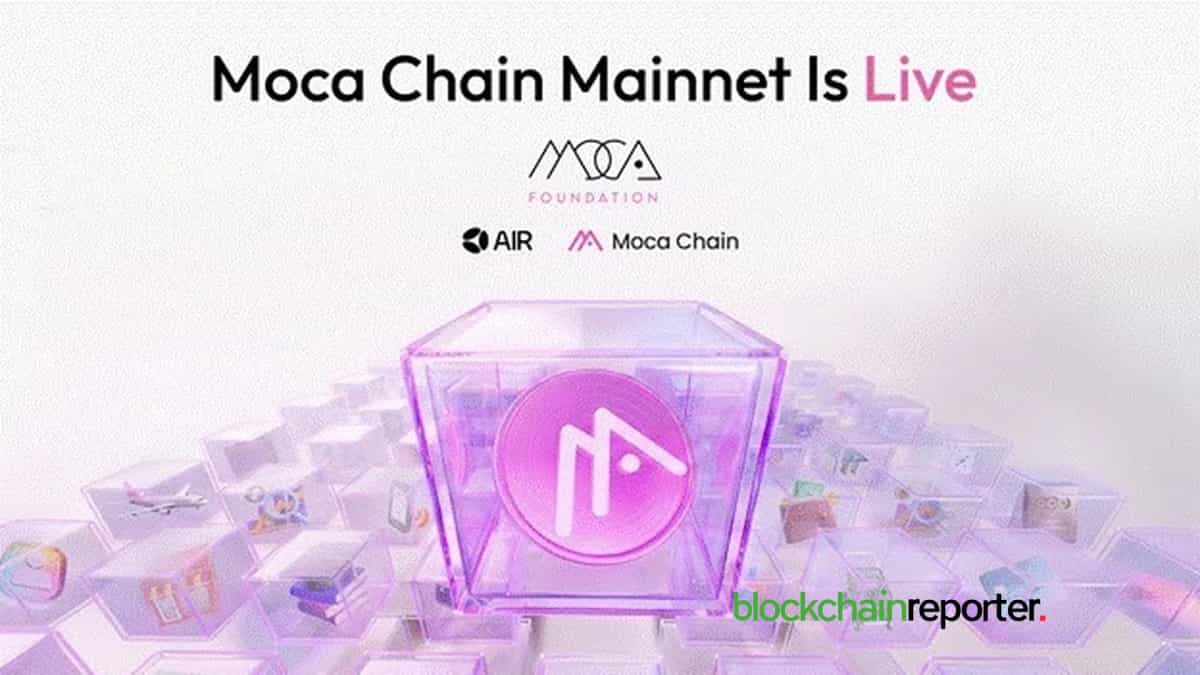
Animoca's Moca Network put its identity-focused Moca Chain mainnet live about nine months past its first target, with AIR carrying credentials to businesses.
MocaPortfolio launches with Magic Eden ($ME) token drop with MOCA stakers access to Animoca Brands ecosystem tokens through curated portfolio allocations.

As per CryptoRank data, Aptos $APT, Jito Labs $JTO, and Moca $MOCA stand atop the prominent seven token unlocks to take place over the next seven days.








