If you searched for what is limitless, limitless prediction market, or limitless crypto, this is the main explainer.
For the broader category introduction, start here: What Are Prediction Markets in Crypto?.
If you want to understand how market prices translate to probabilities, read How Prediction Market Probabilities Work.
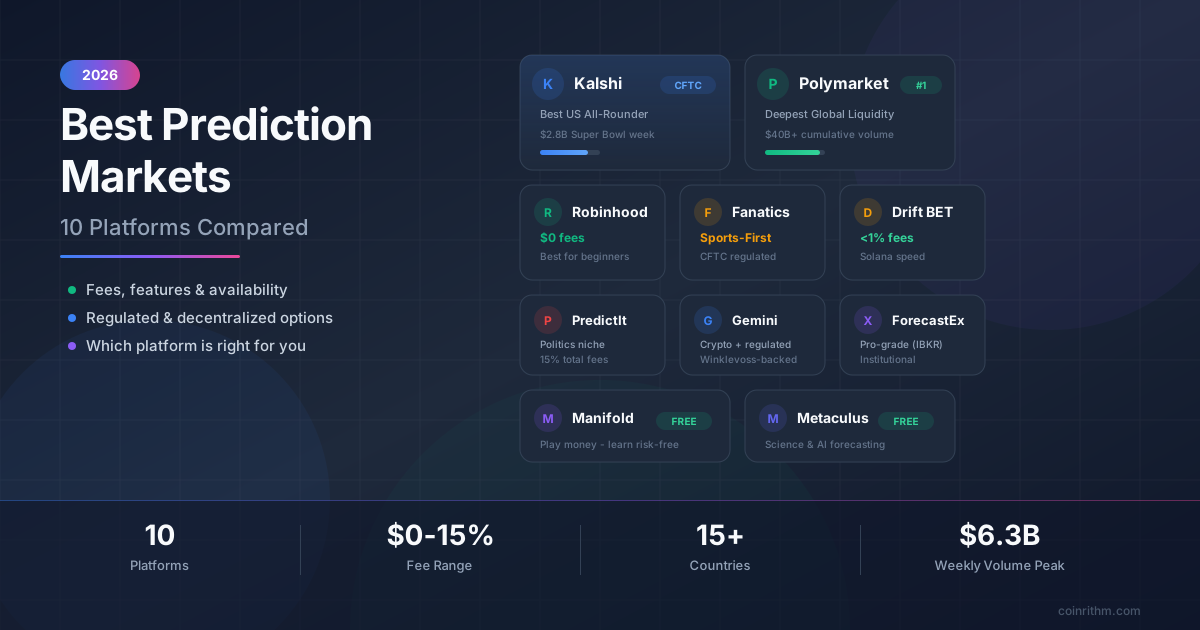
If you are comparing platforms, read Best Prediction Markets or Kalshi vs Polymarket.
Limitless is a crypto-native, on-chain prediction market that focuses on fast-resolving markets with on-chain settlement in USDC. It targets traders who are already comfortable with blockchain infrastructure and want a market venue built around that assumption from the start: no fiat onboarding layer, no centralized intermediary holding funds.
This guide covers what Limitless is, how it works mechanically, how it compares to other platforms, and how to use CoinRithm to browse and research Limitless markets before committing real money.
TL;DR
- Limitless is an on-chain prediction market on Base, operated by Street Chow Inc., a Panamanian company. Markets are collateralized in USDC, and each winning share pays 1 USDC.
- Many markets are short: Limitless lists hourly, daily and weekly markets, plus 5-minute and custom ones, and most resolve automatically from crypto and stock price feeds.
- Limitless does not hold a platform balance: your USDC stays in your own wallet on Base. There is no identity check at sign-up, and trading is closed to users from the US, Ontario, Alberta and the other jurisdictions listed in its terms.
- AMM markets charge a flat 0.40% per trade. On order-book markets, takers pay 0.40% to 3.00% to buy and 0.42% to 1.50% to sell, and makers pay nothing.
- CoinRithm aggregates Limitless markets at /en/prediction-markets/limitless: odds, history, cross-source comparison, all in one place.
- You can paper-trade prediction market events on CoinRithm with mock USD ($10 min) before risking real money anywhere.
What Is Limitless
Limitless is an on-chain prediction market on Base, an Ethereum layer 2, built for crypto-native participants. It is operated by Street Chow Inc., a Panamanian company. Markets are traded and settled on-chain in USDC: smart contracts lock the collateral behind outcome shares and pay out winning shares, and Limitless does not hold a platform balance for you.
The defining characteristics that separate Limitless from broader-audience platforms:
- On-chain settlement. Trades and payouts happen through smart contracts. You hold your position in your wallet. After a market resolves, each winning share can be redeemed for 1 USDC from the contract.
- USDC-denominated. Markets are collateralized and settled in USDC on Base. Limitless's guides describe funding only by sending USDC on Base; there is no bank or card deposit in them.
- Fast-resolving markets. Limitless lists hourly, daily and weekly markets, 5- and 15-minute crypto up/down markets, and custom markets. Most track crypto or stock prices and resolve automatically at their deadline. This suits traders who want to see outcomes quickly and iterate frequently.
- Crypto-native audience. You can connect your own wallet, or sign in with an email address, Google or Twitter and let Limitless create a wallet for you. Either way you need USDC on Base, so Limitless suits people who already hold and move crypto.
This positions Limitless differently from Polymarket (broader audience, longer markets, large-event focus) and Kalshi (regulated, open in the US and many other countries, fiat-friendly). Limitless trades reach for breadth and accessibility in exchange for an audience that is already inside the crypto stack.
How Limitless Works
The core mechanics follow the standard prediction market model: you buy shares in an outcome, shares pay $1.00 (1 USDC) if correct and $0.00 if wrong. The price of a share reflects the market's collective probability estimate.
What Limitless adds on top of that baseline:
1. Market Creation
The Limitless team creates markets, and anyone can also create a user-generated market, which carries a green Community badge and pays its creator a share of the taker fees it generates. Every market has a resolution condition, a resolution source and a deadline.
2. AMM and Order-Book Markets
Limitless runs two market types. On AMM markets, you trade against an automated liquidity pool at a flat 0.40% fee. On order-book (CLOB) markets, you trade against other users' orders: a market order fills instantly at the best available price, and a limit order rests in the book at your price. Your USDC stays in your wallet on Base until you trade, and before resolution 1 Yes share plus 1 No share can always be redeemed for 1 USDC.
3. Fast Lifecycle
Many Limitless markets run for an hour, a day or a week, and some crypto up/down markets last only 5 or 15 minutes. This compression means outcomes arrive faster, positions turn over more quickly, and the cost of being wrong (holding a losing position for a long time) is lower. It also means you have less time to change your mind after entering.
4. Resolution and Payout
When the deadline passes, trading stops and the market resolves from the source named on its market page. Pyth Network price feeds resolve most markets automatically, Chainlink TWAP feeds resolve the 5- and 15-minute crypto up/down markets, and the Limitless team resolves custom event markets, such as sports and politics, manually, typically within 24 to 72 hours. Once the payout is posted on-chain, each winning share can be redeemed for 1 USDC and losing shares become worthless. If a market is misresolved, Limitless refunds the bet amount, not the $1.00 payout.
5. Gas and Transaction Costs
Limitless runs on Base. If you trade directly from your own wallet, or from the embedded wallet that a social login creates, you pay gas in ETH for each on-chain transaction. If you trade through Limitless's smart wallet, which is created when you sign in with a social login and which wallet users can also switch to, Limitless sponsors the gas and you only need USDC. Trading fees come on top (see the fees answer in the FAQ below). For small positions, every cost matters. Always factor it in.
Prices as Probabilities
The same logic applies here as on every prediction market: a share priced at $0.70 (0.70 USDC) implies roughly a 70% market-implied probability. If you believe the real probability is higher, buying gives you positive expected value (before fees and gas). If you believe it is lower, selling or buying the opposing outcome makes sense.
For the full probability and payout mechanics explainer, read How Prediction Market Probabilities Work.
Resolution Rules Are Non-Negotiable
Before trading any Limitless market, read the resolution criteria on the market page. They govern the outcome: not your interpretation, not common sense, not what you assumed. Limitless's docs say that if the stated criteria for Yes are not met, the market resolves No.
Specific things to check:
- What data source determines resolution
- The exact definition of the resolving event
- The time window (especially relevant for fast-resolving markets where hours matter)
- What happens in ambiguous or edge-case scenarios
Not reading the rules is the most common reason experienced prediction market traders lose money on unfamiliar platforms.
Who Limitless Is For
Limitless is built for a specific trader profile:
- You already hold and manage crypto in your own wallet.
- You are comfortable paying gas fees and understand that transactions cost money.
- You want prediction markets that resolve quickly: you prefer many short cycles over holding a position for months.
- You want on-chain guarantees over company custodianship.
- You are comfortable operating in a DeFi-adjacent environment where the interface assumes familiarity.
If you are new to crypto generally, Limitless is not the gentlest entry point. Platforms with fiat on-ramps and more guided UX (Kalshi in the US and many other countries, Polymarket for broader crypto onboarding) are easier starting points. Come back to Limitless once the on-chain mechanics feel natural.
If you are an experienced crypto user looking for short-duration, on-chain markets, Limitless is designed with you in mind.
Ground Truth: What We Know and What We Don't
This section is a direct honesty note. Limitless is a smaller, evolving platform than Polymarket or Kalshi. The facts below come from Limitless's docs and its terms of service (last updated September 15, 2026), read on September 23, 2026.
What we are confident about:
- On-chain market structure on Base, with USDC as collateral
- Operator: Street Chow Inc., a Panamanian company
- AMM markets charge a flat 0.40% per trade; on order-book markets, takers pay 0.40% to 3.00% to buy and 0.42% to 1.50% to sell, and makers pay nothing
- No identity check at sign-up, although Limitless may ask for proof of age, identity or eligibility at any time
- Trading is closed to users from the US, Ontario, Alberta and the other jurisdictions listed in its terms
- CoinRithm aggregates its markets and tracks odds
What you should verify directly with Limitless:
- The resolution source and criteria for each market, shown on its market page
- Whether your own country's law allows you to use it: outside its restricted list, its terms leave this to local law
- The fee on the market you trade, since some promotional markets have a reduced or zero fee and the order-book fee curve is not published as a formula
- Minimum position sizes and any position caps
- Current liquidity levels across market categories
For any of the above, check limitless.exchange and its docs directly for current terms. We will not claim a country is available without an official source: that is how users get misled.
Limitless vs Other Prediction Markets
The platforms differ along a few key axes. This is a directional comparison; for the full current comparison, use CoinRithm's prediction market compare page.
| Dimension | Limitless | Polymarket | Kalshi |
|---|---|---|---|
| Settlement | On-chain (Base, USDC) | On-chain (Polygon, pUSD backed 1:1 by USDC) | Centralized, regulated |
| Audience | Crypto-native DeFi users | Broad crypto + casual | US and many other countries, fiat-friendly |
| Market duration | Short (5 minutes to a week typical), plus custom markets | Mixed (days to months+) | Mixed |
| Fiat access | No, USDC only | Partial (card deposit option) | Yes |
| Regulatory status | Run by a Panamanian company; closed to US users for trading | polymarket.com closed to US residents; Polymarket US is CFTC-regulated | CFTC-regulated (US) |
| Liquidity depth | Smaller overall | Largest on-chain PM | Growing regulated market |
The practical read: if you are already deep in DeFi and want fast-cycle, on-chain markets, Limitless fits that use case. If you want the most liquid on-chain markets across broad event categories, Polymarket is larger. If you are in the US, Limitless's terms close trading to you; Kalshi and Polymarket US are the regulated options with fiat.
These are not mutually exclusive. Many traders track all three and route positions based on which platform has better odds or liquidity for a given market. CoinRithm's prediction markets hub and sources directory are built for exactly that kind of cross-platform research.
How to Research Limitless Markets on CoinRithm
CoinRithm aggregates Limitless markets alongside Polymarket, Kalshi, Manifold, and others. You can browse odds, view odds history, and compare across sources without connecting a wallet or visiting multiple platforms.
The dedicated hub for Limitless is: coinrithm.com/en/prediction-markets/limitless.
From there you can:
- See all aggregated open Limitless markets
- View current implied probabilities for each outcome
- Check odds history (24h, 7d, 30d charts where data is available)
- Compare Limitless odds against the same or similar markets on other platforms
- Read resolution rules without needing a wallet
For cross-platform discovery, finding which platform has the best odds on a given topic, use coinrithm.com/en/prediction-markets/compare.
For the full directory of platforms CoinRithm aggregates, use coinrithm.com/en/prediction-markets/sources.
Useful Research Steps Before Trading on Limitless
1. Check the odds on CoinRithm first
Open the Limitless hub and find the market you are interested in. Check whether similar markets exist on other platforms. If Limitless shows 65% and Polymarket shows 72% on the same underlying question, that spread is worth understanding before you commit.
2. Read the resolution rules
The market detail on CoinRithm surfaces the resolution criteria. Read them before you open a position. Fast-resolving markets are particularly unforgiving: if the resolution window closes before you expected it to, there is no appeal.
3. Check liquidity depth
Thin liquidity means your position entry and exit can move the price against you. CoinRithm shows volume and liquidity figures where available. For Limitless, liquidity is generally smaller than the largest Polymarket markets, so size your positions accordingly.
4. Track the odds history
The 24h and 7d trend on CoinRithm's market detail shows how implied probability has moved. A market that drifted from 40% to 70% over the last week may be pricing in recent news you should understand before buying at 70%.
5. Open on Limitless when ready
CoinRithm is a research and discovery layer, not a trading interface. Once you have done the research, and if Limitless is open to users where you are, open the market directly on Limitless to place your trade. CoinRithm is not Limitless, is not affiliated with Limitless, and is not a broker: CoinRithm is a research tool.
Paper Trading Prediction Markets on CoinRithm
If you want to practice prediction market thinking without risking real money on Limitless (or any other platform), CoinRithm supports paper trading for prediction market events with mock USD.
The minimum paper trade size is $10.
This lets you:
- Get used to reading odds and making probability judgments
- Track whether your reads are consistently good before scaling up
- Practice position sizing without real financial consequences
- Develop a research process before applying it to real money
Paper trading does not simulate gas costs, wallet friction, or the psychological weight of real money. But it is useful for building and testing a prediction market research process. If you are consistently losing mock money, that is a good signal to pause before using real money on Limitless.
Common Mistakes When Trading Fast-Resolving Markets
Limitless's short-duration design creates some specific failure modes that are less common on longer-horizon platforms.
Not checking the resolution time carefully
A market labeled "resolves this week" might resolve in 36 hours. If you expect five days to monitor and react, and the market closes in two, you may find yourself holding through resolution with no chance to exit. Always check the exact resolution date and time before entering.
Treating speed as safety
Fast-resolving markets do return outcomes quickly. But that speed also means less time for your thesis to be vindicated, and less time to exit if new information changes the situation. Speed is neutral: it cuts both ways.
Underestimating fees relative to your edge
On order-book markets, a taker who buys at $0.50 pays 3.00% and a taker who sells at $0.50 pays 1.50%, so a quick round trip near the middle of the range costs about 4.5% of the amounts traded. A trade with a 3% edge does not survive that. If you trade from your own wallet, gas on Base comes on top. Use limit orders, which pay no fee, or skip small edges.
Extrapolating from Polymarket or Kalshi mechanics
Limitless is a different protocol. Assuming that how resolution, dispute, or liquidity works on Polymarket is how it works on Limitless is how traders get surprised. Read the Limitless-specific documentation.
Chasing liquidity
If a Limitless market has very low volume and no recent trades, the spread between buy and sell is wide. Entering a position means paying that spread immediately. For thin markets, check whether CoinRithm shows any other platform with better liquidity on the same event.
Frequently Asked Questions
What is Limitless in simple terms
Limitless is a prediction market that runs on-chain on Base. You trade on the outcomes of real-world events, mostly crypto and stock prices, using USDC. When the event resolves, each winning share can be redeemed for 1 USDC from the smart contract. Limitless does not hold a platform balance: your USDC stays in your own wallet.
How is Limitless different from Polymarket
The core structural difference is audience and design philosophy. Polymarket.com runs on Polygon, holds balances in pUSD (backed 1:1 by USDC) and lists a broad mix of politics, sports, crypto and culture markets. Limitless runs on Base with USDC as collateral, mixes AMM and order-book markets, and skews toward short-duration markets such as hourly and daily crypto prices. Both are closed to US residents, and Polymarket offers them a separate CFTC-regulated app, Polymarket US.
Is Limitless safe
Limitless does not hold a platform balance: your USDC stays in your own wallet on Base, which reduces custodial risk. However, smart contract bugs are a real risk on any on-chain platform, and thin liquidity markets carry manipulation risk. Custom event markets are resolved manually by the Limitless team, and if a market is misresolved, Limitless refunds your bet amount rather than paying $1.00 per share. Its operator, Street Chow Inc., is a Panamanian company. Regulatory posture toward crypto-native prediction markets varies by country and can change. Verify current status and risks directly with Limitless before depositing significant funds.
What fees does Limitless charge
According to Limitless's fee docs (September 2026), AMM markets charge a flat 0.40% on every trade, and some promotional markets have a reduced or zero fee. On order-book (CLOB) markets, only takers pay: buying costs 0.40% to 3.00% (3.00% at prices up to $0.50, falling as the price rises), and selling costs 0.42% to 1.50% (highest at $0.50). Limit orders that rest in the book pay nothing, and redeeming winning shares after resolution carries no trading fee. If you trade from your own wallet, gas on Base comes on top; with the smart wallet, Limitless pays the gas.
Can I use Limitless without a crypto wallet
Not without any wallet. Every Limitless account trades from a wallet on Base: you can connect your own, such as MetaMask or Coinbase Wallet, or sign in with an email address, Google or Twitter and Limitless creates a wallet for you. Either way, you need USDC on Base to trade. If you want a prediction market experience without setting up a wallet, CoinRithm's paper trading feature lets you trade prediction market events with mock USD ($10 min) for practice.
What countries can use Limitless
Limitless's terms (last updated September 15, 2026) close trading to users from the United States, the "Republic of China" and the Canadian provinces of Ontario and Alberta, and close the whole platform to users in Russia, Belarus, Cuba, Iran, North Korea, Syria, and the Crimea, Donetsk and Luhansk regions. Everywhere else, the terms leave eligibility to local law: you must be at least 18, or the age of majority where you live if that is higher, and not in a place where using the platform is prohibited. No official Limitless source confirms access for any specific country, so CoinRithm's availability page lists the other countries as not verified. This is one of the areas where "verify before you deposit" is not optional.
Where can I research Limitless markets before trading
CoinRithm aggregates Limitless markets at coinrithm.com/en/prediction-markets/limitless. You can browse odds, read resolution rules, check odds history, and compare against other platforms, with no wallet required.
How does on-chain settlement work in practice
When a Limitless market's deadline passes, trading stops and the outcome comes from the source named on the market page: Pyth Network price feeds resolve most markets automatically, Chainlink TWAP feeds resolve 5- and 15-minute crypto up/down markets, and the Limitless team resolves custom event markets manually, typically within 24 to 72 hours. Once the payout is posted on-chain, each winning share can be redeemed for 1 USDC, with no trading fee on the redemption. Redeeming is an on-chain transaction: you pay gas if you trade from your own wallet, and Limitless sponsors it if you use its smart wallet.
Can I sell my position early on Limitless
Yes. You can sell shares anytime before the market resolves. On order-book markets, a sell that fills immediately pays a taker fee of 0.42% to 1.50%, while a limit order that rests in the book pays nothing; AMM trades pay a flat 0.40%. For short-duration Limitless markets, the time window before resolution may be narrow, so plan your exit before you enter.
Conclusion
Limitless is a prediction market built for participants who are already inside the crypto stack. On-chain settlement, crypto-native design, and fast-resolving markets are its defining characteristics. It is not a beginner entry point to prediction markets: it assumes you can manage a wallet, fund it with USDC on Base, and navigate on-chain mechanics.
What this guide covered:
- What Limitless is and how it differs from Polymarket and Kalshi
- How on-chain settlement works and what it means for custody and risk
- Who the platform is designed for
- Its network, fees and restricted jurisdictions, and what to verify directly
- How to use CoinRithm to research Limitless markets without committing real money
- Common mistakes specific to fast-resolving, on-chain market formats
If you want to start with Limitless:
- Browse open markets on CoinRithm's Limitless hub to get familiar with what is available.
- Compare odds against other platforms using coinrithm.com/en/prediction-markets/compare.
- Read the resolution rules for any market you are considering before entering.
- If you are new to prediction markets, use CoinRithm's paper trading feature to build a research process first.
- When you are ready, and if Limitless is open to users where you are, open the market directly on Limitless with an amount you can afford to lose.
Next Step
Browse Limitless markets: CoinRithm Limitless Hub.
Compare platforms: Prediction Market Compare or Best Prediction Markets.
Understand probabilities: How Prediction Market Probabilities Work.
Broader platform comparison: Kalshi vs Polymarket.
All prediction market sources: CoinRithm Prediction Market Sources.
Last Updated: September 23, 2026
Disclaimer: Prediction markets involve financial risk. This guide is for educational purposes only and is not financial, legal, or investment advice. Verify the legal status of prediction markets in your jurisdiction before participating. Only trade money you can afford to lose.