If you searched for what is futuur, futuur prediction market, or futuur real money vs play money, this is the main explainer.
For the broader category introduction, start here: What Are Prediction Markets in Crypto?.
If you want to understand how market prices translate to probabilities, read How Prediction Market Probabilities Work.
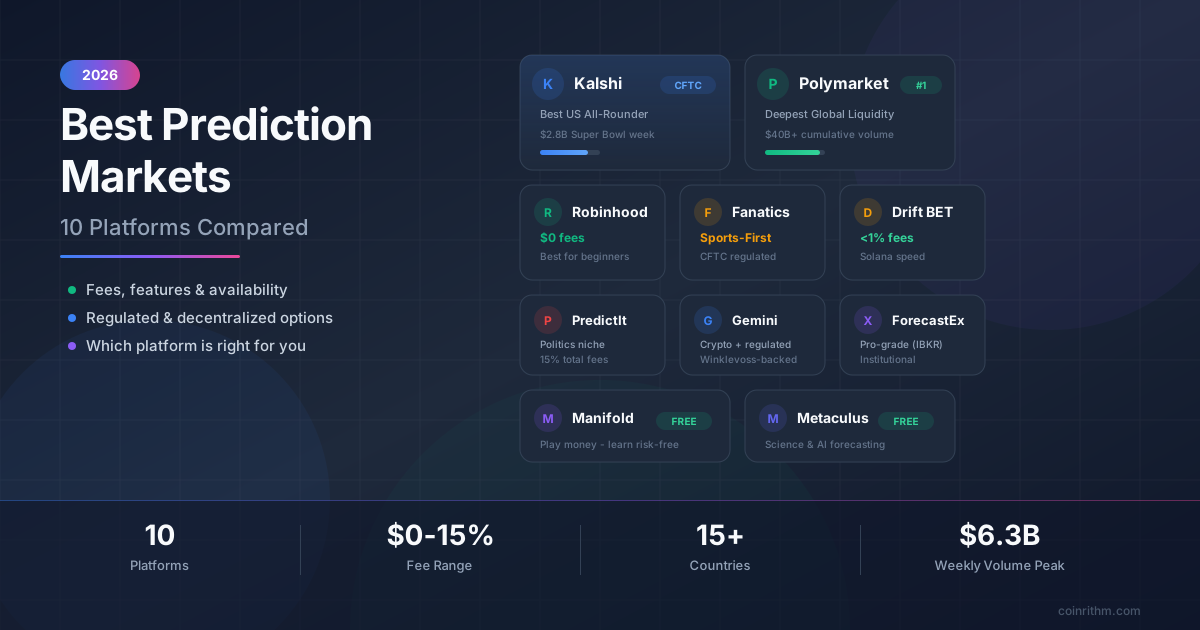
If you are comparing platforms, read Best Prediction Markets or Kalshi vs Polymarket.
Futuur is a prediction market with one trait that sets it apart from almost every other venue: it runs two books at once. One is a play-money book where you predict with a virtual currency and nothing financial is at stake. The other is a real-money book where you deposit funds and win or lose actual money. This dual real-and-play design is the single most important thing to understand about Futuur, because it changes how you should read its prices.
This guide covers what Futuur is, how the two modes differ, why that difference matters for interpreting its odds, how it works mechanically, and how to use CoinRithm to browse and research Futuur markets before committing real money.
TL;DR
- Futuur runs both a play-money book and a real-money book. This dual nature is its defining trait.
- Play money uses a virtual currency called Ooms; every new account starts with 10,000 Ooms for free. Real money uses two stablecoins, USDC and USDT.
- Orders fill against an order book first and then against an automated market maker (AMM), so you can almost always enter and exit positions at once, and a price maps directly to an implied probability.
- Play-money odds reflect crowd sentiment and reputation-chasing, not financial conviction. Read them differently from real-money venue prices.
- CoinRithm aggregates around 600 open Futuur markets (September 2026) at /en/prediction-markets/futuur, with odds, history, and cross-source comparison in one place.
- You can paper-trade prediction market events on CoinRithm with mock USD ($10 min) before risking real money anywhere.
What Is Futuur
Futuur is a prediction market platform that has operated since 2017, covering a wide range of topics including politics, business and finance, science, entertainment, and sports. It started as a play-money forecasting platform and later added a real-money book, so today the same site offers two ways to participate side by side.
The characteristics that define Futuur:
- Dual real-and-play structure. Anyone can predict with play money, and users outside Futuur's restricted countries can also use real money. Most other major venues are one or the other. Polymarket and Kalshi are real-money only. Futuur is deliberately both.
- Broad topic coverage. Futuur lists a large number of active markets across many categories rather than specializing in one vertical. Over its history it has run predictions on a very large number of events: CoinRithm's database alone holds about 210,000 Futuur markets, open and resolved (September 2026).
- Order book plus AMM pricing. Your order first fills against resting orders from other traders on an order book, and any remainder fills against an automated market maker that always quotes a price. You can buy or sell a position at almost any time without waiting for a counterparty.
- Stablecoins in real-money mode. The real-money book accepts two stablecoins, USD Coin (USDC) and Tether (USDT), sent from a crypto wallet or exchange. Trading then happens on Futuur's hosted platform, so you are not managing on-chain contracts yourself.
That combination positions Futuur differently from the venues most people know. It is not purely crypto-native like an on-chain protocol, and it is not a regulated US exchange like Kalshi. It is a long-running, broad-topic prediction market that lets the same crowd predict for fun and for money in parallel.
Real-Money vs Play-Money: Futuur's Defining Split
This is the section to read carefully, because it is what makes Futuur unusual and what most affects how you should use it.
The play-money book. When you register on Futuur, you receive a starting balance of 10,000 Ooms, Futuur's virtual currency. You use Ooms to predict on markets exactly as you would with real money: you buy a position in an outcome, and if you are right, your Ooms balance grows. Nothing financial is at stake: Ooms cannot be bought, sold, withdrawn or converted into money. The incentive is reputation, leaderboard standing, and the satisfaction of being right. Futuur says its play-money markets are free to use anywhere in the world, without the deposit and verification steps a real-money book requires.
The real-money book. Futuur also offers real-money markets where you deposit actual funds and your winnings and losses are real. The real-money book uses two stablecoins, USD Coin (USDC) and Tether (USDT), so you can fund an account with crypto you already hold. Futuur is operated by Futuur Anjouan Ltd. under a gaming license from the Autonomous Island of Anjouan (Union of Comoros). Real money is closed to residents of the countries on Futuur's restricted lists, which include the United States, the United Kingdom, Canada, Australia, Germany, France, the Netherlands, Spain, Italy, Singapore, the United Arab Emirates, Japan and Turkey, while play-money markets stay open worldwide. Futuur's terms and its help center publish slightly different lists, and both can change, so check the availability page for your country and futuur.com before depositing.
The practical upshot: on Futuur, a market you are looking at might be a play-money market, a real-money market, or the platform may run parallel versions. Before you act on a Futuur price, know which book it comes from. A play-money price and a real-money price on the same question are not the same signal, and the next section explains why.
Why the Play-vs-Real Distinction Matters for Reading Odds
A prediction market price is only as informative as the incentive behind it. This is the core idea in How Prediction Market Probabilities Work: prices become accurate because being wrong costs you money, so participants who are careless get filtered out over time and prices converge on something close to the true probability.
Play money changes that incentive. In a play-money market, being wrong costs you nothing but bragging rights. That has two consequences worth holding in mind:
- Play-money prices reflect crowd sentiment, not financial conviction. People predict with play money for entertainment, to chase a leaderboard, or to express a hope rather than a calibrated estimate. There is no capital being risked to discipline the number. The price still aggregates a crowd view, but it is a softer signal than a market where real money is on the line.
- Play money can still be surprisingly accurate, but do not assume it. Futuur has reported strong forecast accuracy on its play-money markets over its history, measured by a Brier score (a standard scoring rule for probabilistic forecasts). So play money is not noise. But calibration varies by market, and a thinly-predicted play-money market can be pulled around by a handful of participants with no financial cost for being wrong.
The rule for using Futuur alongside other venues:
- Treat a real-money Futuur price as comparable in spirit to prices on Polymarket or Kalshi. Real capital is disciplining it.
- Treat a play-money Futuur price as a sentiment reading. Useful, sometimes sharp, but not the same as a market where being wrong burns money.
- When a Futuur price diverges sharply from a real-money venue on the same question, the first thing to check is whether you are comparing a play-money number to a real-money one. That mismatch, not a genuine disagreement, is often the whole explanation.
For a structured approach to comparing prices across venues, read How to Compare Prediction Markets.
How Futuur Works
The core mechanics follow the standard prediction market model: you buy shares in an outcome, a winning share pays out a fixed amount and a losing share pays nothing, and the price of a share reflects the market's collective probability estimate.
What Futuur layers on top of that baseline:
1. Order Book First, AMM as Backup
Futuur combines an order book with an automated market maker (AMM). A market order first fills against resting limit orders from other traders, at their posted prices. Any unfilled remainder goes to the AMM, a pricing curve that always quotes a price (Futuur uses the LS-LMSR model), comparable in concept to an AMM like Uniswap in DeFi. You can also post a limit order at your own price and wait for someone to fill it. This means you can almost always enter or exit a position immediately, although Futuur notes that liquidity can be limited at extreme prices. The trade-off is that a large market order moves the price more in thin markets, so size matters.
2. Prices as Probabilities
Prices on Futuur are set by market activity. A lower price on an outcome means a larger payout if that outcome happens, which is another way of saying the crowd thinks it is less likely. Futuur surfaces this as a percentage likelihood. As with every prediction market, a share priced around 70 cents on the dollar implies roughly a 70 percent market-implied probability. If you believe the true probability is higher, buying has positive expected value before fees. If lower, the opposing side does.
3. Two Currencies, One Mechanism
The order book, the AMM and the pricing logic work the same way in both books. The difference is what you are risking: Ooms in the play-money book, USDC or USDT in the real-money book. The mechanics of buying, selling, and reading a price are identical, which is part of what makes Futuur a comfortable place to practice before moving to real money.
4. Resolution
When the event underlying a market occurs, the market resolves, winning positions are paid, and losing positions expire worthless. As with any venue, the resolution criteria written into the market are what govern the payout, not your interpretation of the question. For a fuller treatment of how settlement works and where it goes wrong, read How Prediction Markets Resolve.
Resolution Rules Are Non-Negotiable
Before trading any Futuur market, read the resolution criteria in the market description. Specifically check:
- What data source or authority determines the outcome
- The exact definition of the resolving event
- The time window that counts
- What happens in ambiguous or edge-case scenarios
Not reading the rules is the most common reason experienced traders lose money on an unfamiliar platform. This is true on every venue, and Futuur is no exception.
Who Futuur Is For
Futuur suits a few distinct profiles because of its dual structure:
- People who want to learn prediction markets risk-free. The play-money book with a free Ooms balance is a genuine sandbox. You can learn to read odds, size positions, and test your judgment with zero financial downside.
- Crypto holders who want a real-money book without going fully on-chain. Because the real-money side accepts the USDC and USDT stablecoins, you can fund with assets you already hold, while still using a hosted platform rather than managing on-chain contracts yourself.
- Broad-topic forecasters. If you want variety across politics, finance, science, sports, and entertainment in one place rather than a single-vertical venue, Futuur's wide market coverage fits.
- Sentiment readers. If you specifically want a crowd-sentiment gauge to compare against sharper real-money venues, Futuur's play-money book is a useful data point once you know to read it as sentiment.
Who it is less suited to: anyone in a jurisdiction where the real-money book is unavailable and who specifically wants real-money trading, and anyone who assumes every Futuur price carries the same weight as a deep real-money market. Both of those are solvable by knowing the platform, which is what this guide is for.
Ground Truth: What We Know and What We Don't
This is a direct honesty note. Some facts about Futuur are well established, and others (fees, currencies, country lists and verification rules) can change, so re-check them on the source before you rely on them.
What we are confident about:
- Futuur runs both a play-money book (Ooms) and a real-money book. This dual nature is its defining trait.
- New accounts receive a starting play-money balance of 10,000 Ooms.
- The real-money book supports two stablecoins, USDC and USDT.
- Orders fill on an order book first and then against an automated market maker, and prices map to implied probabilities.
- Futuur has operated since 2017 with broad topic coverage.
- Futuur is operated by Futuur Anjouan Ltd. under gaming license No. ALSI-202410061-FI2 from the Autonomous Island of Anjouan (Union of Comoros).
- CoinRithm aggregates around 600 open Futuur markets and tracks their odds.
What we checked on Futuur's help center (September 2026), and you should re-check before depositing:
- Fees. Only takers, whose orders fill against existing orders, pay a trading fee: 0.05 × contracts × price × (1 - price). That peaks at $1.25 per 100 contracts at a 50-cent price. Makers pay nothing and get 80% of the taker fee back as a rebate. Futuur charges nothing to receive deposits, and withdrawal fees depend on the network, from nothing on Polygon or Solana to 5 USDC on Ethereum (ERC20).
- Minimums and timing. The smallest real-money bet is 1 USD. Minimum withdrawals depend on the network, for example 1 USDC on Polygon or Solana and 10 USDC on Ethereum. Crypto deposits typically arrive in 10 to 30 minutes, and Futuur reviews withdrawals manually, generally within 24 hours.
- Currencies. USDC and USDT only. The list has changed before, so confirm it on the platform.
- Countries. Real money is restricted in the United States, the United Kingdom, Canada, Australia, Germany, France, the Netherlands, Spain, Italy, Singapore, the United Arab Emirates, Japan, Turkey and other listed countries. Play money is open everywhere. CoinRithm's availability page shows each country's documented status.
- KYC. Real money needs a verified email address, and your first deposit asks for your name, date of birth, country and address. Futuur may ask for proof of identity and address at any time, and says it generally does once your lifetime deposits pass the equivalent of $2,000. Lifetime withdrawals above that amount can also trigger the check.
These details can change, so check futuur.com for current terms before you deposit. We only state a fee, currency or country fact when Futuur's own pages support it, and we date it, because an outdated figure is how users get misled.
Futuur vs Other Prediction Markets
The platforms differ along a few key axes. This is a directional comparison. For a repeatable method rather than a snapshot, read How to Compare Prediction Markets.
| Dimension | Futuur | Polymarket | Kalshi |
|---|---|---|---|
| Money model | Both play-money and real-money books | Real money only | Real money only |
| Settlement / custody | Hosted platform, gaming-licensed real-money book | On-chain (Polygon, pUSD backed 1:1 by USDC) | Centralized, regulated |
| Currencies | USDC or USDT (Ooms for play money) | pUSD, backed 1:1 by USDC | USD (card, bank or crypto deposits) |
| Audience | Broad, from casual play-money to real-money | Broad crypto plus casual | US and many other countries, fiat-friendly |
| Topic breadth | Very broad across categories | Broad | Broad, regulated event set |
| Regulatory status | Anjouan gaming license; real money restricted in the US, UK and other listed countries | polymarket.com closed to US residents, who use the separate CFTC-regulated Polymarket US | CFTC-regulated (US); restricted in the jurisdictions its member agreement lists |
| Pricing mechanism | Order book plus AMM (LS-LMSR) | Order book | Exchange order book |
The practical read: Futuur's edge is optionality. It is the venue where you can practice for free and trade for real in the same interface, across a wide topic range. Polymarket is the deepest on-chain real-money venue. Kalshi is the clearest regulated path for US residents. If you want US-accessible real money, a CFTC-regulated exchange such as Kalshi or Polymarket US is the route, not Futuur. If you want a free sandbox plus a crypto-friendly real-money book, Futuur is distinctive.
These are not mutually exclusive. Many people track several venues and read each for what it is best at. CoinRithm's prediction markets hub is built for exactly that kind of cross-platform research.
How to Research Futuur Markets on CoinRithm
CoinRithm aggregates Futuur markets alongside Polymarket, Kalshi, Limitless, Manifold, and others. You can browse odds, view odds history, and compare across sources without creating an account on every platform.
The dedicated hub for Futuur is: coinrithm.com/en/prediction-markets/futuur.
From there you can:
- See aggregated open Futuur markets (around 600 in September 2026)
- View current implied probabilities for each outcome
- Check odds history (24h, 7d, 30d charts where data is available)
- Compare Futuur odds against the same or similar markets on other platforms
- Read market details without needing to deposit anything
Useful Research Steps Before Trading on Futuur
1. Check the odds on CoinRithm first
Open the Futuur hub and find the market you are interested in. Check whether similar markets exist on other platforms. If Futuur shows 60 percent and Polymarket shows 72 percent on the same underlying question, understand that spread before you act, and remember to check whether the Futuur figure is from its play-money or real-money book.
2. Identify the book
This is the Futuur-specific step. Confirm on Futuur whether the market you are reading is play money or real money. A play-money price is a sentiment reading; a real-money price is a capital-backed one. Do not treat them as interchangeable.
3. Read the resolution rules
The market detail surfaces the resolution criteria. Read them before you open a position. Ambiguous resolution is where surprises come from on every venue.
4. Track the odds history
The 24h and 7d trend on CoinRithm's market detail shows how implied probability has moved. A market that drifted from 40 percent to 70 percent over a week may be pricing in recent news you should understand before buying at 70 percent.
5. Open on Futuur when ready
CoinRithm is a research and discovery layer, not a trading interface. Once you have done the research, open the market directly on Futuur to place your trade. CoinRithm is not Futuur, is not affiliated with Futuur, and is not a broker. CoinRithm is a research tool.
Paper Trading Prediction Markets on CoinRithm
If you want to practice prediction market thinking without risking real money on Futuur (or any other platform), CoinRithm supports paper trading for prediction market events with mock USD.
The minimum paper trade size is $10.
This lets you:
- Get used to reading odds and making probability judgments
- Track whether your reads are consistently good before scaling up
- Practice position sizing without real financial consequences
- Develop a research process before applying it to real money
There is a nice parallel here: Futuur's own play-money book exists for the same reason. Using CoinRithm paper trading and Futuur play money both let you build judgment before capital is at stake. The difference is that CoinRithm paper trading spans every venue we aggregate, so you can practice reading and comparing across platforms rather than inside a single one. If you are consistently losing mock money, that is a good signal to pause before using real money anywhere.
Common Mistakes When Reading Futuur Prices
Futuur's dual structure creates a few failure modes that are specific to it.
Confusing a play-money price for a real-money one
This is the big one. A play-money price is a sentiment gauge, not a capital-backed probability. Reading a play-money number as if it carried Polymarket-level conviction is the most common Futuur-specific mistake. Always know which book you are looking at.
Assuming a Futuur-vs-other-venue gap is a real edge
If Futuur shows a very different number from a real-money venue, check the book first. A play-money-versus-real-money mismatch explains most of these gaps and is not a tradable edge.
Ignoring geographic access before depositing
The real-money book is closed to residents of the United States, the United Kingdom and the other countries on Futuur's restricted lists. Check your country on CoinRithm's availability page and confirm access on Futuur before assuming you can deposit. Futuur's terms prohibit using a VPN to get around these restrictions and allow it to block the account and forfeit its balance. Do not build a plan around a real-money position you cannot legally take.
Underestimating AMM slippage in thin markets
Instant liquidity from an AMM is convenient, but a large order in a thinly traded market moves the price against you. Size your position to the market's depth, and check volume on CoinRithm before committing to a big position.
Treating fees as zero
Futuur's help center (September 2026) says takers pay 0.05 × contracts × price × (1 - price), so buying 100 contracts at 50 cents costs $1.25 in fees on top of the $50. Makers who rest limit orders pay nothing and get 80% of the taker fee back as a rebate. Fees can change, so check the current rate on the platform and factor it into any expected-value calculation. For how fees erode edge across venues generally, read Prediction Market Fees Comparison.
Frequently Asked Questions
Is Futuur real money
Futuur offers both. It runs a play-money book using a virtual currency called Ooms, and a separate real-money book where you deposit and win or lose actual funds in the USDC or USDT stablecoins. Real money is not available to residents of the United States, the United Kingdom, Canada, Australia and other countries on Futuur's restricted lists, so whether you can use the real-money side depends on where you live. The play-money book is open worldwide.
What is play money on Futuur
Play money on Futuur is a virtual currency called Ooms. Every new account starts with 10,000 Ooms for free. You use Ooms to predict on markets exactly as you would with real funds, but nothing financial is at stake: Ooms cannot be bought, sold, withdrawn or converted into money. The incentive is reputation and leaderboard standing. Play money is a useful way to learn the platform and to gauge crowd sentiment, but a play-money price reflects sentiment rather than financial conviction, so read it differently from a real-money price.
Is Futuur legit
Futuur has operated since 2017. It is run by Futuur Anjouan Ltd., and its real-money book operates under a gaming license from the Autonomous Island of Anjouan (Union of Comoros). It is an established platform with broad topic coverage. As with any venue, legitimacy of the operator is separate from your own risks: real-money gaming carries financial risk, thin markets carry slippage risk, and regulatory access varies by country. Verify current terms, fees, and availability for your jurisdiction directly on futuur.com before depositing.
Futuur vs Polymarket
The core difference is the money model. Polymarket is a real-money-only, on-chain platform on Polygon, where balances are held in pUSD, a token backed 1:1 by USDC. Futuur runs both a play-money and a real-money book, fills orders on an order book backed by an automated market maker, and settles real money in USDC or USDT on its own hosted platform. Polymarket tends to have deeper liquidity on its largest markets. Futuur's distinctive feature is the free play-money sandbox alongside real-money trading. For a deeper venue comparison, see Kalshi vs Polymarket and Best Prediction Markets.
What fees does Futuur charge
Futuur charges a trading fee only to takers, whose orders fill against existing orders: 0.05 × contracts × price × (1 - price), which peaks at $1.25 per 100 contracts at a 50-cent price. Makers pay nothing and get 80% of the taker fee back as a rebate. Futuur charges nothing to receive deposits, and withdrawal fees depend on the network, from nothing on Polygon or Solana to 5 USDC on Ethereum. These figures are from Futuur's help center in September 2026, so check futuur.com before trading and factor fees into your expected-value math. For how fees compare across venues in general, read Prediction Market Fees Comparison.
Can I use Futuur without depositing real money
Yes. The play-money book is designed for exactly that. You get a starting balance of 10,000 Ooms and can predict on markets without depositing anything. If you want to practice reading and comparing odds across multiple venues rather than one, CoinRithm's paper trading feature lets you trade prediction market events with mock USD ($10 min).
Where can I research Futuur markets before trading
CoinRithm aggregates Futuur markets at coinrithm.com/en/prediction-markets/futuur, with around 600 open markets tracked (September 2026). You can browse odds, read market details, check odds history, and compare against other platforms, with no account required.
Conclusion
Futuur is a prediction market defined by one thing above all: it runs both a play-money book and a real-money book. That dual structure is its strength and the source of its one big gotcha. The strength is optionality, a free sandbox to learn in, and a crypto-friendly real-money book in the same place. The gotcha is that a play-money price and a real-money price are different signals, and treating them as the same is the most common mistake people make with Futuur.
What this guide covered:
- What Futuur is and how the play-money and real-money books differ
- Why the play-vs-real distinction changes how you should read Futuur's odds
- How the order book, AMM pricing and resolution mechanics work
- Who the platform is best suited to
- Current fees, currencies, country restrictions and KYC rules, and why to re-check them before depositing
- How to use CoinRithm to research Futuur markets without depositing anything
If you want to start with Futuur:
- Browse open markets on CoinRithm's Futuur hub to get familiar with what is available.
- For any market, confirm on Futuur whether it is a play-money or real-money market before you act on the price.
- Read the resolution rules for any market you are considering before entering.
- If you are new to prediction markets, use CoinRithm's paper trading feature, or Futuur's own play-money book, to build a research process first.
- When you are ready, and only if the real-money book is available in your jurisdiction, open the market directly on Futuur with an amount you can afford to lose.
Next Step
Browse Futuur markets: CoinRithm Futuur Hub.
Compare platforms: How to Compare Prediction Markets or Best Prediction Markets.
Understand probabilities: How Prediction Market Probabilities Work.
Understand settlement: How Prediction Markets Resolve.
Broader platform comparison: Kalshi vs Polymarket.
Last Updated: September 23, 2026
Disclaimer: Prediction markets involve financial risk. This guide is for educational purposes only and is not financial, legal, or investment advice. Real-money availability on Futuur is restricted in some jurisdictions. Verify the legal status of prediction markets in your jurisdiction before participating. Only trade money you can afford to lose.