If you searched for what is myriad, myriad prediction market, or myriad markets, this is the main explainer.
For the broader category introduction, start here: What Are Prediction Markets in Crypto?.
If you want to understand how market prices translate to probabilities, read How Prediction Market Probabilities Work.
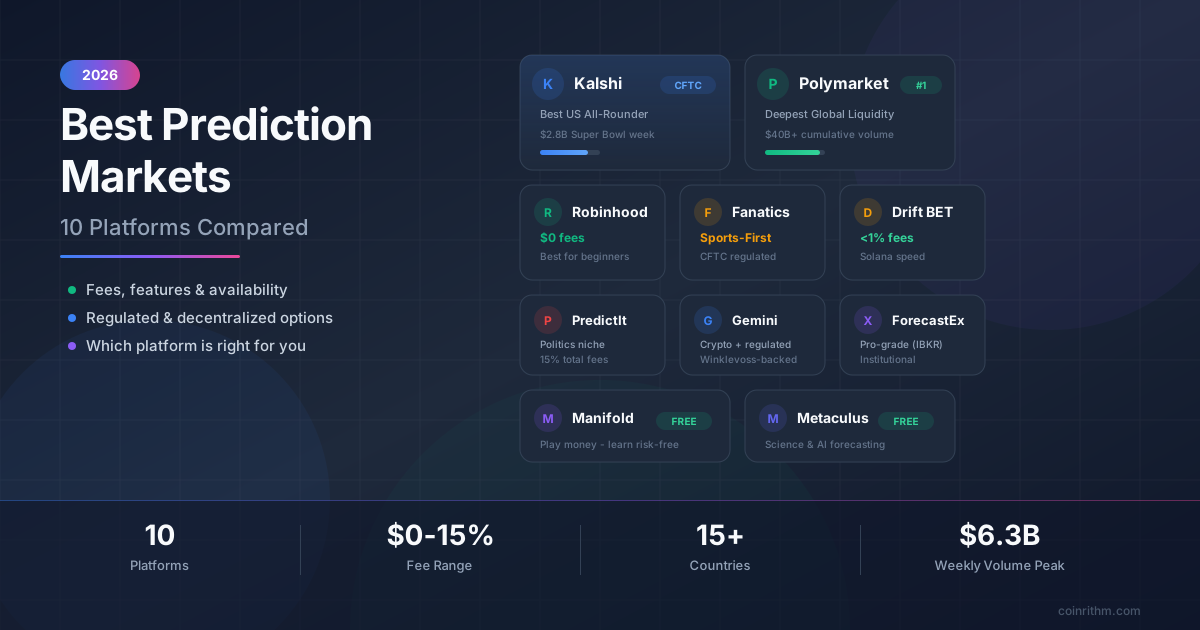
If you are comparing platforms, read Best Prediction Markets or Kalshi vs Polymarket.
Myriad is an on-chain prediction market that prices most outcomes using an automated market maker (AMM) rather than a traditional order book, and it is rolling out an order book on select markets. It runs two kinds of markets side by side: real-money markets denominated in stablecoins, and play-money markets that use in-app points (PTS). It was launched by Dastan, the parent company of the crypto-media brands Decrypt and Rug Radio, and it began on the Abstract chain before expanding to Linea, BNB Smart Chain and Celo.
This guide covers what Myriad is, how its AMM mechanic actually prices outcomes, why the stablecoin-versus-play-money split matters when you read the odds, who the platform is for, and how to use CoinRithm to browse and research Myriad markets before committing any real money.
TL;DR
- Myriad is an on-chain prediction market that prices most markets with an AMM, not an order book. There is always a price to trade against, even in thin markets. An order book is rolling out on select markets.
- It runs real-money markets settled in stablecoins (USDC, USDT or USD1) and play-money markets that use in-app points (PTS). The two look similar but mean very different things.
- Play-money (PTS) odds reflect engagement and sentiment, not real-money conviction. Weight them accordingly when you read probabilities.
- Myriad was launched by Dastan, the parent company of Decrypt and Rug Radio, on the Abstract chain. Its terms of use (January 2026) name the Cayman Islands-based Myriad Foundation as the operator of its website.
- Myriad's terms do not permit trading by residents of the US, France, Switzerland, Singapore, Ontario (Canada) and other listed jurisdictions, and they prohibit using a VPN to get around this.
- CoinRithm aggregates around 40 open Myriad markets (September 2026) at /en/prediction-markets/myriad so you can see odds, history, and cross-source comparison in one place.
- You can paper-trade prediction market events on CoinRithm with mock USD ($10 min) before risking real money anywhere.
What Is Myriad
Myriad is an on-chain prediction market where you trade shares in the outcomes of real-world and digital events, and prices on most markets are set by an automated market maker. It was launched by Dastan, the parent entity behind the crypto-media brands Decrypt and Rug Radio, and it started on the Abstract chain before expanding to Linea, BNB Smart Chain and Celo. Its terms of use (updated January 13, 2026) name Myriad Foundation, a Cayman Islands company, as the operator of its website.
The defining characteristics that shape how Myriad feels and behaves:
- AMM-based pricing. Instead of matching your buy order against another trader's sell order, you trade against a liquidity pool. A pricing curve sets the cost of each outcome share, so there is always a quotable price even when few people are active in a market. Myriad is also rolling out an order book on select markets.
- Two currency modes. Some markets are real-money markets denominated in stablecoins: USDC.e on Abstract, USDT or USD1 on BNB Smart Chain, and USDC on Linea. Others are play-money markets that use in-app points called PTS. This is the single most important thing to understand about reading Myriad odds, and we cover it in its own section below.
- On-chain settlement. Markets live on-chain. Your funds stay in your own non-custodial wallet or in Myriad's smart contracts, which handle positions and payouts, rather than with a company custodian deciding when to release them. The Myriad team decides how each market resolves, under that market's rules.
- Embedded in media. Myriad is designed to surface prediction markets alongside articles, posts, and other media content rather than only living on a standalone exchange. The prediction sits next to the thing you are already reading about.
That embedded, media-native positioning is what makes Myriad distinct from a pure trading venue. It is trying to turn passive content consumption into active forecasting, which also means a meaningful share of its markets are lightweight, culture-driven, and short-lived rather than heavyweight financial or political markets.
How Myriad Works: The AMM Mechanic
The core model is the standard prediction market one: you buy shares in an outcome, and a winning share pays out one unit (one point, or the stablecoin equivalent) while a losing share pays zero. The price of a share, somewhere between 0 and 1, reflects the market's implied probability of that outcome.
What is worth understanding on Myriad specifically is how those prices are produced.
An AMM Prices Outcomes Differently From an Order Book
On an order-book venue, a trade only happens when your order meets someone else's opposing order at an agreed price. If nobody is offering to sell YES shares near the price you want, your order sits unfilled, or you cross a wide spread and pay a worse price. Thin order books produce large gaps between the best buy and best sell price.
An AMM works differently. Instead of matching two traders, it holds a pool of outcome shares and prices them with a formula. When you buy YES shares, you remove YES shares from the pool and add funds to it. That imbalance moves the price: YES gets more expensive, and the opposing outcome gets cheaper. When someone buys the other side, the balance shifts back. Because the pool is always willing to quote a price off its curve, you can enter and exit without waiting for a specific counterparty to appear. This is why AMMs can keep functioning in low-liquidity conditions where an order book would stall.
The practical consequences for a trader:
- There is always a price. You are not blocked by an empty book. Even a quiet market gives you a tradeable quote.
- Your own trade moves the price. In a thin pool, buying a meaningful size walks the price up as you go. The bigger your order relative to the pool, the worse your average fill. This is slippage, and it is the AMM equivalent of crossing a wide spread.
- Liquidity depth still matters. A deep pool absorbs your trade with little price impact. A shallow pool does not. Position sizing on Myriad should scale with how much liquidity the specific market holds, not with how confident you feel.
Myriad is also rolling out an order book on select markets. There, traders post limit orders, a Myriad service matches buy and sell orders off-chain, and smart contracts settle the trades on-chain. Myriad's docs say market orders in its app are fill-or-kill: they go through only if the book can fill the whole order. All 52 open markets in Myriad's public API used the AMM on September 23, 2026, and the exact pricing curve and parameters can change between versions. Treat the description above as the general AMM logic and check the individual market and the venue documentation for the specifics of any market you actually trade.
Prices as Probabilities
The probability logic is the same as on any prediction market. A share priced at 0.70 implies roughly a 70% market-implied probability. If you believe the true probability is higher, buying has positive expected value before fees. If you believe it is lower, the opposing outcome is the better buy.
One caveat that is bigger on Myriad than elsewhere: that 0.70 only carries the usual meaning if it is a real-money market. In a play-money PTS market, the number reflects points-based sentiment, which is a weaker signal. More on that in the next section.
For the full probability and payout mechanics explainer, read How Prediction Market Probabilities Work.
Resolution
When the event concludes, the market resolves and the winning outcome's shares become worth one unit each while losing shares become worthless. Resolution relies on the criteria and data sources defined for that market. Myriad's docs say the Myriad team resolves markets based on each market's rules, typically within a few minutes of expiry and in some cases up to 48 hours later, and that if a market is canceled you can claim your stake at the market value of your position at that time. As with any prediction market, the resolution rules encoded for the market are what govern the payout, not your interpretation of what "should" have happened.
Before trading any Myriad market, read the resolution criteria on the market page and check:
- What data source or oracle determines the outcome
- The exact definition of the resolving event
- The resolution date and window
- What happens in ambiguous or edge-case scenarios
For a deeper look at how settlement works across venues, read How Prediction Markets Resolve.
Fees and On-Chain Costs
According to Myriad's docs (September 2026), AMM markets charge a fee on buys of 0% to 2%, depending on the market, and the Myriad app adds $0.0085 per transaction to cover blockchain gas. Myriad's own API listed a higher 3% total buy fee on some Abstract markets on September 23, 2026, and 0% on sells everywhere, so read the fee the app shows before you confirm. On order-book markets only takers pay: the fee peaks at 1.5% at a 50-cent price and falls to zero toward the extremes, while makers pay nothing and receive rebates. Featured Spotlight markets charge 0% or 0.2%. Fees can change, so check the venue directly, and see Prediction Market Fees Comparison for how fee structures differ across platforms and why they matter for small positions.
Stablecoin Markets vs Play-Money (PTS) Markets
This is the part that trips people up, and it is the most important thing to internalize before you read a single Myriad odds number.
Myriad runs two kinds of markets that can look almost identical in the interface:
Real-money markets are denominated in stablecoins. When you buy a share, you commit real value. If you are wrong, you lose real money. The odds in these markets are backed by financial conviction: someone put actual capital behind that price.
Play-money markets use PTS, Myriad's in-app points. You can forecast without committing real capital. This is great for practice, for engagement, and for lowering the barrier to participating. But it changes what the price means.
Why the Distinction Changes How You Read the Odds
The whole reason prediction-market prices are treated as useful probability estimates is that real money disciplines them. If a real-money market misprices an outcome, a trader can profit by correcting it, and that pressure pulls the price toward a fair estimate. That mechanism is the source of the "wisdom of the crowd" that makes these markets worth watching.
In a play-money PTS market, that discipline is much weaker. There is little or no financial cost to being wrong, so prices can drift on enthusiasm, fandom, or whichever side is more fun to back. A PTS market sitting at 70% tells you something about sentiment and engagement among participants. It does not carry the same weight as a stablecoin market at 70% where capital is genuinely at risk.
Neither is bad. They serve different purposes:
- Use PTS markets to learn the mechanics, gauge community sentiment, and participate without financial risk.
- Weight real-money stablecoin markets more heavily when you are using Myriad odds as an actual probability estimate or comparing them against other venues.
How to Tell Which Is Which
Check the currency and market details before you treat any Myriad number as a probability. If it is a PTS points market, read it as sentiment. If it is a stablecoin market, read it as a real-money implied probability, subject to the usual caveats about liquidity depth and how thin the pool is. On CoinRithm, the venue and market context help you keep these straight when you compare Myriad against other sources.
Who Myriad Is For
Myriad fits a specific profile:
- You are comfortable in an on-chain, wallet-based environment.
- You like the idea of forecasting on culture, media, crypto, and current-events questions that show up alongside content, not only heavyweight financial or political markets.
- You want a low-friction way to start, which the play-money PTS mode provides before you commit real stablecoin capital.
- You understand that an AMM means your own trade moves the price in thin markets, and you size positions accordingly.
If you are new to prediction markets generally, the PTS play-money mode is a genuinely useful on-ramp, because you can learn how buying and selling outcome shares behaves without risking money. Just keep the sentiment-versus-conviction distinction in mind when you graduate to reading real odds.
If you are an experienced trader hunting the deepest liquidity across broad event categories, Myriad is one venue to track rather than the only one. Its strength is breadth of lightweight, media-native markets and an always-quotable AMM, not necessarily the deepest books on any single large event.
Ground Truth: What We Know and What We Don't
This is a direct honesty note. Myriad is an evolving platform, and some details are easier to state with confidence than others.
What we are confident about:
- Myriad is an on-chain prediction market that prices most of its markets with an AMM, and it is rolling out an order book on select markets.
- It runs both real-money stablecoin markets and play-money PTS (points) markets.
- It was launched by Dastan, the parent company of Decrypt and Rug Radio. Its terms of use (updated January 13, 2026) name Myriad Foundation, a Cayman Islands company, as the operator of its website.
- It launched on the Abstract chain and has expanded to Linea, BNB Smart Chain and Celo.
- CoinRithm aggregates its markets and tracks odds.
What we checked in Myriad's docs and terms (September 2026), and you should re-check before depositing:
- Fees. AMM markets charge 0% to 2% on buys, depending on the market, according to Myriad's docs, although its API listed 3% in total on some Abstract markets. The app adds $0.0085 per transaction for gas. On order-book markets only takers pay, up to 1.5% at a 50-cent price, and makers pay nothing.
- Chains, stablecoins and deposits. Real-money markets use USDC.e on Abstract, USDT or USD1 on BNB Smart Chain, and USDC on Linea; points markets run on Abstract and Celo. Sign-up needs only an email or Google account, which creates a non-custodial wallet. Crypto transfers through MoonPay start at $3, card and other cash payments through MoonPay start at $20, and withdrawals go out as USD1 on BNB Smart Chain or as USDC.e to an Abstract wallet.
- Market model. All 52 open markets in Myriad's public API used the AMM on September 23, 2026, while the order book rolls out on select markets, so check which model a market uses and its exact pricing parameters.
- Countries. Myriad's terms do not permit trading by residents of the US, France, Switzerland, Singapore and Ontario (Canada), among other listed jurisdictions, and they prohibit using a VPN to get around this. For other countries, no official source confirms access either way. CoinRithm's availability page shows each country's documented status.
- Liquidity. Current liquidity levels vary a lot between a headline market and a quiet, culture-driven one.
These details change, so check myriad.markets for current terms before depositing. We only state a fee, chain or country fact when Myriad's own docs or terms support it, and we date it, because an outdated figure is how users get misled.
Myriad vs Other Prediction Markets
The platforms differ along a few key axes. This is a directional comparison. For a structured way to compare venues on odds, liquidity, and fees, read How to Compare Prediction Markets.
| Dimension | Myriad | Polymarket | Kalshi |
|---|---|---|---|
| Pricing model | AMM (pool + curve), order book rolling out on select markets | Order book, settled on-chain | Order book, regulated exchange |
| Currency | Stablecoins (USDC, USDT or USD1) and play-money PTS points | pUSD, backed 1:1 by USDC | US dollars (card, bank or crypto deposits) |
| Settlement | On-chain (Abstract, BNB Smart Chain, Linea, Celo) | On-chain (Polygon, pUSD) | Centralized, regulated |
| Audience | Crypto + media-native, culture-driven markets | Broad crypto + casual | US and many other countries, fiat-friendly |
| Distinctive trait | Embedded in content; play-money on-ramp | Largest on-chain liquidity | CFTC-regulated (US) |
| Regulatory status | Cayman Islands operator; terms bar the US, France, Switzerland, Singapore, Ontario and others | polymarket.com closed to US residents, who use the separate CFTC-regulated Polymarket US | CFTC-regulated (US); restricted in the jurisdictions its member agreement lists |
The practical read: if you want an always-quotable AMM, a play-money mode to practice with, and a lot of lightweight media-native markets, and Myriad's terms allow trading where you live, Myriad fits. If you want the deepest on-chain liquidity across broad event categories, Polymarket is larger. If you are in the US, Myriad's terms do not permit you to trade, and a CFTC-regulated exchange such as Kalshi or Polymarket US is the regulated path.
These are not mutually exclusive. Many people track several venues and read odds across them. CoinRithm's prediction markets hub is built for exactly that kind of cross-platform research.
How to Research Myriad Markets on CoinRithm
CoinRithm aggregates Myriad markets alongside Polymarket, Kalshi, Limitless, Manifold, and others. You can browse odds, view odds history, and compare across sources without connecting a wallet or hopping between platforms.
The dedicated hub for Myriad is: coinrithm.com/en/prediction-markets/myriad.
From there you can:
- See the aggregated open Myriad markets (around 40 in September 2026)
- View current implied probabilities for each outcome
- Check odds history (24h, 7d, 30d charts where data is available)
- Compare Myriad odds against similar markets on other platforms
- Read resolution rules without needing a wallet
Useful Research Steps Before Trading on Myriad
1. Check the odds on CoinRithm first
Open the Myriad hub and find the market you care about. Check whether a similar market exists on another venue. If Myriad shows 65% and Polymarket shows 72% on the same underlying question, that spread is worth understanding before you commit.
2. Confirm whether it is a stablecoin or PTS market
This is the Myriad-specific step. If the price you are looking at comes from a play-money PTS market, read it as sentiment, not as a real-money probability. When you compare against other venues, make sure you are comparing a real-money Myriad market against their real-money markets.
3. Read the resolution rules
The market detail surfaces the resolution criteria. Read them before opening a position. Knowing the exact data source and resolution window prevents the most common and most avoidable losses.
4. Check liquidity depth
Because Myriad prices with an AMM, thin pools mean your own trade moves the price against you. CoinRithm shows volume and liquidity figures where available. Size your position to the pool, not to your conviction.
5. Track the odds history
The 24h and 7d trend on CoinRithm's market detail shows how implied probability has moved. A market that drifted from 40% to 70% over the past week may be pricing in recent news you should understand before buying at 70%.
6. Open on Myriad when ready
CoinRithm is a research and discovery layer, not a trading interface. Once you have done the research, open the market directly on Myriad to place your trade. CoinRithm is not Myriad, is not affiliated with Myriad, and is not a broker. CoinRithm is a research tool.
Paper Trading Prediction Markets on CoinRithm
If you want to practice prediction market thinking without risking real money on Myriad (or any other platform), CoinRithm supports paper trading for prediction market events with mock USD.
The minimum paper trade size is $10.
This lets you:
- Get used to reading odds and making probability judgments
- Track whether your reads are consistently good before scaling up
- Practice position sizing without real financial consequences
- Develop a research process before applying it to real money
Myriad's own PTS points mode is another way to practice on the platform itself. The difference is that CoinRithm's paper trading lets you build and test a cross-venue research process in one place, with mock USD, across every source it aggregates. If you are consistently losing mock money, that is a useful signal to pause before using real stablecoin funds on Myriad.
Common Mistakes When Reading Myriad Odds
Treating a PTS price like a real-money probability
This is the big one. A points market at 70% is a sentiment reading, not a capital-backed forecast. If you copy that number into a decision as though it were a stablecoin market, you are trusting a weaker signal than you think.
Ignoring slippage in thin AMM pools
The AMM always quotes a price, which is convenient, but a shallow pool means a meaningful buy walks the price up as you fill. Check the liquidity depth and expect a worse average price on larger orders in quiet markets.
Assuming Myriad works exactly like Polymarket or Kalshi
Myriad is a different protocol with a different pricing model and a play-money mode neither of those has. Do not carry over assumptions about resolution, liquidity, or what a price means. Read the Myriad-specific details.
Skipping the resolution rules
Settlement is governed by each market's written rules, which the Myriad team applies when it resolves the market, not by common sense. The single most common way experienced traders lose money on an unfamiliar venue is failing to read exactly how a market resolves.
Forgetting on-chain transaction costs on small positions
Trading fees plus on-chain costs can eat a meaningful share of a small position's potential profit. Factor total cost in before entering, especially for low-stake trades.
Frequently Asked Questions
Is Myriad real money or play money
Both. Myriad runs real-money markets denominated in stablecoins (USDC, USDT or USD1), where you commit and can lose real value, and it also runs play-money markets that use in-app points called PTS. They can look similar in the interface, so always confirm which currency a market uses before you treat its price as a real-money probability.
How does Myriad work
You buy and sell shares in the outcomes of events. On most markets, prices are set by an automated market maker: you trade against a liquidity pool, and a pricing curve moves the price as shares are bought and sold, so there is always a quotable price even when few people are active. An order book is rolling out on select markets. A winning share pays out one unit and a losing share pays zero. The Myriad team resolves each market under its rules, and payouts settle on-chain.
What is PTS on Myriad
PTS is Myriad's in-app points, used for play-money markets. It lets you forecast and participate without committing real capital, which makes it a useful practice and engagement mode. The trade-off is that PTS prices reflect sentiment rather than real financial conviction, so they are a weaker probability signal than the stablecoin markets.
Myriad vs Polymarket: what is the difference
The main structural differences are the pricing model and the currency modes. Myriad prices most markets with an AMM (a pool and a curve) and offers both stablecoin and play-money PTS markets, and it is built to sit alongside media content. Polymarket uses an order book, holds balances in pUSD (a token backed 1:1 by USDC) on Polygon, and has the largest on-chain liquidity across broad event categories. Many people track both and compare odds across them.
What chains and stablecoins does Myriad use
Myriad launched on the Abstract chain and has expanded to Linea, BNB Smart Chain and Celo. As of September 2026, real-money markets use USDC.e on Abstract, USDT or USD1 on BNB Smart Chain, and USDC on Linea, while points markets run on Abstract and Celo. Withdrawals go out as USD1 on BNB Smart Chain or as USDC.e to an Abstract wallet. This list has changed before, so verify it directly on myriad.markets before depositing.
Is Myriad safe
Myriad is non-custodial: your funds stay in your wallet or in its smart contracts rather than with a company deciding when to release them, which reduces custodial risk, although the Myriad team decides how each market resolves. Smart contract bugs are a real risk on any on-chain platform, thin AMM pools carry slippage and manipulation risk, and regulation varies by country: Myriad's terms do not permit trading by residents of the US, France, Switzerland, Singapore, Ontario and other listed jurisdictions. Verify current status and risks directly with Myriad before depositing significant funds.
Where can I research Myriad markets before trading
CoinRithm aggregates Myriad markets at coinrithm.com/en/prediction-markets/myriad. You can browse odds, read resolution rules, check odds history, confirm whether a market is stablecoin or play-money, and compare against other platforms, with no wallet required.
Conclusion
Myriad is an on-chain prediction market with two features that set it apart: it prices most markets with an AMM rather than an order book, so there is always a tradeable price, and it runs both real-money stablecoin markets and play-money PTS markets. That second point is the one to remember. A price only carries full probability meaning when real capital is behind it, so read PTS markets as sentiment and weight the stablecoin markets when you are treating odds as a genuine forecast.
What this guide covered:
- What Myriad is and where it sits in the crypto-media ecosystem
- How an AMM prices outcomes, and why that differs from an order book
- The stablecoin-versus-play-money (PTS) split and why it changes how you read odds
- Who the platform is for
- Current fees, chains, stablecoins, market models and restricted countries, and why to re-check them before depositing
- How to use CoinRithm to research Myriad markets without committing real money
If you want to start with Myriad:
- Browse open markets on CoinRithm's Myriad hub to see what is available.
- Confirm whether each market is stablecoin or play-money before you read its price as a probability.
- Read the resolution rules for any market you are considering before entering.
- If you are new to prediction markets, use CoinRithm's paper trading feature, or Myriad's own PTS mode, to build a research process first.
- When you are ready, and only if Myriad's terms allow trading where you live, open the market directly on Myriad with an amount you can afford to lose.
Next Step
Browse Myriad markets: CoinRithm Myriad Hub.
Compare platforms: How to Compare Prediction Markets or Best Prediction Markets.
Understand probabilities: How Prediction Market Probabilities Work.
Understand settlement: How Prediction Markets Resolve.
Broader platform comparison: Kalshi vs Polymarket.
Last Updated: September 23, 2026
Disclaimer: Prediction markets involve financial risk. This guide is for educational purposes only and is not financial, legal, or investment advice. Verify the legal status of prediction markets in your jurisdiction before participating. Only trade money you can afford to lose.