If you searched for what is rothera, rothera prediction market, or rothera robinhood, this is the main explainer.
For the broader category introduction, start here: What Are Prediction Markets in Crypto?.
If you want to understand how market prices translate to probabilities, read How Prediction Market Probabilities Work.
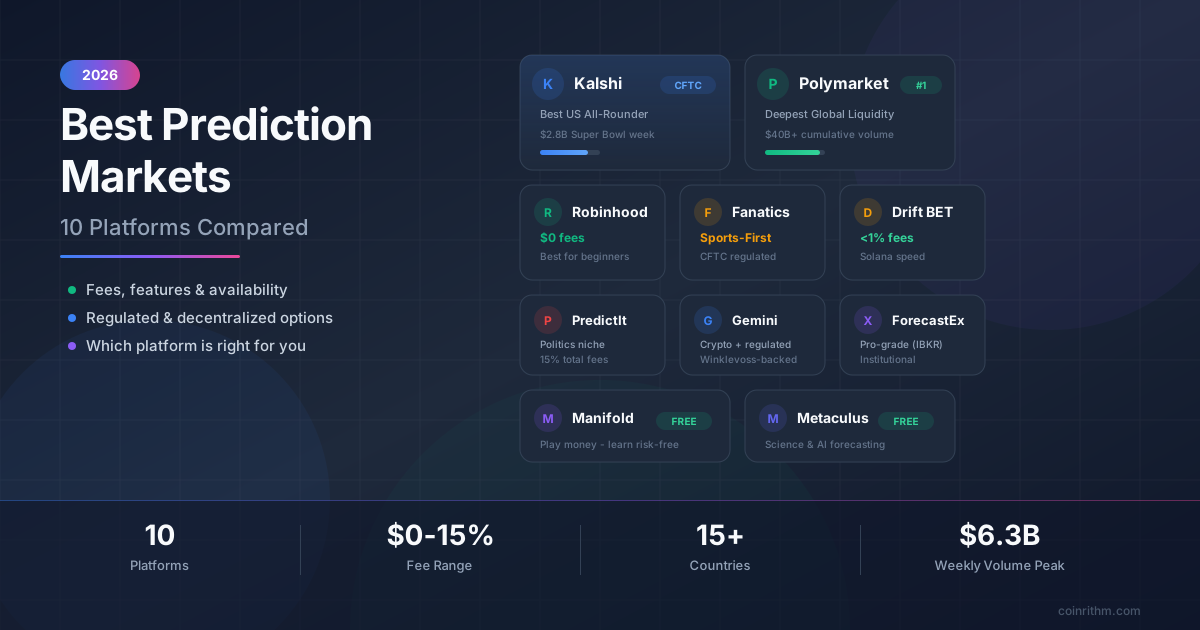
If you are comparing platforms, read Best Prediction Markets or Kalshi vs Polymarket.
Rothera is a CFTC-regulated prediction market exchange founded by Robinhood Markets and Susquehanna International Group (SIG). It is one of the newer venues CoinRithm tracks, and it is structurally very different from the crypto-native on-chain venues most people associate with prediction markets. There is no wallet to set up, no token to hold, and no blockchain in the middle. Instead, Rothera runs as a regulated derivatives exchange with an attached clearinghouse, and Robinhood distributes access to it through the same app people already use for stocks, options, and crypto.
This guide covers what Rothera is, how it works mechanically as a regulated exchange, what makes it different from Polymarket and Kalshi, who it is built for, and how to use CoinRithm to browse and research Rothera markets before committing real money.
TL;DR
- Rothera is a CFTC-regulated prediction market exchange, founded by Robinhood and Susquehanna International Group. It is not on-chain and does not use crypto.
- It runs as a Designated Contract Market (DCM) with a Derivatives Clearing Organization (DCO). Trades clear through a regulated clearinghouse, not a smart contract.
- Access is distributed mainly through Robinhood's app. No crypto wallet is required, and contracts are denominated and settled in US dollars.
- Coverage skews heavily toward sports (World Cup soccer, baseball, American football), with macroeconomic and other event categories alongside them.
- CoinRithm aggregates Rothera markets at /en/prediction-markets/rothera: odds, history, and cross-source comparison in one place.
- You can paper-trade prediction market events on CoinRithm with mock USD ($10 min) before risking real money anywhere.
What Is Rothera
Rothera is a regulated prediction market exchange, built for a mainstream, brokerage-style audience rather than a crypto-native one. It was founded by Robinhood Markets and Susquehanna International Group, and it operates as a CFTC-regulated venue. In plain terms, it is much closer in shape to Kalshi than to Polymarket. Users trade event contracts that settle in cash, and a regulated clearinghouse stands behind the trades.
The defining characteristics that separate Rothera from crypto-native platforms:
- Regulated exchange structure. Rothera operates as a Designated Contract Market (DCM) with a paired Derivatives Clearing Organization (DCO). That is the same regulated-exchange-plus-clearinghouse pattern used by traditional derivatives venues, not the smart-contract pattern used by on-chain markets.
- No crypto, no wallet. Contracts are denominated and settled in US dollars. You do not need a crypto wallet, an offshore account, or a niche standalone app. This is one of the main things Robinhood emphasizes about the venue.
- Robinhood distribution. A large share of retail access comes through Robinhood's existing app, alongside the same interface people already use for stocks, options, futures, and crypto. That distribution reach is a big part of why Rothera scaled quickly.
- Sports-heavy coverage. Rothera leans heavily into sports. On CoinRithm's tracking, the largest categories are sports overall, then soccer, baseball, and American football. Macroeconomic and other event types sit alongside the sports book.
This positions Rothera as a regulated, mainstream-distributed venue. It reaches for scale and accessibility through a familiar brokerage app and a regulated clearing structure, in exchange for the openness and permissionless access that on-chain venues like Polymarket offer.
How Rothera Works
The core mechanics follow the standard prediction market model: you buy a contract on an outcome, the contract pays $1.00 if it resolves in your favor and $0.00 if it does not, and the price of the contract reflects the market's collective probability estimate. That much is the same as every prediction market.
What matters on Rothera is the plumbing underneath, which is exchange-and-clearing rather than blockchain.
1. A Central Limit Order Book
Rothera runs a central limit order book with price/time priority. Buyers and sellers post orders, and the book matches them the same way a securities or futures exchange does. This is a very different liquidity model from the automated-market-maker or pooled-liquidity designs common on on-chain venues. It supports institutional connectivity (including standard exchange protocols for order entry and market data), which helps professional market makers provide tighter pricing.
2. Event Contracts, Fully Funded
Positions are event contracts. On the exchange side these are structured as fully-funded contracts, which means the cash to cover the position is posted up front. There is no leverage-and-margin-call dynamic of the kind you see in leveraged futures. Your maximum loss on a contract is what you paid for it, the same intuition as buying a share at some price between $0.00 and $1.00.
3. Regulated Clearing and Settlement
Trades clear through the Derivatives Clearing Organization. The clearinghouse holds funds in segregated accounts and handles settlement. Because settlement runs through a regulated clearing entity rather than a smart contract, there is no gas cost, no on-chain transaction, and no oracle in the loop. The trade-off is that you are trusting a regulated financial institution and its rulebook rather than trustless code.
4. Resolution to a Defined Outcome
When the underlying event concludes, each contract resolves to its defined outcome under the contract's official rules, and winning contracts pay out in cash through the clearinghouse. For sports, the resolving event is typically the official result of a match, series, or tournament stage. Because Rothera is a rules-based regulated venue, the contract specification is what governs resolution, not your interpretation of the question.
5. Fees
Robinhood's prediction market pricing charges a commission based on contract price and order size, and public reporting has described that commission as capped at roughly one cent per contract on the Robinhood side. Do not treat that as a permanent, universal number. Fee schedules on regulated venues can change, and the exact cost depends on how you access the market. Check current terms directly before you trade.
Prices as Probabilities
The same logic applies here as on every prediction market. A contract trading at 65 cents implies roughly a 65% market-implied probability of that outcome. If you believe the real probability is higher, buying has positive expected value before fees. If you believe it is lower, the other side of the market is the better position. Because Rothera contracts are cash contracts that pay $1.00 on a correct outcome, the price maps cleanly to an implied probability.
For the full probability and payout mechanics explainer, read How Prediction Market Probabilities Work.
Resolution Rules Are Non-Negotiable
Before trading any Rothera market, read the contract's resolution criteria. Regulated venues publish precise contract specifications, and the specification is what settles the market. For sports contracts specifically, check how the venue handles edge cases: postponed or abandoned games, overtime, disputed results, and the exact source of the official outcome. These details decide who gets paid.
For a deeper walkthrough of how outcomes are determined across venues, read How Prediction Markets Resolve.
Not reading the rules is the most common reason experienced traders lose money on an unfamiliar venue.
What Makes Rothera Different
Most of the prediction market attention over the last few years has gone to on-chain venues. Rothera is a deliberate counterexample, and its differences are worth stating plainly.
- It is a regulated exchange, not a protocol. The DCM-plus-DCO structure means a clearinghouse stands behind trades and a rulebook governs behavior. That is a fundamentally different trust model from trustless smart contracts.
- It is backed by serious financial institutions. Robinhood provides retail distribution and a familiar interface. Susquehanna International Group is one of the largest options and derivatives trading firms in the world, which matters for market-making depth and pricing quality.
- It is dollar-denominated and wallet-free. For a mainstream user, removing the crypto wallet, the token, and the bridge removes most of the friction and most of the operational risk that comes with on-chain trading.
- It is built to scale through an existing app. Rothera did not have to acquire an audience from scratch. Robinhood's user base gives it a distribution advantage that pure-play prediction market startups do not have, and that is part of why its tracked volumes climbed quickly, especially around major sporting events.
- It leans into sports. Sports contracts are the center of gravity. If your interest is match, series, and tournament outcomes rather than long-horizon political or macro questions, Rothera's book is oriented toward you.
The honest summary: Rothera is trying to make prediction markets feel like a normal, regulated product inside an app people already trust, rather than a crypto-native experience.
Who Rothera Is For
Rothera is built for a specific profile:
- You want prediction markets without touching crypto, wallets, or tokens.
- You value a regulated venue with a clearinghouse behind your trades.
- You are interested in sports outcomes, and you want depth in soccer, baseball, and American football.
- You already use a mainstream brokerage app and want event contracts in the same place.
- You are comfortable trusting a regulated financial institution and its rulebook rather than trustless on-chain code.
If you specifically want permissionless, on-chain, crypto-settled markets, Rothera is not that. Venues like Polymarket or other on-chain markets fit that preference better. If you want a regulated, dollar-based, sports-forward venue with mainstream distribution, Rothera is designed with you in mind.
Ground Truth: What We Know and What to Verify
This section is a direct honesty note. Rothera is a newer, fast-moving venue, and a few things are easy to state with confidence while others should be checked at the source.
What we are confident about:
- Rothera is a CFTC-regulated prediction market exchange founded by Robinhood and Susquehanna International Group.
- It operates as a Designated Contract Market with a paired clearing organization, using a central limit order book.
- Contracts are denominated and settled in US dollars, with no crypto wallet required. It is not an on-chain venue.
- Coverage is sports-heavy (soccer, baseball, American football) with macroeconomic and other categories alongside.
- CoinRithm aggregates its markets, tracks odds, and shows volume and liquidity from the exchange's public clearing data.
What you should verify directly with Rothera or Robinhood:
- Current fee structure. Public reporting has described a per-contract commission cap on the Robinhood side, but fee schedules change and depend on how you access the market. Confirm current terms.
- Eligibility and geographic availability. As a US-regulated venue distributed largely through a US brokerage, access rules apply and can change. Confirm your own eligibility.
- Exactly which categories are live versus forthcoming. Some event types (for example certain politics and crypto contracts) have been described as planned rather than fully live. Check what is actually tradable now.
- Account requirements, funding methods, and settlement timelines for your specific account type.
For any of the above, treat this article as directional and check rothera.io and Robinhood directly for current terms. We will not invent a fee number, an availability claim, or a launch-status detail we cannot confirm. That is how users get misled.
Rothera vs Other Prediction Markets
The platforms differ along a few key axes. This is a directional comparison. For the full current comparison, use CoinRithm's prediction market compare page, and for the underlying method read How to Compare Prediction Markets.
| Dimension | Rothera | Polymarket | Kalshi |
|---|---|---|---|
| Structure | Regulated exchange + clearinghouse (DCM/DCO) | On-chain protocol | Regulated exchange (CFTC) |
| Settlement | Cash, via clearinghouse | On-chain (Polygon, USDC) | Cash, regulated |
| Wallet required | No | Yes | No |
| Denomination | US dollars | USDC (crypto) | US dollars |
| Distribution | Robinhood app + institutional access | Crypto-native web | Own app and web |
| Focus | Sports-heavy + macro | Broad events | Broad events + sports |
| Regulatory status | CFTC-regulated (verify eligibility) | Complex US restrictions | CFTC-regulated (US) |
The practical read: if you want a regulated, dollar-based venue with mainstream distribution and deep sports coverage, Rothera fits that use case, and its closest peer is Kalshi rather than Polymarket. If you want permissionless on-chain markets across broad event categories, Polymarket is the on-chain option. If you want another regulated US venue, Kalshi is the direct comparison.
These are not mutually exclusive. Many traders track several venues and route positions based on which one has better odds or liquidity for a given market. CoinRithm's prediction markets hub and sources directory are built for exactly that kind of cross-platform research. For a fee-by-fee breakdown across venues, see Prediction Market Fees Comparison.
How to Research Rothera Markets on CoinRithm
CoinRithm aggregates Rothera markets alongside Polymarket, Kalshi, Limitless, and others. You can browse odds, view odds history, and compare across sources without holding an account on every venue.
The dedicated hub for Rothera is: coinrithm.com/en/prediction-markets/rothera.
As of this writing, CoinRithm tracks roughly 88 open Rothera markets, with substantial 24-hour volume (into the hundreds of millions of dollars) and tens of millions in liquidity. Those figures move a lot, and they spike around major sporting events, so treat any single snapshot as a point in time rather than a fixed number.
From the hub you can:
- See all aggregated open Rothera markets
- View current implied probabilities for each outcome
- Check odds history (24h, 7d, 30d charts where data is available)
- Compare Rothera odds against the same or similar markets on other platforms
- Read the resolving question and category without an account
For cross-platform discovery, finding which venue has the best odds on a given topic, use coinrithm.com/en/prediction-markets/compare. For the full directory of venues CoinRithm aggregates, use coinrithm.com/en/prediction-markets/sources.
Useful Research Steps Before Trading on Rothera
1. Check the odds on CoinRithm first
Open the Rothera hub and find the market you are interested in. Check whether a similar market exists on another venue. If Rothera shows 60% and Kalshi shows 66% on the same underlying question, that spread is worth understanding before you commit.
2. Read the contract's resolution rules
The market detail on CoinRithm surfaces the resolving question. On a regulated venue like Rothera, the official contract specification governs settlement, especially the sports edge cases (postponements, overtime, disputed results). Read them before you open a position.
3. Check liquidity depth
Thin liquidity means your entry and exit can move the price against you. On an order-book venue, that shows up as a wide bid/ask spread. CoinRithm shows volume and liquidity figures where available. Rothera's sports markets can be very deep during a marquee event and much thinner outside it, so size accordingly.
4. Track the odds history
The 24h and 7d trend on CoinRithm's market detail shows how implied probability has moved. A market that drifted from 40% to 65% over the last few days may be pricing in recent news (an injury, a lineup change, a result elsewhere) that you should understand before buying at 65%.
5. Open on Rothera when ready
CoinRithm is a research and discovery layer, not a trading interface. Once you have done the research, place your trade directly on Rothera (via Robinhood or your access point). CoinRithm is not Rothera, is not affiliated with Rothera or Robinhood, and is not a broker. CoinRithm is a research tool.
Paper Trading Prediction Markets on CoinRithm
If you want to practice prediction market thinking without risking real money on Rothera (or any other venue), CoinRithm supports paper trading for prediction market events with mock USD.
The minimum paper trade size is $10.
This lets you:
- Get used to reading odds and making probability judgments
- Track whether your reads are consistently good before scaling up
- Practice position sizing without real financial consequences
- Develop a research process before applying it to real money
Paper trading does not simulate order-book slippage, account funding friction, or the psychological weight of real money. But it is useful for building and testing a prediction market research process. If you are consistently losing mock money, that is a good signal to pause before using real money on Rothera. Always research before risking real money.
Common Mistakes When Trading Sports-Heavy Markets
Rothera's sports orientation creates some specific failure modes worth flagging.
Not reading the contract's edge-case rules
Sports outcomes are full of edge cases. Does a postponed match void the contract or roll to the rescheduled date? How is overtime handled? What is the official source of the result? On a regulated venue, the contract specification answers these questions precisely, and the answer may not match your intuition. Read it first.
Trading illiquid markets outside the big events
A soccer market during the World Cup final can be extremely deep. The same category on a quiet weekday can be thin, with a wide spread. Entering a thin market means paying that spread immediately. Check CoinRithm for whether another venue offers better liquidity on the same event.
Assuming Rothera works like an on-chain venue
Rothera is a regulated exchange with a clearinghouse and an order book. It is not Polymarket. Do not assume on-chain mechanics (wallet custody, oracle resolution, gas) apply here. The trust model, the fee model, and the settlement model are all different.
Treating volume spikes as permanent liquidity
Rothera's tracked volume surges around marquee sporting events and recedes afterward. A market that looked deep during a big game may be much thinner a week later. Do not size a position on the assumption that peak-event liquidity will still be there when you want to exit.
Ignoring fees on small, high-churn trades
Even a small per-contract commission adds up if you trade frequently in and out of positions. Factor the fee into your edge, especially on markets where your expected advantage is thin.
Frequently Asked Questions
What is Rothera in simple terms
Rothera is a regulated prediction market exchange founded by Robinhood and Susquehanna International Group. You trade event contracts on real-world outcomes, mostly sports, using US dollars. When the event resolves, winning contracts pay out in cash through a regulated clearinghouse. There is no crypto and no wallet involved.
Is Rothera legit
Rothera is a CFTC-regulated venue backed by two established financial firms: Robinhood Markets and Susquehanna International Group. That regulated structure, with a Designated Contract Market and a clearing organization, is a meaningful legitimacy signal compared with unregulated offshore venues. As with any trading product, regulation reduces certain risks but does not remove market risk. You can still lose money, and you should confirm your own eligibility and the current terms before trading.
How does Rothera work
It runs as a regulated exchange with a central limit order book, where buyers and sellers are matched on price and time. Contracts are fully funded and denominated in US dollars, and they clear and settle through a regulated clearinghouse rather than a blockchain. When an event concludes, contracts resolve to their defined outcome and winning positions are paid in cash.
Rothera vs Polymarket, which is which
They are structurally opposite. Polymarket is an on-chain protocol where you trade with a crypto wallet and settle in USDC on-chain. Rothera is a regulated, dollar-based exchange with a clearinghouse, distributed largely through Robinhood's app, with no wallet required. Rothera's closest peer is actually Kalshi, another regulated US venue, rather than Polymarket.
Do I need a crypto wallet to use Rothera
No. Rothera is not on-chain and does not use crypto. Contracts are denominated and settled in US dollars, and access is distributed through a mainstream brokerage app. If you want a prediction market experience without any crypto setup, that is one of Rothera's main selling points. If you want to practice without any account at all, CoinRithm's paper trading lets you trade prediction market events with mock USD ($10 min).
What fees does Rothera charge
Public reporting has described Robinhood's prediction market commission as capped at roughly one cent per contract, but we do not present that as a fixed, universal number here. Fee schedules on regulated venues can change, and the exact cost depends on how you access the market and your order details. Check rothera.io and Robinhood directly for current fees before trading. For a cross-venue view, see Prediction Market Fees Comparison.
What can I trade on Rothera
Coverage is sports-heavy, with soccer, baseball, and American football among the largest categories, alongside macroeconomic and other event types. Some additional categories have been described as planned rather than fully live, so verify what is actually tradable now. On CoinRithm you can browse the aggregated open Rothera markets to see current coverage at a glance.
Where can I research Rothera markets before trading
CoinRithm aggregates Rothera markets at coinrithm.com/en/prediction-markets/rothera. You can browse odds, read the resolving questions, check odds history, and compare against other platforms without holding an account on every venue.
Conclusion
Rothera is a prediction market built for a mainstream, regulated, dollar-based audience rather than a crypto-native one. A regulated exchange structure, a clearinghouse behind trades, Robinhood distribution, and deep sports coverage are its defining characteristics. It is much closer to Kalshi than to Polymarket, and it is the right fit if you want event contracts without crypto, wallets, or on-chain mechanics.
What this guide covered:
- What Rothera is and how it differs from Polymarket and Kalshi
- How its regulated exchange-and-clearing structure works, and what that means for trust and settlement
- Who the platform is designed for
- What specifics (fees, eligibility, live categories) to verify directly
- How to use CoinRithm to research Rothera markets without committing real money
- Common mistakes specific to sports-heavy, order-book markets
If you want to start with Rothera:
- Browse open markets on CoinRithm's Rothera hub to get familiar with what is available.
- Compare odds against other platforms using coinrithm.com/en/prediction-markets/compare.
- Read the contract's resolution rules for any market you are considering before entering.
- If you are new to prediction markets, use CoinRithm's paper trading feature to build a research process first.
- When you are ready, place your trade directly on Rothera with an amount you can afford to lose, and always research before risking real money.
Next Step
Browse Rothera markets: CoinRithm Rothera Hub.
Compare platforms: Prediction Market Compare or Best Prediction Markets.
Understand probabilities: How Prediction Market Probabilities Work.
Broader platform comparison: Kalshi vs Polymarket.
All prediction market sources: CoinRithm Prediction Market Sources.
Last Updated: July 8, 2026
Disclaimer: Prediction markets involve financial risk. This guide is for educational purposes only and is not financial, legal, or investment advice. Verify the legal status and your own eligibility for prediction markets in your jurisdiction before participating. Only trade money you can afford to lose.