Trying to decide between Kalshi and Polymarket without reading 20 threads, fee tables, and legal caveats?
Short answer: Kalshi is usually the better fit if you want a regulated, fiat-friendly exchange, in the US or in one of the many other countries it accepts. Polymarket is usually the better fit for crypto users outside the US and its other restricted countries who want broader market variety. US residents cannot trade on polymarket.com; Polymarket's US option is Polymarket US, a separate CFTC-regulated app.
If you are searching for kalshi vs polymarket, polymarket vs kalshi, or is Kalshi better than Polymarket, this is the direct decision page for that question.
This guide compares Kalshi and Polymarket across the factors that matter most: legality, onboarding, fees, liquidity, market coverage, and who each platform suits best. Use it if you already understand prediction markets and now need to pick the right platform.
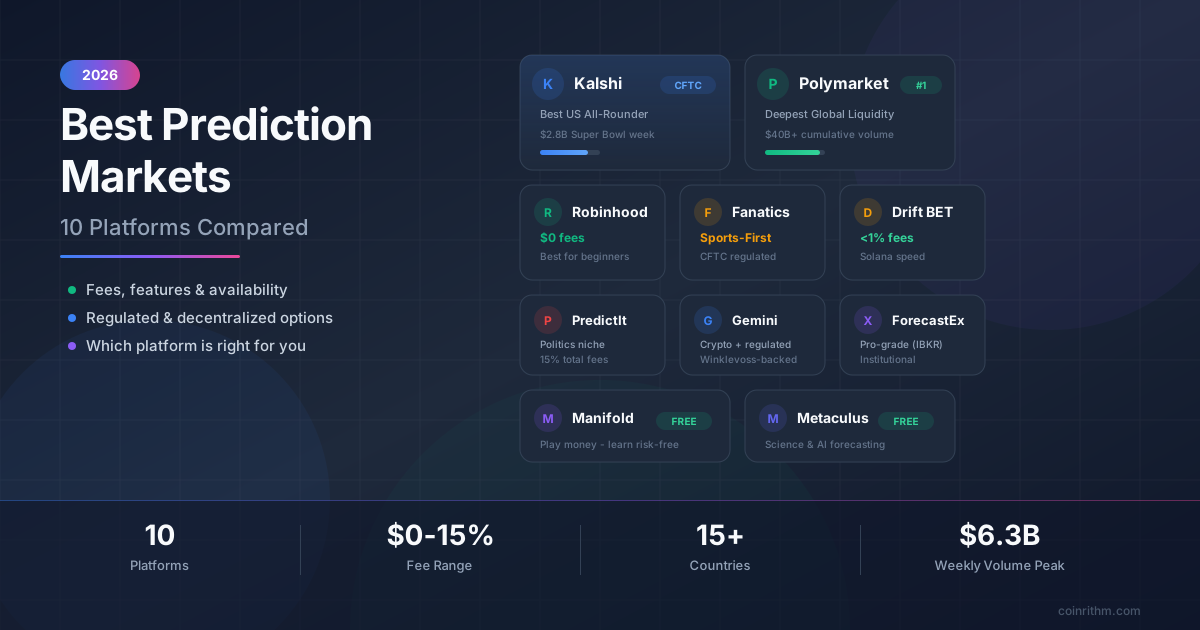
If you need the category explainer first, read What Are Prediction Markets in Crypto?. If you want the broader platform list, read Best Prediction Markets in 2026. If your main question is cost, read Prediction Market Fees Comparison. If your main question is legality, read Are Prediction Markets Legal in the US?.
TL;DR
- Choose Kalshi if you want regulated access, fiat deposits, and simpler beginner onboarding, in the US or in one of the many other countries it accepts (its Member Agreement restricts 55 jurisdictions, including the UK, Canada and Australia).
- Choose Polymarket if you want crypto-native access and more market variety, and you live outside the US and Polymarket's other restricted countries. US residents can use only Polymarket US, a separate CFTC-regulated app with its own market list.
- Kalshi is stronger on regulatory clarity and bank-funded ease.
- Polymarket is stronger on catalog size, crypto-event coverage, and on-chain transparency.
- Use CoinRithm Prediction Markets to research market availability and odds before you decide where to trade.
Kalshi vs Polymarket: Quick Answer
Use this if you want the fastest decision:
- US resident, wants the safest regulated route: Kalshi, or Polymarket US if you specifically want Polymarket (polymarket.com is closed to US residents)
- Beginner who prefers bank deposits over wallets: Kalshi
- User outside the US and Polymarket's restricted countries who is comfortable with crypto: Polymarket (balances in pUSD, backed 1:1 by USDC)
- Trader who wants the widest event selection: Polymarket
- User who cares most about on-chain transparency: Polymarket
- User who cares most about formal US regulatory structure: Kalshi
Neither platform is universally “better.” They solve different problems for different users.
Quick Comparison Table
| Factor | Kalshi | Polymarket (polymarket.com) |
|---|---|---|
| Core model | Regulated US event exchange | Crypto-native decentralized prediction market |
| Best for | US and eligible international users, fiat onboarding, regulatory clarity | Crypto-native users outside its restricted countries, broad market variety |
| Funding | USD from $10 ($1,000 by wire): bank (ACH), debit card, PayPal, Venmo, crypto or wire in the US; debit card, crypto or wire elsewhere | Crypto from supported networks, or a card via MoonPay where offered; held as pUSD on Polygon, backed 1:1 by USDC |
| Access | US plus many other countries; 55 jurisdictions restricted, including the UK, Canada and Australia | Closed to US residents (they use Polymarket US); its help center lists 39 restricted countries plus four Canadian provinces |
| Fees | Takers pay 0.07 x contracts x price x (1 - price), rounded up: at most $1.75 per 100 contracts; makers free on most markets | Takers pay a category rate (0 to 0.07) x shares x price x (1 - price): at most $1.75 per 100 shares; makers pay nothing |
| Market breadth | Strong in US macro, sports, politics | Very broad across politics, crypto, sports, geopolitics |
| Learning curve | Lower | Higher if new to wallets and stablecoins |
Kalshi wins on regulated simplicity. Polymarket wins on crypto-native flexibility and catalog size.
What Kalshi and Polymarket Actually Are
Kalshi is a CFTC-regulated event-contract exchange based in New York. It was built for US users and, since October 2025, also accepts users from many other countries. It feels more like a regulated financial product, with cleaner fiat onboarding and clearer formal protections.
Polymarket is the best-known crypto-native prediction market. Its international site, polymarket.com, runs on Polygon, holds balances in pUSD, a token backed 1:1 by USDC, and gives users access to a broader and often faster-moving market environment. US residents cannot trade there; they use Polymarket US, a separate CFTC-regulated app funded in US dollars.
In simple terms:
- Kalshi feels closer to a regulated US brokerage experience
- Polymarket feels closer to a crypto trading product built around event contracts
That difference affects almost everything else:
- who can use it
- how you fund it
- what markets you can access
- how much crypto knowledge you need
Legality and Access
This is usually the first real decision point.
Kalshi
Kalshi's biggest advantage is regulatory clarity for US users. It operates under CFTC oversight, which matters if you want the most straightforward answer to “Can I use this legally in the US?”
Strengths:
- clearer regulated framework
- better fit for US residents
- easier trust story for first-time users
- open to users in many countries outside the US since October 2025
Limitations:
- not available everywhere: its Member Agreement (September 20, 2026) restricts 55 jurisdictions, including the UK, Canada, Australia, France, Italy, Ireland and Switzerland
- some state-level restrictions can still matter depending on contract type: court orders keep some contract types geofenced in Nevada and Michigan
Polymarket
Polymarket is stronger on crypto-native reach, but its access map has hard edges. Polymarket.com is closed to US residents, and Polymarket's help center lists 39 restricted countries, including the UK, Germany, France, Italy, Australia and Brazil, plus four Canadian provinces. US residents can use Polymarket US instead, a separate CFTC-regulated app with its own accounts and market list.
Strengths:
- broad global awareness and usage
- strong fit for crypto-native users outside the strict regulated-US flow
- a CFTC-regulated US route through the separate Polymarket US app
Limitations:
- polymarket.com is closed to US residents, who must use the separate Polymarket US app
- users need to verify current availability themselves because this changes
- access follows where you are physically located, and using a VPN to get around a block breaks its terms
Decision rule:
- if legal clarity in the US is your top concern, Kalshi is usually the safer starting point (Polymarket US is the regulated way to use Polymarket there)
- if you live outside both platforms' restricted lists and crypto-native participation matters more, Polymarket is usually the better fit
- check your country on CoinRithm's availability page, or read Kalshi Countries and Availability and Polymarket Countries and Availability
Deposits, Funding, and Onboarding
This is where the beginner experience splits most clearly.
Kalshi onboarding
Kalshi is easier for users who do not want to deal with wallets.
What that usually means:
- fund with USD, from a $10 minimum deposit ($1,000 by wire)
- in the US, use a bank account (ACH), debit card, PayPal, Venmo, crypto or wire; outside the US, a debit card, crypto or wire
- skip the wallet + network learning curve
That makes Kalshi better for:
- traditional retail users
- US beginners
- users who want to start small with less setup friction
Polymarket onboarding
Polymarket is easier for crypto-native users, not true beginners.
Typical flow:
- Check that your country is not on Polymarket's restricted list (US residents use Polymarket US instead).
- Sign up with email, Google or a crypto wallet.
- Deposit crypto from a supported network (Polymarket lists 15), or buy crypto with a card through MoonPay where offered. Deposits convert automatically to pUSD, backed 1:1 by USDC.
- Trade with your pUSD balance.
That makes Polymarket better for:
- crypto users already comfortable with wallets
- users who prefer on-chain tools
- users who do not mind a slightly steeper setup curve
Decision rule:
- if you want the smoother beginner onboarding, choose Kalshi
- if you are already comfortable moving USDC on-chain and live outside Polymarket's restricted countries, choose Polymarket
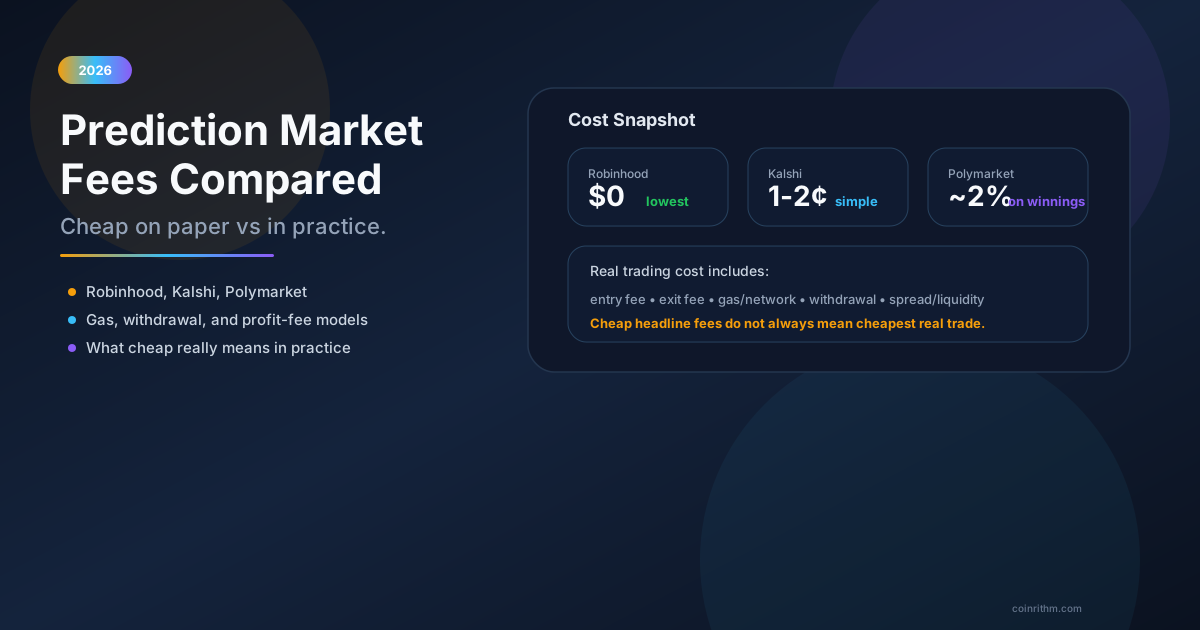
Fees and Trading Costs
In 2026 the two fee models converged: both charge takers (orders that fill immediately) a rate x contracts x price x (1 - price), so fees peak at a 50¢ price and shrink toward 1¢ or 99¢.
Kalshi
Takers pay 0.07 x contracts x price x (1 - price), rounded up: $1.75 on 100 contracts at 50¢ and $0.63 at 10¢ or 90¢ (fee schedule effective July 7, 2026). Resting maker orders are free on most markets; a listed set of series, mostly sports and major economic markets, charges makers a quarter of the taker rate. There is no settlement or membership fee, bank (ACH) deposits are free, debit card deposits cost up to 2%, and Kalshi charges no withdrawal fee by bank, card, PayPal, Venmo or crypto.
Best for:
- users who want predictable fiat-style costs
- users who dislike wallet/network considerations
Polymarket
On polymarket.com only takers pay, at a rate set by market category: 0.07 for crypto, 0.05 for sports, economics, culture, weather and other markets, 0.04 for politics, finance, tech and mentions, and 0 for geopolitics and world events. On 100 shares at 50¢ that is $1.75, $1.25, $1.00 or nothing. Makers pay nothing, Polymarket charges no deposit or withdrawal fee (on-ramps such as Coinbase or MoonPay may), and it relays transactions so you do not need POL for gas. Polymarket US has its own schedule: up to $1.74 per 100 contracts at 50¢, with a rebate for makers.
Best for:
- users who want low-friction crypto rails
- users who are already used to thinking in network fees and stablecoin transfers
The practical takeaway:
- Kalshi's 0.07 taker rate matches Polymarket's crypto rate; every other Polymarket category charges takers less (0.04 or 0.05), and geopolitics is free
- on both platforms, resting limit orders are the cheapest way to trade (free on polymarket.com and on most Kalshi markets)
If fee comparison is your main question, read Prediction Market Fees Comparison.
Liquidity and Market Variety
On market variety, Polymarket usually pulls ahead. On September 23, 2026, CoinRithm tracked 15,809 open Polymarket events and 12,991 open Kalshi events, and about half of the events on Kalshi's own market list that day were sports.
Kalshi strengths
Kalshi is strongest when you care about:
- regulated US event contracts
- high-quality access to major macro, sports, and political markets
- a more curated environment
Polymarket strengths
Polymarket is strongest when you care about:
- wider market variety
- global and crypto-native event coverage
- faster-moving narratives around crypto and politics
In practice:
- Kalshi can be the cleaner choice
- Polymarket can be the richer market-discovery environment
That matters for CoinRithm because users exploring crypto-event theses often care more about breadth and narrative tracking than beginner simplicity alone.
User Experience and Beginner Fit
Kalshi is better for:
- first-time prediction-market users in the US
- people who want the cleanest trust story
- users who prefer dollars, bank funding, and simpler onboarding
Polymarket is better for:
- users already comfortable in crypto
- people who want more market variety
- traders who value on-chain settlement and broader market coverage
The key nuance:
“Better for beginners” does not mean “better platform overall.”
It simply means the setup and trust model are easier for a new retail user to understand.
Which One Is Better for Different Use Cases
| Use Case | Better Choice | Why |
|---|---|---|
| US beginner | Kalshi | Regulated and easier to fund with fiat |
| US resident who wants Polymarket | Polymarket US | Separate CFTC-regulated app funded in US dollars; polymarket.com is closed to US residents |
| Crypto-native user outside the US and Polymarket's other restricted countries | Polymarket | Better wallet-based and crypto-native flow |
| Broadest market variety | Polymarket | More event breadth and crypto adjacency |
| Simplest compliance story | Kalshi | Stronger formal US regulatory framing |
| Crypto-event tracking | Polymarket | Better fit for Bitcoin/Ethereum and crypto narrative markets |
| Lowest learning curve | Kalshi | Easier onboarding for non-crypto users |
The honest summary:
- Kalshi is the safer first choice for many US beginners
- Polymarket is the more compelling ecosystem for many crypto-native users
How to Research Both with CoinRithm
Before funding either platform, check which markets are active and whether they match what you want to trade.
Use CoinRithm Prediction Markets to:
- compare market categories
- see what is active now
- review market context before choosing where to trade
- follow event-driven themes that overlap with coin research
- use the compare page to see platform-level differences side by side, or the live Polymarket vs Kalshi comparison for these two venues' open markets, volume and liquidity, plus related questions and their prices on each venue
- browse by topic (elections, crypto, sports) to see what is active across both platforms
If you want the platform-specific pages, open the Kalshi profile and the Polymarket profile. If you want the broader directory first, use prediction market sources. If access by country is the main issue, use the prediction market availability page.
Best workflow:
- Open CoinRithm Prediction Markets.
- Find the category you actually understand.
- Compare how the market thesis fits your interests.
- Decide whether your onboarding needs point more toward Kalshi or Polymarket.
- Only then open an external platform.
If you still need the broader category explainer, read What Are Prediction Markets in Crypto?.
If you want the platform-specific walkthrough, read What Is Polymarket?.
Frequently Asked Questions
Is Kalshi better than Polymarket?
For many US beginners, yes, and US residents cannot trade on polymarket.com at all (Polymarket's US option is the separate Polymarket US app). For many crypto-native users outside the US, no. Kalshi is better for regulated simplicity. Polymarket is better for crypto-native breadth and market variety.
Is Polymarket legal in the US?
Polymarket.com is not available to US residents: they cannot deposit or place trades there. For the US, Polymarket runs Polymarket US, a separate exchange that the CFTC designated as a contract market in July 2025. It requires identity verification, trades in US dollars and does not share accounts with polymarket.com, and its app listing says trading is currently unavailable in Nevada. Read Is Polymarket Legal in the US? for the details.
Which is easier for beginners?
Kalshi is usually easier because the onboarding is more familiar and fiat-based.
Which one has more markets?
Polymarket usually has the broader and more crypto-adjacent market environment.
Do I need crypto for Kalshi?
No. That is one of Kalshi's main advantages for beginners.
Do I need crypto for Polymarket?
On polymarket.com, yes. Your balance is held in pUSD, a token on Polygon backed 1:1 by USDC, and you fund it by sending crypto from a supported network or, where offered, by buying crypto with a card through MoonPay. You can sign up with email or Google instead of an existing wallet. Polymarket US, which is only for US residents, trades in US dollars instead.
Conclusion
Kalshi and Polymarket are both strong, but they are strong for different reasons.
Choose Kalshi if you live in the US or another country it accepts and want:
- US regulatory clarity
- simpler onboarding
- fiat funding
- a lower learning curve
Choose Polymarket if you live outside its restricted countries and want:
- crypto-native access
- deeper market breadth
- stronger overlap with crypto-event trading
In the US, the Polymarket option is Polymarket US, a separate CFTC-regulated app.
Do not pick based on hype. Pick based on:
- where you live
- how comfortable you are with crypto rails
- what kind of events you want to trade
- whether you value simplicity or flexibility more
Start by researching markets on CoinRithm Prediction Markets, then move to the platform that fits your actual use case.
Next Step
Need the cost-only view? Read Prediction Market Fees Comparison.
Need the broader platform list? Read Best Prediction Markets in 2026.
Need the US legal/access context first? Read Are Prediction Markets Legal in the US?.
Want to compare live markets before picking a side? Start on CoinRithm Prediction Markets.
Last Updated: September 23, 2026
Disclaimer: This comparison is for educational purposes only and is not financial or legal advice. Platform availability, fees, and regulatory access can change. Always verify current rules directly before trading.