If you searched for "what is Manifold," "how does Manifold Markets work," or "Manifold play-money prediction market," this is the main explainer for that intent.
If you want the broader category first, start here: What Are Prediction Markets in Crypto?.
If your question is how prediction market probabilities are priced, read How Prediction Market Probabilities Work.
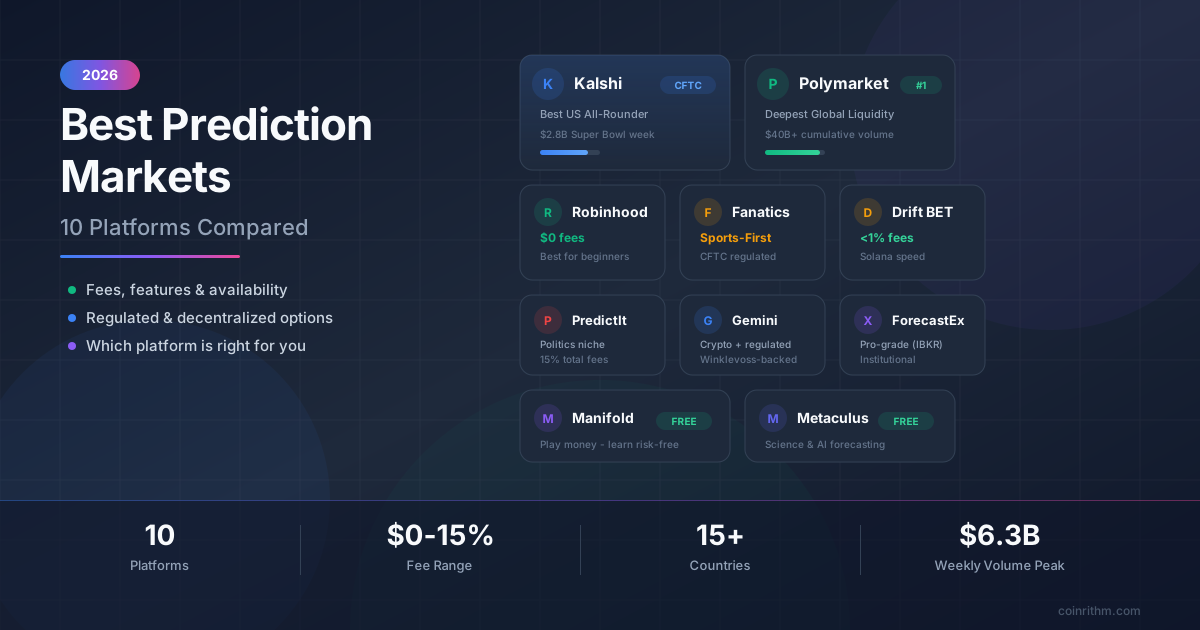
If your question is how Manifold compares to real-money platforms, skip to the comparison section or read Best Prediction Markets in 2026.
Manifold is a community prediction market platform where users trade with play money — a virtual currency called mana — rather than real dollars. Anyone can create a market, anyone can trade, and nobody risks real financial loss. The resulting odds are a snapshot of crowd wisdom: what a large, engaged forecasting community collectively thinks the probability of an event is.
CoinRithm aggregates Manifold markets alongside real-money platforms, so you can research Manifold odds, compare them against Kalshi or Polymarket on the same event, and see how community forecasts track over time — all without needing a Manifold account.
TL;DR
- Manifold uses play money (mana), not real USD. No real financial risk from trading.
- Anyone can create markets on any topic — breadth is massive, curation is light.
- Odds reflect community consensus, not money-weighted conviction.
- CoinRithm aggregates Manifold markets, shows odds history, and lets you compare against real-money platforms.
- You can paper-trade Manifold prediction events on CoinRithm with mock USD ($10 minimum) before using real money elsewhere.
What Is Manifold
Manifold (manifold.markets) is a free, play-money prediction market platform where users create markets on almost any question and trade using a virtual currency called mana.
No real money changes hands. You are not buying financial instruments. You are registering your opinion — and the opinions of everyone else trading — as a market price.
The questions span an enormous range:
- Will a specific AI model release before a certain date?
- Will a particular political figure win an upcoming election?
- Will a crypto project reach a price target?
- Will a sports team win a championship?
- Will a company ship a product feature by a given month?
Because there are no real-money stakes, the barrier to creating a market is very low. The result is a breadth of coverage that real-money platforms simply cannot match — tens of thousands of markets on topics that would never attract enough liquidity to trade on Polymarket or Kalshi.
You can browse live Manifold markets, view current odds, and see how they trend over time on the Manifold hub on CoinRithm. If you want to compare Manifold against other sources, use the prediction market sources directory or the comparison page.
How Manifold Works
Creating an Account
Manifold accounts are free. You sign up, receive a starting mana balance, and can immediately start trading or creating markets. No deposit, no wallet, no identity verification is required for standard use. Check Manifold's current terms directly — policies can evolve.
The Mana Currency
Mana is Manifold's virtual currency. It has no real-world monetary value in normal use. You cannot withdraw mana as cash.
When you sign up, Manifold gives you a starting mana balance. You earn more by:
- Trading correctly in markets
- Creating markets that attract engagement
- Community bonuses and referrals
When you run out of mana from bad trades, you can receive additional mana via daily bonuses or community mechanisms. There is no dollar value attached to your balance.
Market Creation
Any user can create a prediction market. When creating a market, you:
- Write a question
- Define resolution criteria (what counts as "Yes" or "No" or which outcome wins)
- Set a close date
- Optionally add context, external links, or liquidity
Manifold supports binary markets (Yes/No), multiple-choice markets, numeric range markets, and other formats. The creator is also the default resolver — they close the market and mark the winning outcome when the event happens. This creator-as-resolver dynamic is worth understanding: it introduces a layer of trust in the market creator that does not exist on platforms with third-party oracles.
Trading
Once a market exists, other users buy shares in outcomes using mana. Prices move as trades come in. If you buy Yes shares and the market settles Yes, you receive mana proportional to your position. If the market settles No, your Yes shares are worth zero.
The mechanics resemble real prediction markets, but the currency is fictional. The forecasting discipline, resolution reading, and probability reasoning you practice on Manifold are directly applicable to real-money platforms — just without financial consequences.
Resolution
The market creator (or designated resolver) resolves the market when the event concludes. On binary markets, they mark Yes or No. On multiple-choice markets, they select the winning option.
This is one of Manifold's structural differences from Polymarket or Kalshi. Those platforms use third-party oracles or regulated resolution processes. Manifold resolutions are community-trust-based. Most markets resolve correctly, but disputes and resolution delays do occur, particularly on niche or ambiguously defined markets.
What Manifold Odds Actually Tell You
When you see a market on Manifold priced at 73%, that means the current aggregate of all mana trades implies a 73% probability the event happens.
This is the same price-as-probability logic that applies to real-money platforms — but the calibration is different. On Polymarket or Kalshi, traders are staking real USD. A $10,000 trade moves the market meaningfully. On Manifold, a large trade moves in virtual mana, and the incentive to be right is reputation and mana accumulation rather than financial return.
That said, Manifold's forecasting community is not unsophisticated. It includes active forecasters, researchers, and people who take prediction accuracy seriously. For well-trafficked markets on mainstream topics, Manifold odds can be a reasonable signal of collective belief. For thin or niche markets, treat the odds more cautiously — low volume means a single user's mana bet can move the price.
The key takeaway: Manifold odds are a crowd signal, not a money signal. They reflect the beliefs of people who care about forecasting accuracy, but those people have no real dollar riding on the outcome. Compare Manifold odds against Polymarket or Kalshi on the same question — agreement across sources strengthens the signal, divergence is worth investigating.
You can do exactly this comparison on CoinRithm's prediction markets compare page.
Ground Truth: What Manifold Is and Isn't
Manifold is often described as a "prediction market" and that label is accurate in the mechanical sense. But a few specifics matter for anyone using Manifold as a research tool.
What Manifold is:
- A community forecasting platform with real probabilistic markets
- A free, open environment where anyone can create markets on any topic
- A useful signal source for crowd beliefs, particularly on tech, AI, and niche topics
- A place to develop forecasting intuition without financial risk
What Manifold is not:
- A real-money market. Mana has no cash value in normal use.
- A regulated financial instrument. No CFTC oversight, no UMA oracle disputes.
- A substitute for real-money markets when calibration under financial pressure matters.
- A place where odds are necessarily calibrated by sophisticated, money-motivated traders.
Manifold itself is transparent about this. The platform positions itself as a community forecasting and social prediction game, not a financial product. That framing is accurate.
For contexts where you want crowd wisdom for free and with massive breadth, Manifold is a genuinely useful source. For contexts where you want financially-motivated probabilities from participants with real stakes, Polymarket or Kalshi are the right tools.
How CoinRithm Uses Manifold Data
CoinRithm aggregates Manifold markets alongside other sources — Polymarket, Kalshi, and others — into a single research interface.
What that means practically:
- You can browse open Manifold markets on CoinRithm without a Manifold account
- You can see current odds and odds history over time
- You can compare Manifold's community odds against real-money platforms on overlapping events
- You can filter the full prediction market feed by source and see only Manifold markets when you want them
The Manifold hub on CoinRithm is the fastest way to see what is currently active and trending on the platform.
The broader prediction markets page gives the combined view across all sources — useful when a high-profile event (an election, a major crypto milestone, an AI announcement) has markets open on multiple platforms simultaneously.
Paper-Trading Manifold Events on CoinRithm
CoinRithm is not Manifold and not a broker. CoinRithm does not execute real trades or mana trades on your behalf.
What CoinRithm does offer is simulated (paper) trading: you can place practice trades on prediction market events — including events that originate from Manifold — using mock USD on CoinRithm. The minimum is $10 simulated. This lets you:
- Practice reading resolution rules before committing to a position
- Test a forecasting thesis on a real market without real or play-money consequences
- Build a track record on your CoinRithm paper account that you can review later
If you later want to trade on Manifold directly (with mana), or on a real-money platform for the same event type, the research habit you build on CoinRithm transfers directly.
Manifold vs Real-Money Platforms
The decision between Manifold and real-money platforms is not just about risk — it's about what you want from prediction markets.
| Dimension | Manifold | Polymarket / Kalshi |
|---|---|---|
| Currency | Mana (virtual, no cash value) | Real USD |
| Financial risk | None | Real — positions can go to zero |
| Market breadth | Extremely broad, user-created | Narrower, higher liquidity per market |
| Market curation | Minimal — anyone can create | Controlled — operators approve markets |
| Resolution trust | Creator/community-based | Oracle (UMA) or CFTC-regulated |
| Calibration pressure | Social, reputation-based | Financial — real money on the line |
| Access | Free, no deposit, global | Wallet or account required; varies by country |
| Best use | Learning, research, niche topics | Real financial forecasting, liquid events |
If platform comparison is what you are mainly after, read Kalshi vs Polymarket for the real-money head-to-head, and Best Prediction Markets in 2026 for the broader landscape including Manifold's place in it.
Who Uses Manifold
Manifold attracts a specific type of user: people interested in forecasting as a practice, not primarily as a financial activity.
That includes researchers and academics interested in collective intelligence, rationalist and effective altruism communities that have historically cared about calibrated probabilistic thinking, developers and AI researchers who create markets around technical milestones, and casual users who want to participate in prediction markets without financial exposure.
The demographic matters when interpreting odds. Manifold's user base skews toward people who are already familiar with probability and forecasting concepts. On tech and AI topics especially, Manifold can surface well-reasoned community consensus from an engaged audience. On political and sports markets, the user base is smaller and potentially less representative of the broader public than a mainstream real-money platform.
None of this makes Manifold less useful — it makes it differently useful. Cross-referencing Manifold's odds against a real-money platform on the same event is a legitimate research step, particularly when the two diverge.
Common Questions About Manifold
Can you make real money on Manifold?
In standard use, no. Mana has no cash value. Check Manifold's current platform terms directly — as of this writing, the standard model is play money only, but platform policies can evolve.
How many markets does Manifold have?
Manifold has tens of thousands of markets across topics. The total fluctuates as markets close and new ones are created. For current counts, visit the Manifold hub on CoinRithm or Manifold's own site directly.
Are Manifold odds reliable?
For well-trafficked markets, Manifold odds are a reasonable crowd signal. For thin markets (very few traders, low activity), treat the odds with more skepticism — a single active trader can dominate the price. Comparing Manifold odds against a real-money platform on the same question is the most useful sanity check.
How does Manifold differ from Polymarket?
Polymarket uses real USD, runs on blockchain, and has a third-party oracle for resolution. Manifold uses virtual mana, is a centralized web platform, and resolves via market creator or community. Polymarket has higher per-market liquidity on mainstream events; Manifold has far broader topic coverage. For the real-money platform comparison in depth, see Kalshi vs Polymarket.
Do I need an account to see Manifold markets on CoinRithm?
No. CoinRithm's aggregated view of Manifold markets is available without signing in. Visit coinrithm.com/en/prediction-markets/manifold directly.
Frequently Asked Questions
What is Manifold in simple terms?
Manifold is a free prediction market where you trade on real-world outcomes using virtual currency (mana) instead of real money. You create or join markets on questions like "Will X happen before Y date?" and the crowd's collective trading produces a probability estimate.
Is Manifold free to use?
Yes. Creating an account and trading costs nothing. Manifold gives you a starting mana balance and provides daily bonuses. No credit card or deposit is required.
What is mana in Manifold?
Mana is Manifold's play-money currency. It has no real-world cash value in the standard product. You use it to place trades, and you earn or lose it based on whether your predictions are correct.
Can Manifold markets be wrong?
Yes. Any prediction market — real-money or play-money — can be wrong. A 70% probability market fails roughly 30% of the time by definition. Manifold odds reflect the current crowd consensus, not a guarantee. High-traffic Manifold markets tend to be better calibrated than thin ones.
How does Manifold resolve markets?
The market creator (or a designated resolver) reviews the outcome and manually marks it. This is different from real-money platforms that use automated oracles or regulated processes. Most markets resolve correctly; ambiguous resolution criteria are the most common source of disputes.
Is Manifold a gambling site?
No real money changes hands in normal Manifold use, so the gambling classification does not apply in the typical sense. It is closer to a community forecasting game. If you are concerned about the legal classification of prediction markets more broadly, read Are Prediction Markets Legal in the US?.
Can I use CoinRithm to research Manifold markets?
Yes. CoinRithm aggregates Manifold markets and shows current odds, odds history, and cross-source comparisons. Start at coinrithm.com/en/prediction-markets/manifold.
Does CoinRithm let me trade on Manifold?
CoinRithm is not Manifold and not a broker. CoinRithm provides aggregated research and simulated (paper) trading with mock USD. To trade with mana on Manifold, visit Manifold's platform directly.
Conclusion
Manifold fills a specific and useful niche in the prediction market landscape: a free, open, high-breadth community forecasting platform where the cost of being wrong is virtual rather than financial.
Its play-money structure removes the calibration pressure that real-money markets carry, but it also removes barriers — anyone can create a market on any topic, and many do. The result is an enormous signal surface for crowd beliefs across topics that would never attract real-money liquidity.
For researchers, forecasters, and people learning prediction markets, Manifold is a legitimate tool. For users who want financially-motivated probabilities from participants with real stakes, real-money platforms are the right fit. The best approach for serious research is both: check Manifold for breadth and community signal, then cross-reference against Polymarket or Kalshi for financial calibration on the events they share.
CoinRithm makes that cross-source research step easy. You can see Manifold odds, real-money odds, and odds history in one place, without accounts on each platform.
Start with the Manifold hub: CoinRithm Prediction Markets — Manifold.
See all sources: Prediction Market Sources.
Compare platforms: Prediction Market Compare.
Understand pricing: How Prediction Market Probabilities Work.
See the full landscape: Best Prediction Markets in 2026.
Last Updated: June 14, 2026
Disclaimer: This guide is for educational purposes only. Manifold uses virtual currency with no real-money value. CoinRithm aggregates market data for research purposes and offers simulated trading only — it is not a broker and does not execute real trades. For Manifold's current platform terms, visit Manifold directly.