Metaculus is a forecasting platform, not a trading venue — and that distinction matters for how you use it and what its numbers actually mean.
If you arrived here asking what is Metaculus, how does Metaculus work, or is Metaculus a prediction market, this is the main explainer. For the broader category context, start with What Are Prediction Markets in Crypto?. If you want to understand how probabilities on any of these platforms should be read, see How Prediction Market Probabilities Work.
TL;DR
- Metaculus is a reputational forecasting platform: no real money, no trading, no payouts.
- Forecasters submit probability estimates and are scored on accuracy over time.
- The aggregated community forecast is a meaningful signal, often useful for long-range or expert questions.
- CoinRithm aggregates Metaculus questions alongside real-money markets — so you can research Metaculus odds and compare them with Polymarket and Kalshi in one place.
- You can paper-trade prediction market events on CoinRithm (mock USD, $10 min) to build intuition before risking money elsewhere.
What Is Metaculus
Metaculus is a reputational forecasting platform where a community of forecasters submit probability estimates on real-world questions — and are scored on how accurate those estimates turn out to be.
Unlike Polymarket or Kalshi, there is no money at stake on Metaculus itself. You cannot buy or sell shares. There are no payouts. The incentive is purely reputational: forecasters accumulate scores and track records based on how well-calibrated their predictions have been over time.
What Metaculus produces is an aggregated community forecast — a weighted probability estimate that draws on every forecaster who has submitted a prediction on a given question. That aggregated number is often the most important signal the platform surfaces.
A simple example:
A question on Metaculus might read: "Will a country ban Bitcoin by December 2027?" Hundreds of forecasters submit their individual probability estimates — say, anywhere from 5% to 40%. Metaculus aggregates these, weighting by track record, and publishes a community forecast. If that number comes out at 12%, it tells you something about how a broad, scored community of forecasters collectively assesses the risk.
The question resolves when the real-world outcome is known. Forecasters who were closer to the correct probability (accounting for when they submitted their estimate) earn better scores.
How Metaculus Works
Submitting a Forecast
Any registered user can submit a probability estimate on an open question. Estimates are expressed as a percentage: 0% (impossible) to 100% (certain). Most estimates land somewhere between 5% and 95%, because forecasters who understand calibration avoid extreme certainty on contested questions.
Questions have defined resolution criteria — similar in spirit to what you find on Polymarket, but without the financial stakes. The resolution criteria spell out exactly what has to happen for the question to resolve Yes, No, or to a specific value, and which sources will be used to determine the outcome.
Scoring
Metaculus uses a logarithmic scoring rule (often called a Brier-style system, though the exact formula has evolved — check Metaculus directly for current scoring details). The core idea is that forecasters earn more credit for confident correct predictions and are penalized more heavily for confident wrong ones.
This creates the right incentive: you are rewarded for being honest about your uncertainty rather than for gaming the system by always guessing the crowd consensus.
The Community Forecast
The headline number most people care about is the community forecast — the aggregated probability across all forecasters who have predicted on a question. Metaculus weights contributions by forecaster track record, so someone who has been well-calibrated historically has more influence on the aggregated number than a newcomer.
This aggregated signal is often the most useful output for external research. It represents a crowd of people with skin in the game (their reputation and track record) rather than just an anonymous poll.
Question Lifecycle
- Question opened — A question is submitted, reviewed, and published with resolution criteria and a closing date.
- Forecasting period — Community members submit and update probability estimates.
- Question closes — No more estimates are accepted (often before the event resolves, to avoid last-minute manipulation).
- Resolution — The outcome is determined using the specified data sources. Scores are updated.
- Track record accumulates — Forecasters build long-run calibration records across hundreds of questions.
Metaculus vs Real-Money Prediction Markets
This is where a lot of confusion arises. Metaculus is often grouped with Polymarket and Kalshi under the "prediction markets" label, but the mechanics are meaningfully different.
| Dimension | Metaculus | Polymarket / Kalshi |
|---|---|---|
| Money at stake | None | Yes — real USD or USDC |
| Incentive | Reputational score | Financial profit/loss |
| Mechanism | Submit probability estimates | Buy/sell outcome shares |
| Aggregation | Weighted community average | Market price (supply and demand) |
| Best use | Long-range, expert, scientific questions | Short-term, liquid, financially-motivated |
| Access restrictions | Generally open globally | Geo-restricted in various jurisdictions |
| Resolution disputes | Moderator/community process | Oracle systems (e.g. UMA on Polymarket) |
Neither system is strictly superior — they are optimized for different things. Real-money markets tend to be sharper on near-term liquid questions where financial incentives are strong. Reputational markets like Metaculus can be more useful for long-range or low-volume questions where few people would bother trading but many people care about the forecast.
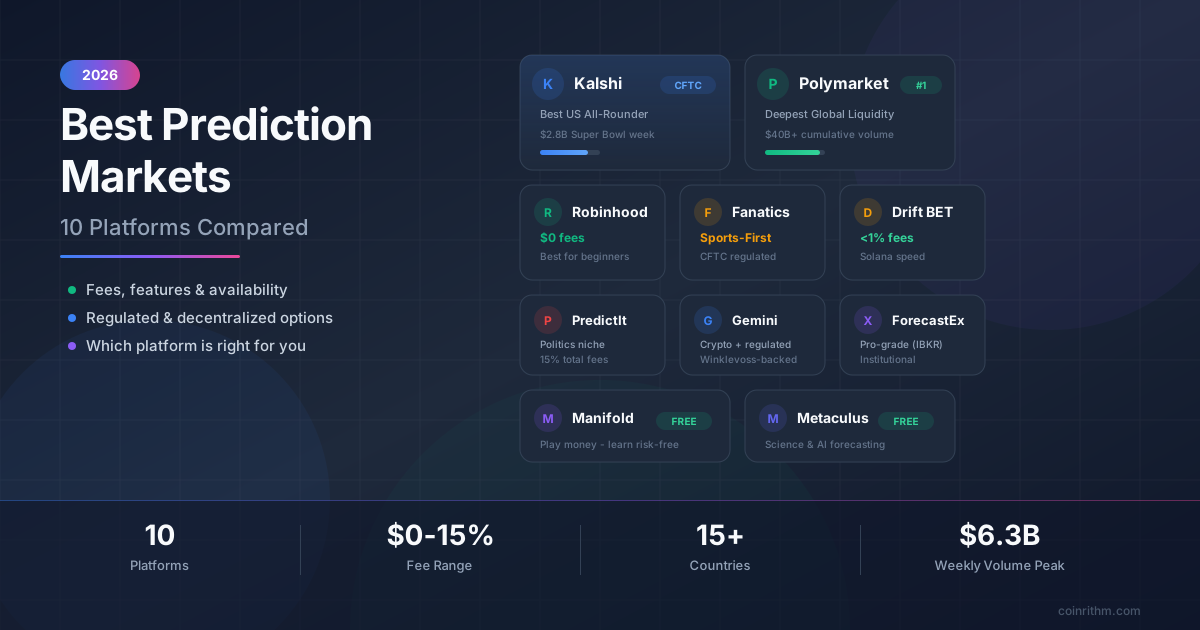
For a practical comparison of the real-money platforms against each other, see Kalshi vs Polymarket and Best Prediction Markets in 2026. For the full platform directory, see the prediction market sources page.
Why the Metaculus Forecast Is Worth Watching
The Metaculus community forecast has demonstrated meaningful accuracy across a range of domains — technology timelines, geopolitical events, scientific outcomes, and economic questions. It is not infallible, and it is only as good as the quality of questions and the forecaster pool on any given topic.
Three specific reasons it matters for prediction market researchers:
1. Long-range signal. Real-money markets often have thin liquidity on questions that resolve years out. Metaculus has an active forecasting community on exactly those questions. For something like "Will X AI capability be demonstrated by 2028?", the Metaculus community forecast may be the richest public signal available.
2. Expert participation. Because the incentive is reputational rather than financial, Metaculus attracts domain experts who would not bother trading small positions but do care about the accuracy of their public forecasts. Domain knowledge is often underrepresented in purely financial markets.
3. Calibration track record. The platform has been running since 2015 (verify current launch date at Metaculus directly). A long history of resolved questions means there is an actual track record to evaluate. You can check how well the community was calibrated on past questions in similar domains.
That said, a community forecast is still an aggregate probability estimate, not a certainty. The same principles apply as with any prediction market: a 75% forecast still fails 25% of the time.
How to Use CoinRithm for Metaculus Research
CoinRithm aggregates Metaculus questions alongside real-money markets from Polymarket, Kalshi, and other sources. You do not need a Metaculus account to browse the questions and see the community forecast numbers — they are available directly on CoinRithm.
The Metaculus source hub on CoinRithm: coinrithm.com/en/prediction-markets/metaculus
From there you can:
- Browse open Metaculus questions and see aggregated community forecast probabilities
- View odds history to see how the community estimate has shifted over time
- Compare Metaculus forecasts directly with Polymarket and Kalshi prices on overlapping questions — where both a reputational forecast and a real-money market exist on the same event, the comparison can surface divergences worth examining
For the cross-platform comparison view, use the prediction market compare page. For the full directory of all aggregated sources, see prediction market sources. The main hub is at coinrithm.com/en/prediction-markets.
Paper Trading Prediction Markets on CoinRithm
CoinRithm offers mock-USD paper trading on prediction market events — including events sourced from Metaculus and other platforms. The minimum is $10 mock USD. This is simulated only: no real money, no connection to Metaculus, no real settlement. It is useful for building intuition about how probability estimates translate into potential payouts before risking real capital on a real-money platform.
CoinRithm is not Metaculus and is not a broker. Simulated trading on CoinRithm does not reflect or affect your standing on any external platform.
What Metaculus Covers
Metaculus questions span a wide range of domains. At the time of writing, common categories include:
- Science and technology — AI capability timelines, scientific milestones, technology adoption
- Geopolitics and global events — conflict outcomes, diplomatic developments, international agreements
- Economics and finance — recession probability, interest rate paths, major economic indicators
- Health and biosecurity — pandemic-related questions, vaccine timelines, public health outcomes
- Politics — elections, policy changes, leadership transitions
- Crypto and digital assets — Bitcoin and Ethereum price and adoption questions, regulatory developments
The categories that overlap most with CoinRithm's prediction market coverage are geopolitics, crypto, finance, and politics — areas where Metaculus community forecasts can serve as a complement to real-money market data.
For questions where there is both a Metaculus forecast and a live Polymarket or Kalshi market, the compare view on CoinRithm lets you see both signals together.
Limitations and Ground Truth
Ground truth note: Metaculus is a well-regarded platform with a real track record, and the community forecast is a meaningful signal. But it has limits that are worth stating plainly.
Question quality varies. Some questions are precisely worded with clear resolution criteria. Others are more ambiguous. A forecaster pool's accuracy on a question is partially a function of how well the question was constructed.
Forecaster depth varies by domain. Metaculus has a strong community on AI timelines, geopolitics, and biosecurity. Questions in more niche areas may attract fewer forecasters, reducing the quality of the aggregated signal.
It is not a live market. Community forecasts update as people submit new estimates, but the mechanism is slower and less reactive than a real-money market with continuous trading. If news breaks, Metaculus estimates may lag behind what a liquid real-money market has already priced.
No financial skin in the game. Reputational incentives are meaningful but different from financial ones. Forecasters on Metaculus face no direct loss from a wrong prediction beyond their calibration score. This may affect how aggressively they update on new information compared with someone trading their own money.
For any specific question about Metaculus features, scoring details, or current platform rules — check metaculus.com directly. Platform details change and any specifics stated in an article can become stale.
Frequently Asked Questions
Is Metaculus a prediction market
Metaculus is often categorized alongside prediction markets, and the questions it asks are structurally similar — probability estimates on real-world outcomes with resolution criteria. But it is more accurately a forecasting platform. There is no trading, no shares, and no financial payouts. The incentive is reputational, not financial.
Does Metaculus use real money
No. Metaculus forecasters do not put up money and do not receive financial payouts. The system is entirely reputational — forecasters earn scores and build calibration track records based on accuracy, not profits.
How is Metaculus different from Polymarket
The main difference is the incentive structure. Polymarket is a real-money prediction market where you buy and sell outcome shares. Metaculus is a reputational forecasting platform where you submit probability estimates and are scored on accuracy. Both produce probability signals, but the mechanisms and use cases differ. See Kalshi vs Polymarket for a real-money platform comparison.
Is Metaculus available worldwide
Generally yes, though verify current access and any registration requirements at Metaculus directly, as platform policies can change. Metaculus is not subject to the same financial regulations as real-money prediction markets, which simplifies geographic access.
How accurate is Metaculus
The Metaculus community forecast has a documented track record across thousands of resolved questions. Calibration varies by domain and question quality. In research on forecasting accuracy, crowd-aggregated forecasts — particularly from scored communities like Metaculus — have generally outperformed simple polls and often expert consensus. That does not make any individual forecast reliable; it is a probabilistic signal, not a certainty.
Can I see Metaculus forecasts on CoinRithm
Yes. CoinRithm aggregates Metaculus questions and community forecast probabilities. Visit the Metaculus hub on CoinRithm to browse questions and odds without needing a Metaculus account.
What is the community forecast on Metaculus
The community forecast is a weighted aggregated probability from all forecasters who have submitted estimates on a question. Higher-scoring forecasters (those with better historical calibration) have more weight in the aggregation. It is Metaculus's primary output — a single probability number representing the collective estimate of the forecasting community.
How does Metaculus score forecasters
Metaculus uses a logarithmic scoring rule that rewards calibration — accurate probability estimates expressed with appropriate confidence. The exact current formula is maintained by Metaculus and may evolve; check their help documentation for the current scoring specification. The core incentive is to be honest about your uncertainty rather than to game the system.
Is Metaculus free to use
As of 2026, Metaculus is free to access for browsing questions and community forecasts. Check Metaculus directly for any current account requirements or premium tiers, as these can change.
Conclusion
Metaculus occupies a distinct role in the prediction market ecosystem. It is not a trading venue and produces no financial payouts. What it produces is an aggregated, reputation-scored community forecast — a signal that has meaningful value, particularly for long-range and expert-driven questions where real-money markets lack liquidity.
If you are researching a prediction market question that also has a Metaculus forecast, comparing both signals is straightforward on CoinRithm. A divergence between what Metaculus forecasters believe and what a real-money market is pricing can itself be worth examining.
What you now know:
- Metaculus is a reputational forecasting platform, not a financial trading venue
- Forecasters submit probability estimates and are scored on calibration over time
- The community forecast aggregates all estimates, weighted by forecaster track record
- Metaculus is most useful for long-range, expert, or scientific questions
- CoinRithm aggregates Metaculus questions alongside Polymarket and Kalshi for cross-source comparison
Next Step
Browse Metaculus questions on CoinRithm: coinrithm.com/en/prediction-markets/metaculus.
Compare platforms side by side: Prediction Market Compare.
New to prediction markets? Read What Are Prediction Markets in Crypto? first.
Want to understand the probability numbers? Read How Prediction Market Probabilities Work.
Comparing real-money platforms? Read Kalshi vs Polymarket or Best Prediction Markets in 2026.
Last Updated: June 14, 2026
Disclaimer: This guide is for educational purposes only and is not financial, legal, or investment advice. Prediction market participation involves risk. Verify platform rules, legal status in your jurisdiction, and current terms directly with each platform before participating.