Kalshi is a US prediction market exchange, regulated by the Commodity Futures Trading Commission (CFTC), where people trade Yes/No contracts on real-world events. Each contract trades between $0.01 and $0.99 and pays $1.00 if the event happens, so its price reads as the market's probability. Kalshi was founded in 2018, has been a CFTC-designated contract market since November 2020, opened to users in more than 140 countries in October 2025, and added perpetual futures in 2026.
Kalshi at a glance (updated September 23, 2026)
| Question | Answer |
|---|---|
| What is Kalshi? | A CFTC-regulated exchange (Designated Contract Market) for event contracts, run by KalshiEX LLC |
| Who founded it? | Tarek Mansour (CEO) and Luana Lopes Lara, in 2018; the company is based in New York |
| How does a trade work? | Buy Yes or No at $0.01 to $0.99; a correct contract pays $1.00, a wrong one pays $0 |
| What can you trade? | About 13,200 open events: half are sports, then elections, entertainment, politics, finance and economics |
| How much are the fees? | Taker fee = 0.07 x contracts x price x (1 - price), rounded up: at most $1.75 per 100 contracts |
| What is the minimum deposit? | $10 by bank, card, PayPal, Venmo or crypto; $1,000 by wire |
| Who can use it? | Adults 18 and over in the US and in many other countries; 55 jurisdictions, including the UK, Canada and Australia, are restricted |
This guide covers how Kalshi works, what you can trade, what it costs, how money moves in and out, where it is available, its legal status in the US and what changed in 2025 and 2026. For a click-by-click walkthrough, read How to Use Kalshi. For the state-by-state legal picture, read Is Kalshi Legal in My State?, and to weigh Kalshi against its best-known rival, read Kalshi vs Polymarket.
What Is Kalshi?
Kalshi is a regulated exchange for event contracts: contracts that pay out based on whether a specific real-world event happens. The exchange is operated by KalshiEX LLC, which the CFTC designated as a contract market in November 2020. That is the same type of federal license held by futures exchanges such as CME. Trades clear through Kalshi Klear LLC, Kalshi's own clearinghouse, which the CFTC registered as a derivatives clearing organization on August 29, 2024.
Kalshi was founded in 2018 by Tarek Mansour and Luana Lopes Lara, who met at MIT, and it went through Y Combinator in 2019. Mansour is the CEO, and the company is based in New York. In May 2026 Kalshi raised $1 billion at a $22 billion valuation and said it handles more than 90% of US prediction-market activity.
Three facts explain how the business works:
- You trade against other people, not against Kalshi. The exchange matches buyers of Yes with buyers of No and says it has no financial stake in any outcome.
- Kalshi earns money from trading fees. In Kalshi's own words, "unlike a casino, Kalshi doesn't win when our customers lose."
- Event contracts settle in US dollars and are fully paid up front. Buying Yes at $0.40 costs $0.40 plus the fee, and that is the most you can lose on that contract.
What Is Kalshi Used For?
People use Kalshi in three main ways:
- To trade a view on sports results, elections, economic data, weather, entertainment, crypto prices and more.
- To hedge a real-world risk, such as a rate decision, a storm or a policy change that would cost them money. Kalshi's help center lists hedgers alongside directional traders and market makers.
- To read probabilities. Because prices move with the crowd's expectations, many people follow Kalshi odds as a live forecast without trading at all.
If prediction markets are new to you, start with What Are Prediction Markets in Crypto?.
How Does Kalshi Work?
Every Kalshi market is a question with two sides, Yes and No. Prices run from $0.01 to $0.99, and a Yes price plus the matching No price add up to $1.00, which is why a price can be read as a probability.
- Pick a side. Buy Yes if you think the event will happen and No if you think it will not.
- Pay the price plus the fee. You can take the best available price immediately or post a limit order and wait for someone to match it.
- Hold or sell early. You can sell before the market closes at whatever other traders will pay, locking in a gain or a loss.
- Settlement. Once the outcome is confirmed by the source named in the market's rules, each winning contract pays $1.00 and each losing contract pays $0. Kalshi says most markets settle within a few hours, often about three.
Worked example. A market asks "Will the Fed cut rates at its next meeting?" and Yes trades at $0.60, meaning the market sees roughly a 60% chance of a cut.
- Buying 100 Yes contracts costs $60.00 plus a $1.68 taker fee, so $61.68 in total.
- If the Fed cuts, you receive $100.00, a profit of $38.32.
- If it does not, the contracts pay $0 and you lose $61.68.
- The opposite trade, 100 No contracts at $0.40, costs $40.00 plus the same $1.68 fee and pays $100.00 if the Fed holds.
Read the rules first. Every market lists its settlement source, close time and payout timing. The close time shown on a market is not always the moment it settles, and markets resolve on their written rules, not on how an outcome looks in the headlines. For more on this, read How Prediction Markets Resolve and How Prediction Market Probabilities Work.
Kalshi trades around the clock, apart from a weekly maintenance window on Thursdays from 3:00 to 5:00 AM ET.
What Can You Trade on Kalshi?
Kalshi groups its markets into Elections, Politics, Sports, Culture, Crypto, Commodities, Climate, Economics, Mentions, Finance, and Tech & Science. To show the real mix, CoinRithm read Kalshi's public market API on September 23, 2026: it listed 13,217 open events, and 6,602 of them (50%) were sports.
| Category (Kalshi API) | Open events, Sept 23, 2026 | Examples open that day |
|---|---|---|
| Sports | 6,602 | 2026-27 Premier League champion, 2030 FIFA World Cup winner, 2027 tennis Grand Slams |
| Elections | 3,396 | Texas governor, balance of power in Congress after the 2026 midterms, UK by-election vote shares |
| Entertainment | 723 | Big Brother Season 28 winner and weekly eliminations, the Daytime Emmy Awards, GTA VI launch details |
| Politics | 669 | The next G7 leader to leave office, a Welsh independence referendum |
| Financials | 618 | Whether OpenAI or Anthropic goes public first, S&P 500 milestones |
| Economics | 547 | Fed funds rate, CPI inflation, state gas prices |
| Climate and Weather | 195 | 2 degrees Celsius of global warming before 2050, a magnitude 8.0 California earthquake before 2035 |
| Science and Technology | 146 | Nuclear fusion, humans on Mars |
| Crypto | 106 | Bitcoin price milestones, year-end XRP and Solana prices |
| Companies, Mentions, Commodities | 186 | What executives say on earnings calls, AI model token prices |
The remaining 29 open events sat in smaller categories such as health and world affairs. The counts change daily as markets open and settle, and one event can hold many individual markets, one per outcome or price level.
Beyond Single Yes/No Contracts
- Combos. A combo bundles several outcomes (for example, three game results) into one contract with its own order book. It pays up to $1.00 only if every leg wins, and its price comes from a request-for-quote system in which other traders quote you a price.
- Perpetual futures. In 2026 Kalshi added perpetual futures, which never expire, on 20 markets: 18 crypto assets plus gold and silver. Leverage goes up to 6x on Bitcoin, funding payments change hands every 8 hours, and US users must apply for access. Retail perpetuals accounts run through Kalshi Prime, a registered futures commission merchant. The CFTC approved Kalshi's Bitcoin perpetual contract on May 29, 2026.
- Kalshi Pro. A free desktop trading terminal, released in beta on July 13, 2026, for active traders who watch many markets at once.
- Interest on balances. Eligible US accounts with at least $250 earn a variable 3.25% APY on cash and open positions.
To browse live Kalshi odds without an account, use CoinRithm's Kalshi hub. For category deep dives, see Sports Prediction Markets, Election Prediction Markets and Economics and Fed Prediction Markets.
Kalshi Fees Explained
Kalshi charges a trading fee only when an order executes, and the fee depends on the contract price. Under the official fee schedule (effective July 7, 2026, with no upcoming changes listed as of September 2026), the taker fee on most markets is:
Fee = round up (0.07 x C x P x (1 - P)), where C is the number of contracts and P is the price in dollars.
| Price per contract | Cost of 100 contracts | Taker fee on 100 contracts | Fee as a share of cost |
|---|---|---|---|
| $0.10 | $10.00 | $0.63 | 6.3% |
| $0.30 | $30.00 | $1.47 | 4.9% |
| $0.50 | $50.00 | $1.75 (the maximum) | 3.5% |
| $0.70 | $70.00 | $1.47 | 2.1% |
| $0.90 | $90.00 | $0.63 | 0.7% |
What the schedule means in practice:
- The fee in dollars peaks at a $0.50 price and shrinks toward $0.01 and $0.99, but as a share of what you pay, cheap longshots cost the most.
- Resting (maker) orders are free on most markets. A listed set of series, mostly sports and major economic markets, charges makers 0.0175 x C x P x (1 - P), a quarter of the taker rate, and on most combos makers pay half the taker fee. Cancelling a resting order is free.
- A few markets carry no trading fees at all, such as the year-end Bitcoin price range series.
- There is no settlement fee and no membership fee.
- Deposits: bank transfer (ACH) is free; debit cards cost up to 2%; the first PayPal or Venmo deposit is free, after which fees of up to 2% can apply; Cash App deposits carry a fee; Kalshi adds no fee to wires, though your bank may; crypto deposits can carry network and provider fees.
- Withdrawals: Kalshi charges nothing to withdraw by bank transfer, debit card, PayPal, Venmo or crypto (any third-party crypto processor fee is shown before you confirm).
- Perpetual futures use a separate volume-tiered schedule that starts at 0.12% (12 basis points) for takers and 0.05% for makers.
For more worked examples, read Kalshi Fees Explained, or compare venues in Prediction Market Fees Comparison.
How to Deposit and Withdraw on Kalshi
To open an account you must be at least 18 and verify your identity with a government photo ID (a driver's license or passport) and a live photo of it taken in the app. PO boxes and business addresses are not accepted. After that, money moves like this:
| Method | Deposits | Withdrawals | Who can use it |
|---|---|---|---|
| Bank transfer (ACH) | Free, $10 minimum, settles within about 5 business days (part is often credited at once) | Free, arrives within a few business days | US only |
| Debit card, Apple Pay, Google Pay | Up to 2%, $10 minimum, usually instant | Free, typically within a few hours | US and international |
| PayPal, Venmo | $10 minimum, first deposit free, then up to 2% | Free | US only, not every state |
| Cash App | $10 minimum, a fee applies | Not available | US only |
| Crypto | Network and provider fees, about 30 minutes | Free, about 30 minutes, needs an earlier crypto deposit | US and international |
| Wire | $1,000 minimum, no Kalshi fee | Only for amounts of $500,000 or more | US and international |
US bank customers can also send instant RTP (real-time payments) deposits, which Kalshi says arrive within minutes with no Kalshi fee.
Two rules explain most "why can't I withdraw?" questions:
- Deposits can be held briefly. If you withdraw by a different method than you deposited, the money can be held for up to 2 days after the deposit settles. PayPal, Venmo, crypto and wire deposits have no hold.
- Money in open positions is not withdrawable until you sell or the market settles. Winnings become withdrawable once they are settled cash.
Step-by-step guides: How to Fund Kalshi and How to Withdraw from Kalshi.
Where Is Kalshi Available?
Kalshi is available in the United States and, since October 10, 2025, to users around the world: Kalshi says people in more than 140 countries can participate, all trading in one shared pool of liquidity. The exceptions live in Section VI of the Kalshi Member Agreement: the version dated September 20, 2026 names 55 restricted jurisdictions where people may not trade event contracts, plus any place under country-wide or regional US sanctions.
| Region | Restricted jurisdictions (Member Agreement, September 20, 2026) |
|---|---|
| Europe (14) | Belarus, Belgium, Bulgaria, France, Hungary, Ireland, Italy, Monaco, Poland, Portugal, Russia, Switzerland, Ukraine, United Kingdom |
| Americas (6) | Bolivia, Canada, Cuba, Haiti, Nicaragua, Venezuela |
| Asia-Pacific (11) | Afghanistan, Australia, China, India, Laos, Myanmar, New Zealand, North Korea, Singapore, Taiwan, Thailand |
| Middle East and North Africa (8) | Algeria, Iran, Iraq, Lebanon, Libya, Syria, United Arab Emirates, Yemen |
| Sub-Saharan Africa (16) | Angola, Burkina Faso, Cameroon, Central African Republic, Côte d'Ivoire, Democratic Republic of the Congo, Ethiopia, Kenya, Mali, Mozambique, Namibia, Niger, Somalia, South Sudan, Sudan, Zimbabwe |
What that means in practice:
- People in the UK, Canada, Australia, India, Ireland, New Zealand and Singapore cannot trade Kalshi event contracts, and neither can people in France, Italy, Switzerland or Poland.
- Countries that are not on the list, such as Germany, Mexico and South Africa, are not restricted by the agreement. Kalshi can still grant, limit or refuse membership at its discretion, and it says each user is responsible for checking that trading is lawful where they live.
- National regulators can block Kalshi even where the agreement does not. In April 2026 Brazil ordered Kalshi's website blocked along with other prediction markets, and in May 2026 Spain's gambling regulator (DGOJ) opened sanctioning proceedings and ordered a precautionary block of Kalshi's website in Spain.
- The rule follows where you live and where you are. The agreement covers anyone "domiciled in, organized in, or located in" a restricted jurisdiction, so a VPN does not make trading permitted, and Kalshi can suspend or revoke access.
- International accounts can deposit by debit card, crypto or wire and withdraw by debit card or crypto. Bank transfers, PayPal, Venmo and Cash App are US-only, as are interest on balances and, for now, perpetual futures.
For the full country guide, including travel and VPN questions, read Kalshi Restricted Countries and Availability. For country-by-country context across venues, see CoinRithm's prediction market availability by country, Prediction Markets in the UK and Prediction Markets in Europe. If Kalshi is closed to you, Kalshi Alternatives covers other options.
Is Kalshi Legal in the US?
Yes, at the federal level. Kalshi has been a CFTC-regulated designated contract market since 2020, and in 2024 it began listing US election contracts after winning a lawsuit against the CFTC over congressional-control markets. What is contested in 2026 is whether states can treat some of its contracts, above all sports contracts, as unlicensed gambling:
- Federal appeals courts are split. In April 2026 the Third Circuit sided with Kalshi in New Jersey. On August 28, 2026 the Ninth Circuit ruled 3-0 for Nevada that sports event contracts are not federally regulated swaps, a split that CNBC reported sets up a likely Supreme Court fight.
- Nevada and Michigan: a Nevada court order from April 2026 requires Kalshi to geofence sports, election and entertainment contracts for people in Nevada, and the state's Gaming Control Board considers Kalshi's operations there unlawful. A Michigan court injunction from September 2026 requires Kalshi to keep sports contracts geofenced for people in Michigan, with a $500,000 daily fine for violations.
- New York: the state attorney general sued Kalshi on July 31, 2026, seeking to stop all of its event contracts nationwide and more than $36 billion in damages. On August 11 the CFTC used its emergency authority to order Kalshi to keep operating under federal rules.
- The CFTC is defending its jurisdiction. Under Chairman Michael S. Selig it has sued nine states: Arizona, Connecticut, Illinois, Kentucky, Minnesota, New Mexico, New York, Rhode Island and Wisconsin.
- Kalshi's position, stated in its FAQ, is that its contracts fall under federal law, the Commodity Exchange Act, rather than state gambling law.
Most state cases center on sports contracts, but Nevada's order also covers election and entertainment contracts and New York's suit targets every Kalshi event contract, so what you can trade can differ by state and change quickly. This is not legal advice: read Is Kalshi Legal in My State? and Are Prediction Markets Legal in the US? for the full picture.
What Changed at Kalshi in 2025 and 2026
- June 2025: Series C funding at a $2 billion valuation.
- October 10, 2025: a $300 million Series D at a $5 billion valuation, and Kalshi opens to users in more than 140 countries.
- December 2, 2025: a $1 billion Series E at an $11 billion valuation, led by Paradigm.
- April 24, 2026: Brazil bans sports, political and entertainment event contracts and orders Kalshi's website blocked, along with other prediction markets.
- May 7, 2026: a $1 billion Series F at a $22 billion valuation, led by Coatue. Kalshi reported annualized trading volume of $178 billion, up from $52 billion six months earlier.
- May 26, 2026: Spain's gambling regulator opens sanctioning proceedings against Kalshi and orders a precautionary block of its website in Spain.
- May 29, 2026: the CFTC approves Kalshi's Bitcoin perpetual futures contract. By September the lineup covers 18 crypto assets plus gold and silver.
- July 7, 2026: the current fee schedule takes effect.
- July 13, 2026: Kalshi Pro, a desktop trading terminal, launches in beta.
- July 31, 2026: New York's attorney general sues Kalshi. On August 11 the CFTC issues an emergency order keeping the exchange running.
- August 28, 2026: the Ninth Circuit rules for Nevada on sports contracts, splitting from the Third Circuit.
- September 2026: a Michigan court injunction requires Kalshi to keep sports contracts geofenced for people in Michigan.
- September 20, 2026: an updated Member Agreement lists 55 restricted jurisdictions.
- September 22, 2026: Kalshi's clearinghouse asks the CFTC to allow margin on event contracts for qualified self-clearing members that meet capital requirements. Today every event contract must be fully paid up front.
Kalshi vs Polymarket and Other Prediction Markets
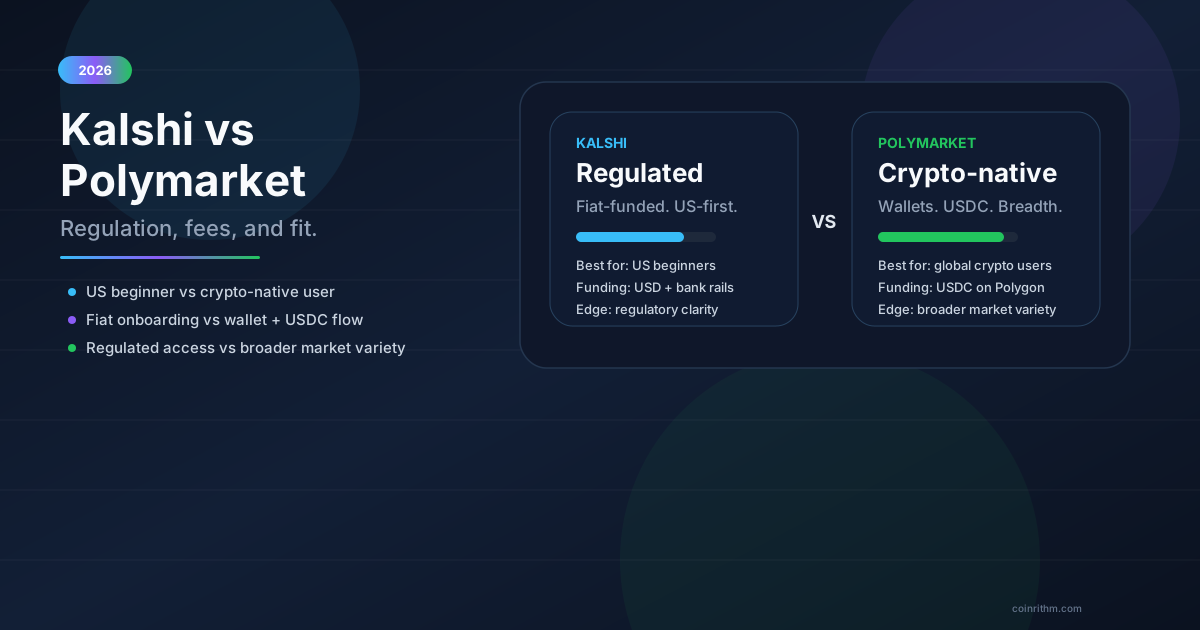
Kalshi's best-known rival is Polymarket, and in 2026 the two differ mainly in structure rather than in the kinds of events they list:
- Kalshi is a CFTC-regulated exchange that settles in US dollars, accepts bank, card, PayPal, Venmo, crypto and wire funding, and serves US residents plus users in many other countries.
- Polymarket.com is an international, crypto-based venue whose balances have been held in pUSD, a token backed 1:1 by USDC, since April 28, 2026. It is not open to US residents, who use the separate Polymarket US app instead.
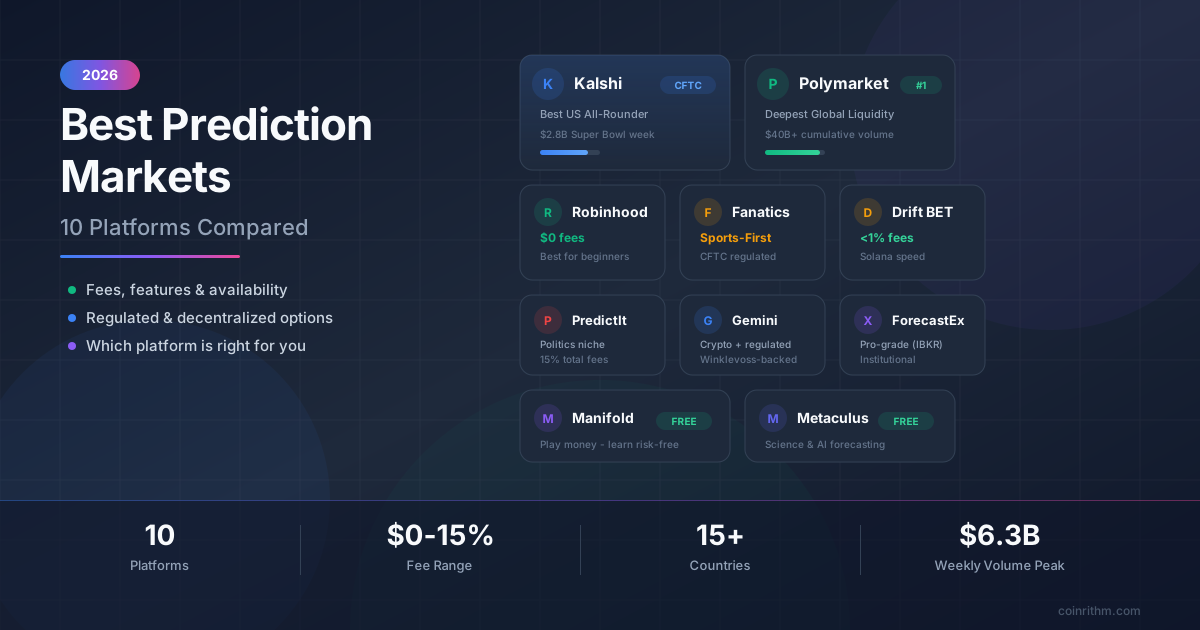
The same event often trades on several venues at different prices. CoinRithm's compare page puts them side by side, and the full trade-offs are in Kalshi vs Polymarket, Kalshi Alternatives and Best Prediction Markets in 2026.
How to Research Kalshi Markets on CoinRithm
CoinRithm is an independent research and paper-trading platform. It is not Kalshi, not a broker and not affiliated with Kalshi, and nothing you do on CoinRithm moves real money.
- Kalshi hub: live Kalshi odds and 24-hour volume, open-market counts and an archive of more than 390,000 settled Kalshi markets (as of September 23, 2026), with no Kalshi account needed.
- Compare page: the same event priced across venues.
- Calibration report: how closely each venue's prices have matched real outcomes.
- Prediction markets hub: every venue CoinRithm tracks in one place.
Practice before you commit money. You can paper trade many Kalshi-listed events with mock USD through CoinRithm's paper trading (minimum 10 mock USD per position), or let an AI agent paper trade prediction markets for you on a 50,000 mUSD account through agentic trading. Kalshi also runs its own demo site with mock funds. Paper results do not predict real results.
Risks to Understand Before Trading
Regulation makes Kalshi accountable, not risk-free.
- You can lose your whole stake. A contract that resolves against you pays $0, and a 70% favorite still fails about 3 times in 10.
- Resolution follows the written rules, which can differ from your reading of the news.
- Thin markets can be hard to exit at a fair price before settlement, and the gap between the best Yes and No prices is a cost on top of the fee.
- Perpetual futures use leverage. Kalshi notes that at 6x leverage, a move of about 17% against you can wipe out your margin.
- Access can change. Court rulings can change which contracts are available in your state or country, sometimes within weeks.
- Platform risk. Kalshi is a centralized exchange, and any exchange can face outages or disruption.
Kalshi offers responsible-trading tools, including a personal monthly deposit cap, trading breaks and voluntary self-exclusion.
Frequently Asked Questions
What is Kalshi and what is it used for?
Kalshi is a CFTC-regulated US exchange where people trade Yes/No contracts on real-world events, from sports and elections to inflation, weather and entertainment. Each contract costs $0.01 to $0.99 and pays $1.00 if the event happens. People use it to trade a view, to hedge a risk such as a rate decision, or simply to follow the market's live probability of an outcome.
Is Kalshi legal in the US?
Yes, federally. Kalshi has been a CFTC-regulated designated contract market since November 2020. Several states dispute some of its contracts: the Third Circuit sided with Kalshi in April 2026, the Ninth Circuit sided with Nevada in August 2026, and court orders keep sports contracts geofenced in Nevada and Michigan. New York also sued in July 2026. Which contracts you can trade can vary by state.
Can you use Kalshi in the UK, Canada or Australia?
No. Kalshi's Member Agreement, dated September 20, 2026, lists the United Kingdom, Canada and Australia among 55 restricted jurisdictions where people may not trade event contracts. India, Ireland, New Zealand, Singapore, France and Italy are also on the list. Kalshi accepts users from more than 140 countries, but the rule applies to where you live and where you are, so a VPN does not change it.
How much are Kalshi fees?
Kalshi's taker fee is 0.07 x contracts x price x (1 - price), rounded up, under the fee schedule effective July 7, 2026. That is at most $1.75 per 100 contracts, at a $0.50 price, and $0.63 per 100 at $0.10 or $0.90. Resting maker orders are free on most markets. There are no settlement or membership fees, bank deposits are free, and so are withdrawals by bank, card, PayPal, Venmo or crypto.
What is the minimum deposit on Kalshi?
The minimum deposit on Kalshi is $10 for bank transfer, debit card, PayPal, Venmo, Cash App and crypto, and $1,000 for a wire transfer. Bank transfers are free but take up to about five business days to settle in full, while debit card deposits are usually instant and can cost up to 2%. International users can deposit by debit card, crypto or wire.
How long does a Kalshi withdrawal take?
Debit card withdrawals usually arrive within a few hours, crypto withdrawals within about 30 minutes, and bank (ACH) withdrawals within a few business days. Kalshi charges no withdrawal fee for bank, debit card, PayPal, Venmo or crypto. Recently deposited money can be held for up to 2 days after settlement if you withdraw by a different method, and money in open positions is not withdrawable.
Is Kalshi safe?
Kalshi is a federally regulated exchange: it sends every trade to the CFTC, clears through its own CFTC-registered clearinghouse, prohibits insider trading and screens out members of Congress and senior officials. That makes it accountable, not risk-free. Contracts that resolve against you pay $0, thin markets can be hard to exit, and court rulings can change which contracts are available where you live.
Is Kalshi the same as sports betting?
Not structurally. A sportsbook takes the other side of your bet, while Kalshi matches you with another trader and earns a fee, so it does not profit when customers lose. Sports are still Kalshi's biggest category, about half of open events in September 2026, and several states argue its sports contracts are gambling. Federal appeals courts are currently split on that question.
Does Kalshi have an app?
Yes. Kalshi works on the web at kalshi.com and through official apps for iPhone and Android, all using the same account and balance. Active traders can also use Kalshi Pro, a free desktop terminal released in beta in July 2026. Kalshi runs a separate demo site with mock funds, and you can browse Kalshi markets without an account on CoinRithm's Kalshi hub.
What is the difference between Kalshi and Polymarket?
Kalshi is a CFTC-regulated exchange that settles in US dollars and serves US residents and users in many other countries. Polymarket.com is an international, crypto-based venue whose balances are held in pUSD, a token backed 1:1 by USDC, and it is not open to US residents, who use the separate Polymarket US app. Both list sports, politics, economics and culture markets.
Conclusion
Kalshi is a CFTC-regulated exchange where Yes/No contracts on real events trade between $0.01 and $0.99 and pay $1.00 when right. By September 2026 it had grown from economic and political contracts into sports, entertainment, crypto and perpetual futures, opened to users in more than 140 countries, reached a $22 billion valuation, and become the center of a court fight over whether states can regulate its sports contracts.
Your next steps:
- Browse live odds on CoinRithm's Kalshi hub.
- Check costs and funding in Kalshi Fees Explained and How to Fund Kalshi.
- Confirm your eligibility with the country list above and Is Kalshi Legal in My State?.
- See how Kalshi compares with other venues in the prediction market sources directory.
- Practice with mock USD in paper trading before you commit real money anywhere.
Last Updated: September 23, 2026
Disclaimer: Prediction markets involve financial risk. This guide is for educational purposes only and is not financial, legal, or investment advice. Kalshi's terms, fees, country list and state availability change, so confirm them directly with Kalshi before participating. CoinRithm is a research and paper-trading platform, is not affiliated with Kalshi and offers no real-money trading. Only trade money you can afford to lose.