Prediction market prices look simple at first, but beginners often misunderstand what they are actually saying.
If you are trying to understand prediction market probabilities, prediction market odds, or how prediction market prices work, this page is the direct explainer.
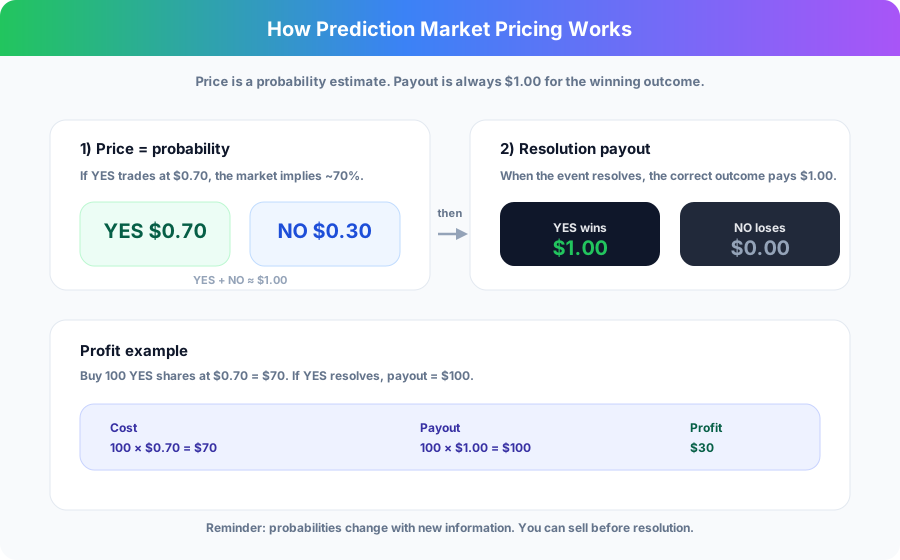
Short answer: a prediction market price is best treated as an implied probability estimate, not a guarantee. If a Yes contract trades at $0.70, the market is roughly pricing that outcome as having a 70% chance. That does not mean it will happen. It means the crowd is currently willing to trade as if that were the probability.
This guide explains how prediction-market probabilities work, how prices translate into payout math, why markets can still be wrong, and how to use probability signals without over-trusting them.
If you need the full category explainer first, read What Are Prediction Markets in Crypto?. If you want a platform-specific example, read What Is Polymarket?.
TL;DR
- In simple yes/no markets, price usually maps closely to implied probability.
- A
Yescontract at$0.70means the market is pricing about a70%chance. - Winning contracts resolve at
$1.00; losing contracts resolve at$0.00. - A high-probability market can still lose.
- Probability is a signal, not certainty.
What a Prediction Market Price Means
In most beginner-friendly prediction markets, prices range from $0.00 to $1.00.
That range is useful because it maps easily to percentage probability:
$0.10= about10%$0.25= about25%$0.50= about50%$0.70= about70%$0.90= about90%
This is why people say prediction markets are “markets for probabilities.”
But the precise way to think about it is:
- the price reflects the current market-implied probability
- that probability changes as traders update their beliefs
- the market can still be wrong
Price is best treated as a live estimate, not an oracle.
How Yes/No Markets Work
The simplest format is a binary market:
Yes= the event happensNo= the event does not happen
Example:
Question: Will Bitcoin hit $120,000 by June 30?
If the market shows:
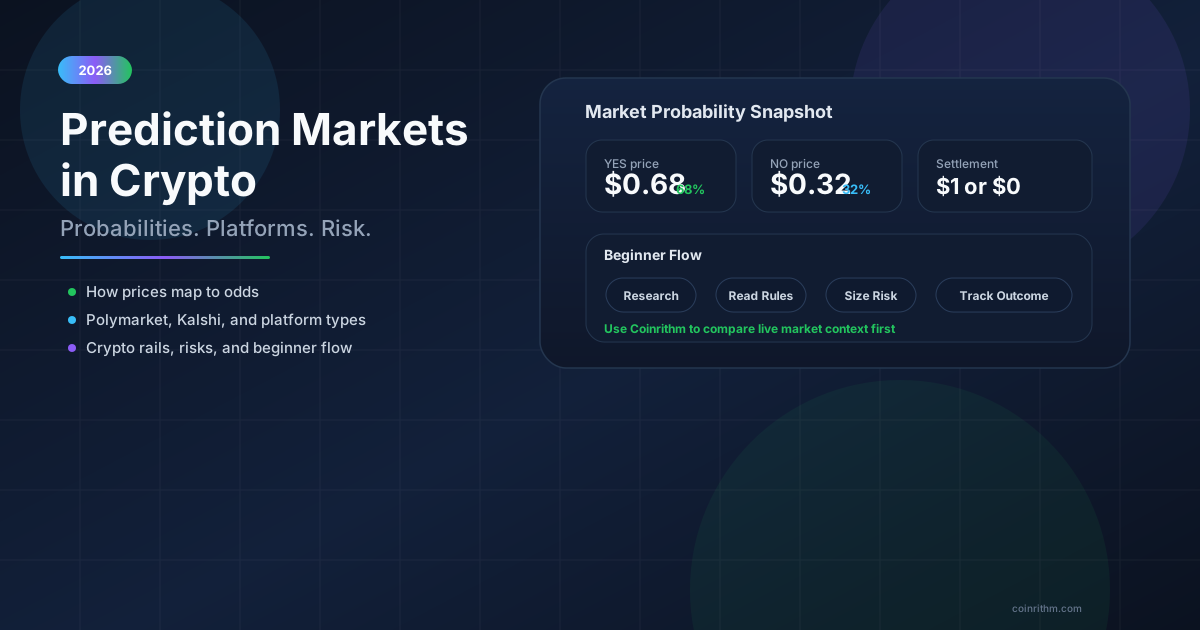
Yes = $0.68No = $0.32
then the crowd is roughly saying:
68%chance the event happens32%chance it does not
The two sides usually add up to around $1.00, though spreads and market conditions can make that slightly imperfect in practice.
When the market resolves:
- if the event happens,
Yespays$1.00andNopays$0.00 - if the event does not happen,
Nopays$1.00andYespays$0.00
How Profit and Loss Work
This is the part beginners should understand before they trade anything.
If you buy 100 Yes shares at $0.70:
- you spend
$70 - if the market resolves Yes, you receive
$100 - your gross profit is
$30
If the market resolves No:
- your Yes shares settle at
$0 - you lose the full
$70
This means your upside and downside depend on entry price, not just whether you were directionally right.
Example:
- Buying at
$0.20gives larger upside if you win, but lower implied probability. - Buying at
$0.90gives smaller upside, but the market thinks the event is more likely.
That tradeoff is the whole point. You are not just asking “Will this happen?” You are asking:
“Is the current price wrong enough to justify a trade?”
Why Prices Are Not Guarantees
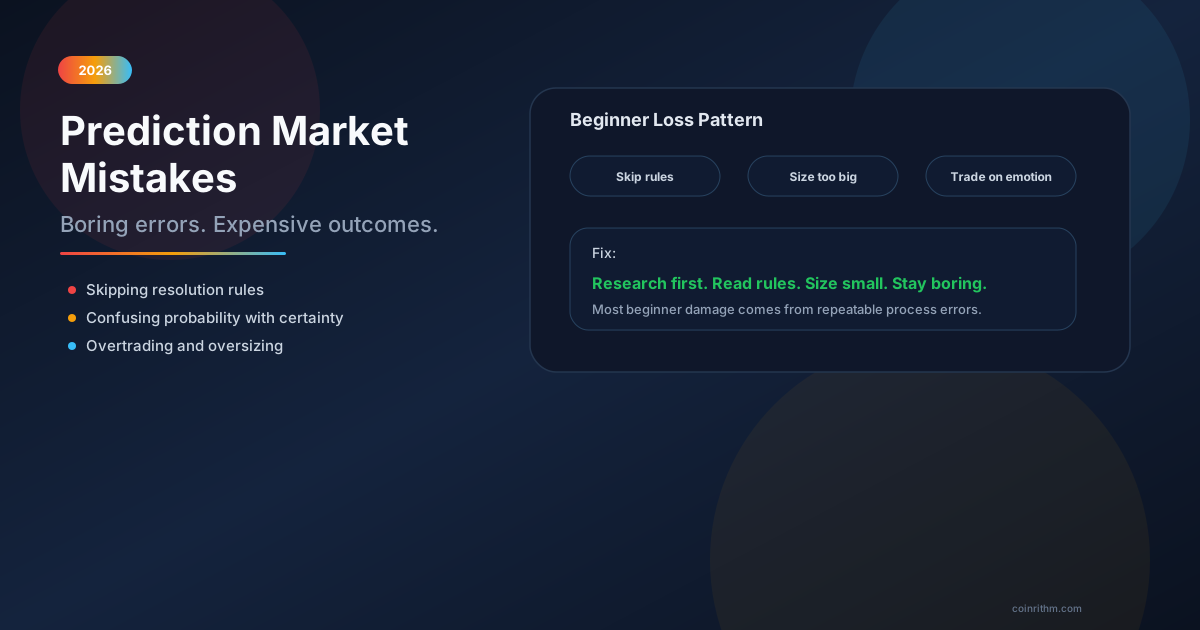
This is the biggest beginner mistake.
People see:
80%90%95%
and start thinking in certainty instead of probability.
But:
80%still fails 1 time in 590%still fails 1 time in 1095%still fails 1 time in 20
That is why markets can feel “obviously wrong” only after the fact.
Prediction markets can misprice outcomes because of:
- thin liquidity
- emotional trading
- breaking news
- poor understanding of the resolution rules
- concentrated buyers or sellers moving the market temporarily
The correct mindset is:
- price is information
- price is not certainty
- probability should guide position sizing, not replace it
How Multi-Outcome Markets Work
Not every prediction market is just Yes/No.
Some markets have multiple possible outcomes.
Example:
Question: Who will win the election?
Possible prices might look like:
- Candidate A:
45% - Candidate B:
31% - Candidate C:
14% - Other:
10%
Each contract still reflects an implied probability, but now the market is splitting that probability across multiple outcomes.
This matters because:
- one favorite can still be far from certain
- mid-range outcomes may be mispriced
- resolution rules matter even more in complex markets
For beginners, binary markets are usually easier to understand and manage.
How to Use Probability Without Misreading It
The practical use of probability is not “copy the market.”
It is:
- understand what the market is pricing in
- compare that with your own reasoning
- identify where the market may be too high or too low
- size your trade so being wrong does not destroy you
Useful beginner questions:
- Why is the market pricing this at
68%instead of55%? - What evidence is the crowd reacting to?
- What would need to happen for the price to move sharply?
- Is this a liquid market or just a noisy one?
- Am I reacting to the event itself, or to a price that already moved?
The best traders do not confuse:
- probability with
- certainty
They also do not confuse:
- interesting event with
- good trade
How to Research Probability Changes with CoinRithm
Use CoinRithm Prediction Markets to watch how market probabilities shift before you commit capital. If you want to compare how those signals show up across platforms, open Prediction Market Sources and the compare page next.
That helps you:
- see what the market is pricing in now
- compare outcome probabilities
- review volume and liquidity context
- avoid jumping into a market without understanding how fast it is moving
Best workflow:
- Open CoinRithm Prediction Markets.
- Find a market you actually understand.
- Check the current probability and whether it changed recently.
- Read the market wording and resolution rules.
- Only then decide whether the price looks fair, too high, or too low.
If you want the broader category hub, read What Are Prediction Markets in Crypto?.
If you want the platform walkthrough, read What Is Polymarket?.
Frequently Asked Questions
Does a 70% market mean the event will probably happen?
It means the market is currently pricing about a 70% chance. That is different from certainty. It still fails regularly over a large enough sample.
Why do Yes and No prices add up to about $1?
Because they represent opposite sides of the same event. In clean binary markets, the two sides usually balance around total probability.
Can the market be wrong?
Yes. Markets can be early, late, emotional, illiquid, or just wrong.
Is a 90% market a good bet?
Not automatically. A high probability can still be a bad trade if the remaining upside is too small for the risk you are taking.
What is the most important beginner mistake here?
Treating price as certainty instead of probability.
Conclusion
Prediction market probabilities are useful because they turn uncertainty into something tradable and comparable.
But the real lesson is not just:
$0.70 = 70%
The real lesson is:
- price reflects what the market currently believes
- that belief can change
- that belief can be wrong
The better you understand that distinction, the less likely you are to over-size trades, chase obvious-looking setups, or confuse market confidence with guaranteed outcomes.
Start by watching probability changes before you trade them.
Use CoinRithm Prediction Markets to research live markets, then move into the broader hub at What Are Prediction Markets in Crypto? or the platform-specific explainer at What Is Polymarket?.
If you want to practice reading and acting on probability signals before risking real money, CoinRithm's paper trading simulator lets you place mock stakes on prediction markets with no financial risk — a practical way to build intuition for what probability levels actually feel like in motion.
Last Updated: June 11, 2026
Disclaimer: This article is for educational purposes only and is not financial advice. Prediction markets involve real financial risk, and probability estimates can still be wrong.