What is the current price of Orbs?
The current price of Orbs is $0.006744 with a 0.66% change in the last 24 hours.
Supply and ATH/ATL data provided by CoinGecko

Hyperliquid perpetuals only. One snapshot every 5 minutes, up to 20 returned price levels per side. Liquidity beyond those levels is unknown. This is not a liquidation heatmap or a fill estimate.
Loading recorded snapshots…
Prices and notionals are USD-equivalent venue units, with USDC collateral. No currency conversion is applied. Notional = venue price × base-asset size. Contract specifications
Derivatives and mapped ecosystem data, with source timings and coverage.
Orbs is a decentralized execution layer that adds capabilities to smart contracts on other blockchains rather than hosting liquidity of its own. The project describes itself as a Layer 3 (L3) protocol: it runs above Layer 1 and Layer 2 networks such as Ethereum, Polygon, BNB Chain, Base, Avalanche and The Open Network (TON), acting as a decentralized backend for logic a normal on-chain contract cannot perform.
In practice, Orbs is best known for on-chain trading infrastructure. A decentralized exchange can integrate Orbs protocols to offer order types and pricing behavior that traders normally associate with centralized venues, without asking users to move funds to a different chain.
ORBS is the network's token. It is staked by validators, called Guardians, and by the community members who delegate to them, and it carries voting power in the Orbs DAO.
Official sources:
Orbs was founded in 2017 by Tal Kol, Daniel Peled, Netta Korin and Uriel Peled, working out of Israel. The original Orbs Position Paper was published in April 2018 and described a public blockchain aimed at consumer-scale applications. A Technology Overview paper followed in May 2019, alongside the Helix consensus paper written with academics from the Technion.
The Orbs mainnet went live on March 28, 2019, and independent validators have been producing on it since. Over time the project narrowed its focus: instead of competing as a general purpose Layer 1, it repositioned as an execution layer sitting above existing chains, and from roughly 2022 onward most shipped work has been trading infrastructure for decentralized exchanges.
Three design choices explain most of the system.
Proof-of-Stake elections that settle on Ethereum The Orbs PoS algorithm is implemented as EVM smart contracts on Ethereum mainnet and Polygon. Guardians stake ORBS into those contracts and can receive delegated stake from other holders. Because the election itself is computed by public Ethereum contracts rather than by the Orbs network, anyone can audit the validator set from outside the network.
A decentralized backend for logic contracts cannot run Smart contracts cannot read off-chain data, schedule future actions, query historical state or be written in general purpose languages. Orbs Guardians run two services that fill those gaps: Orbs Lambda, an event-driven serverless environment conceptually similar to AWS Lambda, and Orbs VM, a container-based virtual machine service. Many DeFi teams solve these gaps with a private server; Orbs replaces that server with a staked validator set.
No liquidity migration Because Orbs operates above the base chain, an integrating exchange keeps its pools and settlement where they already are. Orbs supplies the off-chain computation and the transactions that trigger settlement.
ORBS is used for:
The canonical ORBS contract on Ethereum is 0xff56Cc6b1E6dEd347aA0B7676C85AB0B3D08B0FA, and a direct read of that contract returns a fixed total of 10,000,000,000 ORBS. Bridged representations exist on other networks, so always confirm you are using the correct chain and the official contract before transferring.
Compared with an oracle network such as Chainlink, Orbs occupies a similar architectural layer but specializes in trade execution rather than data delivery and generic automation.
Compared with a Layer 2 rollup, Orbs does not ask an application to redeploy or bridge. A rollup competes for liquidity; Orbs is designed to leave liquidity untouched and add behavior on top of it.
Compared with the private keeper bots that many DeFi protocols still run for limit orders and liquidations, Orbs replaces a single operator with a staked, permissionless validator set.
Guardians must stake ORBS, and elections are computed by EVM contracts on Ethereum and Polygon, which makes the committee externally verifiable. The DAO holds the Certification Manager role and can certify or revoke Guardians. Protocol specifications, token contracts and staking contracts are published openly on GitHub.
It is worth being precise about the trust model. Orbs is not a settlement layer. User funds remain on the underlying chain, and the guarantee Orbs provides is that a decentralized committee, rather than one company, performs the execution work.
Orbs is a long-running attempt to answer a practical question: how do you give decentralized applications the capabilities of a real backend without recentralizing them or fragmenting liquidity across yet another chain. Its trading protocols are among the more widely integrated examples of that idea working in production.
ORBS trades on centralized exchanges and on decentralized exchanges across the networks where it is deployed. Availability, pairs and regional access vary by venue.
ORBS is commonly available on:
Common pairs include ORBS/USDT and ORBS/USD where supported.
After buying, ORBS can be held:
Confirm the network and the official contract address before every deposit or withdrawal, since the same ticker can exist on multiple chains.
Compare ORBS with related infrastructure and trading ecosystems on Coinrithm:
Track Orbs live price, chart, market cap, and volume in real time. Practice mock trading and demo trading for Orbs on CoinRithm before using real money.
Use a crypto paper trading account to demo trade Orbs with real-time prices, AI trade feedback, and trading leagues. Test strategies, learn risk management, and build confidence before trading Orbs with real money.
Read the complete paper trading guideThe current price of Orbs is $0.006744 with a 0.66% change in the last 24 hours.
The daily trading volume is $146,514 representing a 48.11% change in the past 24 hours.
The market capitalization of Orbs is $33,718,325, ranking #396 globally.
The fully diluted valuation (FDV) of Orbs is $67,436,663, calculated assuming the maximum supply of 10,000,000,000 ORBS is in circulation.
Circulating: 4,999,999,023. Total: 10,000,000,000. Max: 10,000,000,000.
In the last 24 hours, Orbs traded between a low of $0.00669 and a high of $0.006852.








 ORBS/USDTTether USDT0.006744 USDT

Orbs launches OIP-9, its first governance vote to establish the Orbs DAO and advance protocol decentralization. Orbs has announced the launch of OIP-9 (Orbs Improvement Proposal 9), the project’s first formal community governance vote to establish the Orbs DAO and…

Ring Protocol integrates Orbs-powered dLIMIT and dTWAP orders across Base, Ethereum, Arbitrum, and BNB Chain. Ring Protocol, a multi-chain decentralized exchange has integrated Orbs-powered dLIMIT and dTWAP. The update brings decentralized limit and time-weighted average price orders to users across…
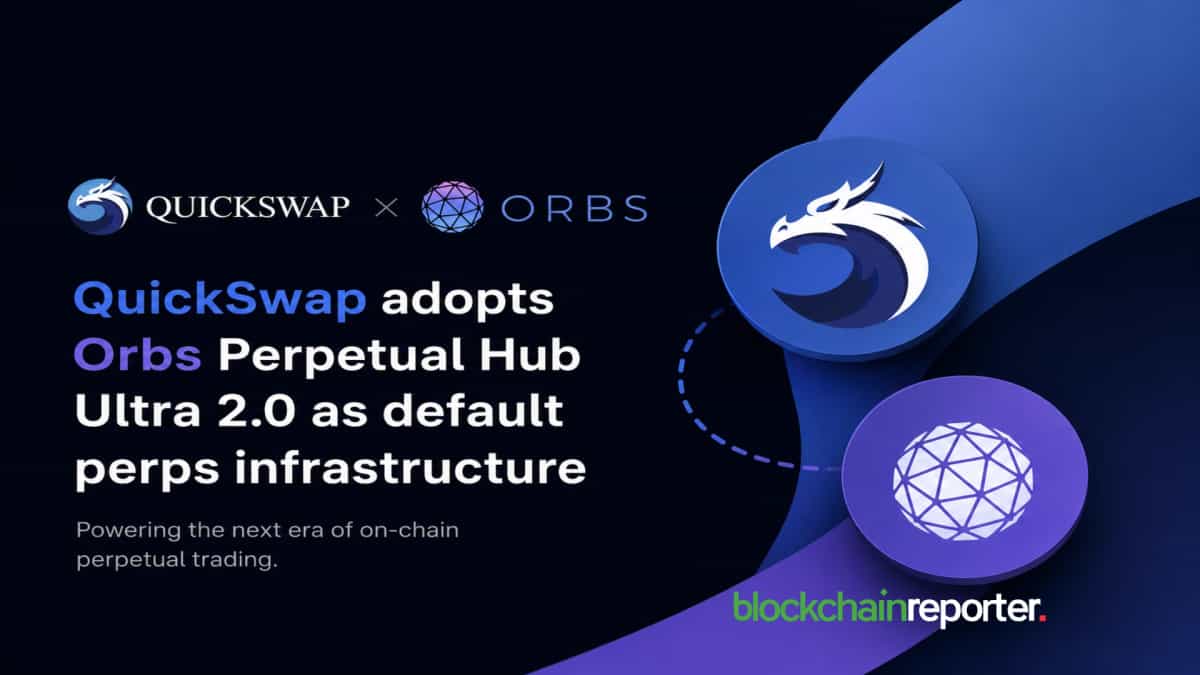
QuickSwap has adopted Orbs' Perpetual Hub Ultra 2.0 as its default perpetual futures infrastructure across all chains.

Eightco Holdings disclosed a $397M treasury mix of OpenAI equity, Beast Industries, over 16,000 ETH, and 283 million WLD tokens, signaling a rare corporate.

Two projects have verified roughly 18 million humans each, by completely different methods, for the same prize: becoming the identity layer of an internet overrun by AI. Worldcoin scans irises with orbs and has Vercel, Zoom, and Tinder integrating its…

Eightco Holdings (NASDAQ: ORBS) reveals a $406M treasury featuring 16,278 ETH, 283M WLD tokens, and a $90M indirect OpenAI stake, underscoring public.