↑ 16: 71%24h Vol: $423.42mo

Hyperliquid perpetuals only. One snapshot every 5 minutes, up to 20 returned price levels per side. Liquidity beyond those levels is unknown. This is not a liquidation heatmap or a fill estimate.
Loading recorded snapshots…
Prices and notionals are USD-equivalent venue units, with USDC collateral. No currency conversion is applied. Notional = venue price × base-asset size. Contract specifications
Active prediction markets related to Chainlink
Derivatives and mapped ecosystem data, with source timings and coverage.
Chainlink is a decentralized oracle network: it delivers off-chain data, computation and cross-chain messages to smart contracts that cannot reach outside their own blockchain. It addresses the "oracle problem", because a lending protocol, stablecoin or derivatives contract is only as reliable as the price or event data it acts on. LINK is the network's token, used to pay node operators for services and to back the network's staking-based security.
Much of decentralized finance (DeFi) relies on Chainlink Data Feeds for collateral and liquidation prices, and the project has since grown into cross-chain interoperability (CCIP) and an orchestration layer for banks and asset managers (the Chainlink Runtime Environment). Official resources: chain.link, developer docs and the Chainlink 2.0 whitepaper.
Chainlink was co-founded in 2017 by Sergey Nazarov and Steve Ellis, who wrote the original whitepaper with Cornell Tech professor Ari Juels. The work grew out of an earlier company called SmartContract, and the core codebase is still published under the smartcontractkit GitHub organization. The LINK token was sold in a September 2017 token sale, which raised $32 million according to the project's public profile.
Key milestones since then:
April 15, 2021: Chainlink 2.0 whitepaper Written by Chainlink Labs researchers and academic advisors, it reframed the network around Decentralized Oracle Networks (DONs) and "hybrid smart contracts" that combine on-chain code with off-chain computation.
December 2022: Staking v0.1 A 25 million LINK staking pool backing the ETH/USD Data Feed on Ethereum.
July 2023: CCIP mainnet early access The Cross-Chain Interoperability Protocol went live on Avalanche, Ethereum, Optimism and Polygon.
November 28, 2023: Staking v0.2 The pool grew to 45 million LINK, with a 28-day unbonding period and slashing for node operators.
April 24, 2024: CCIP general availability Launched on Arbitrum, Avalanche, Base, BNB Chain, Ethereum, Kroma, Optimism, Polygon and WEMIX, alongside the Transporter bridging app.
August 7, 2025: Chainlink Reserve An on-chain reserve of LINK funded by converting service revenue into LINK.
November 4, 2025: Chainlink Runtime Environment (CRE) Released as a live, generally available orchestration layer for institutional workflows.
A Chainlink service is run by a Decentralized Oracle Network, a committee of independent node operators. For a price feed, the nodes aggregate many data sources, agree on a single value off-chain (Off-Chain Reporting), and publish one aggregated report to an on-chain aggregator contract. A feed updates when the value moves past a set deviation threshold or when its heartbeat interval passes, so consuming contracts read a recent value through a proxy contract without querying the nodes themselves. Data Streams works the other way round: an application pulls a sub-second signed report and verifies it on-chain only when it needs one.
The same node infrastructure runs other services. CCIP carries messages and token transfers between chains, with rate limits on token flows enforced on both the source and destination chain and security-critical upgrades passing through a timelock. Automation nodes watch for on-chain conditions and trigger contract functions, and Functions lets a contract call a web API through a DON.
LINK is an ERC-677 token (an extension of ERC-20 that lets a transfer carry a data payload) issued on Ethereum at contract 0x5149...986ca. Its total supply is fixed at 1,000,000,000 LINK, as the contract reports on-chain; there is no mining or inflation schedule. LINK is bridged to many other chains, and Chainlink's docs name CCIP as the supported route.
LINK has three jobs:
Chainlink started as a general-purpose oracle network and has since pushed deeper into institutional finance than most oracle projects. Its CRE launch post lists work with J.P. Morgan's Kinexys, Swift, Euroclear, UBS, Mastercard and the Hong Kong Monetary Authority, among others. Where rival oracles cover only data, one Chainlink integration can supply data feeds, cross-chain transfers, reserve checks and workflow automation.
Security comes from redundancy and economic incentives. Each feed is served by multiple independent node operators, and each operator uses multiple data sources, so no single node or source sets the answer. In Staking v0.2, node operators serving the ETH/USD feed on Ethereum are slashed 700 LINK each when a valid alert shows the feed failed to update, and the alerter receives 7,000 LINK. Community stakers are not slashed. Chainlink says it can later add alerting modules to extend staking to other services, CCIP among them; as of v0.2 only the ETH/USD feed is covered.
Smart contracts that handle loans, stablecoins or tokenized securities need correct external data and safe ways to move value between chains. Chainlink has become a default supplier of both, so its reliability affects a large share of on-chain finance. It works as middleware, not as a blockchain that competes with Ethereum.
LINK is widely traded on centralized exchanges and on decentralized exchanges across Ethereum and the chains where it is bridged. Available pairs and payment methods depend on your country.
LINK spot markets are live on, among others:
Before withdrawing, check which network the exchange sends on, because LINK on another chain uses a different contract address. Transactions can be checked on Etherscan.
Track Chainlink live price, chart, market cap, and volume in real time. Practice mock trading and demo trading for Chainlink on CoinRithm before using real money.
Use a crypto paper trading account to demo trade Chainlink with real-time prices, AI trade feedback, and trading leagues. Test strategies, learn risk management, and build confidence before trading Chainlink with real money.
Read the complete paper trading guideThe current price of Chainlink is $13.08 with a 1.86% change in the last 24 hours.
The daily trading volume is $44,922,570 representing a 32.66% change in the past 24 hours.
The market capitalization of Chainlink is $10,026,747,018, ranking #13 globally.
The fully diluted valuation (FDV) of Chainlink is $13,075,239,493, calculated assuming the maximum supply of 1,000,000,000 LINK is in circulation.
Circulating: 766,849,970. Total: 1,000,000,000. Max: 1,000,000,000.
In the last 24 hours, Chainlink traded between a low of $12.72 and a high of $13.25.








 LINK/USDTTether USDT13.08 USDT
Chainlink is trading at $12.87, below its SMA 7, SMA 20, EMA 12 and EMA 26, with the MACD histogram flat at zero and taker sell volume outpacing buys at an 0.80 ratio. AMBCrypto flagged a condition... (Read More)
Chainlink slipped 1.41% over the past 24 hours to $12.96 on Binance spot, breaking below its short-term moving averages with MACD momentum effectively flat. A concurrent 12.56% rise in open interes... (Read More)

Three altcoins are under pressure as LINK, ADA and SOL lose key chart levels, with traders watching $12.39, $0.21 and $111 if selling continues.

AI has made it cheap to link wallet addresses to the people behind them, and the permanence of the blockchain means records don’t age out. Michael Zhao of Grayscale Research explains how Zcash’s shielded transactions address this problem, and why close to 29% of all ZEC ever mined now sits in the shielded pool.
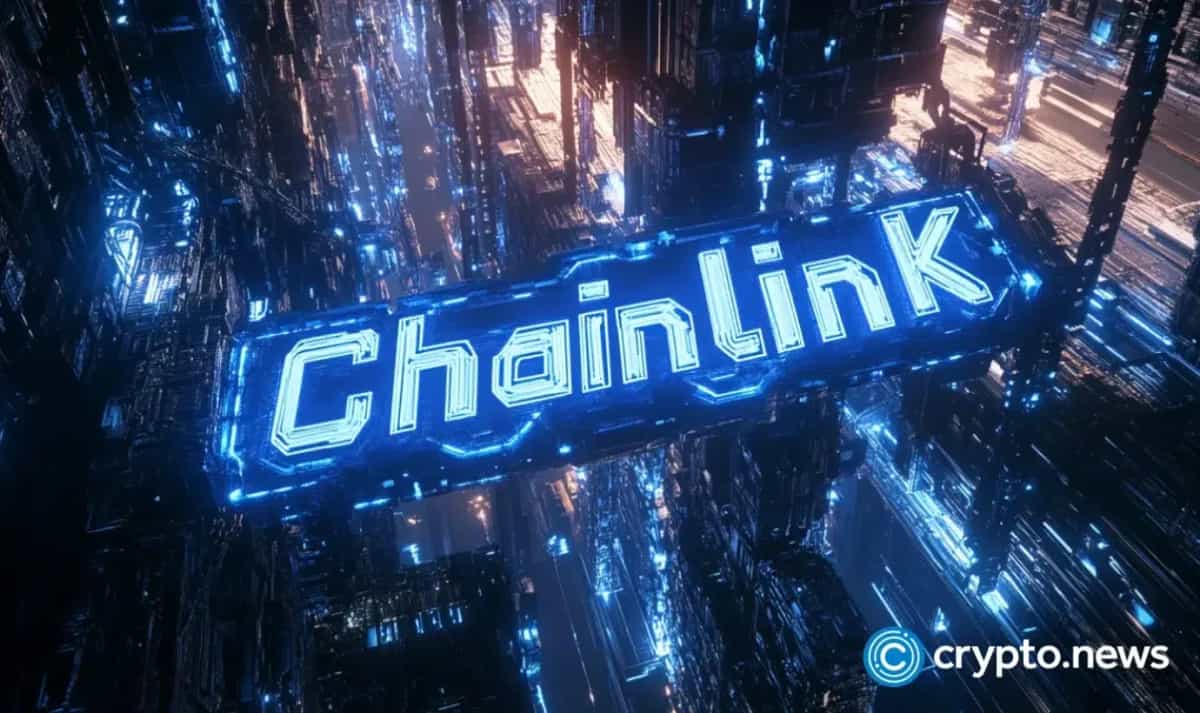
Chainlink price falls nearly 5% toward $13 as LINK traders watch $12 support, $15 resistance and new CCIP 2.0 institutional use.
LINK sits at $13.76 with momentum fully stalled and aggressive sell flow dominating short-term order books — yet top-tier traders are positioned 67% net long. The next 7–10 days likely deliver eith... (Read More)

 Chainlink (LINK): 62%