A trader holding a position that everyone agrees is correct can still lose the payout — not because the event was unclear, but because the process that decides the outcome broke down, got gamed, or landed on a reading of the rules nobody expected.
If you are searching for polymarket dispute, uma dispute polymarket, prediction market wrong resolution, or kalshi market determination dispute, this page is the direct answer: a look at how resolution disputes actually happen, the real controversies that put each mechanism under scrutiny, and what a trader can and cannot do about it. For the underlying mechanics — how each venue resolves markets in the ordinary case — start with How Prediction Markets Resolve. This page assumes that background and goes deep on the part that guide skips: what happens when the resolution itself gets contested.
TL;DR
- Disputes cluster around a handful of causes: ambiguous question wording, disagreement over which source governs, resolution timing that outruns the underlying event, and — rarer but higher-stakes — attempts to game the resolution mechanism itself for profit.
- Polymarket resolves disputes through UMA's token-holder vote when a proposed answer is repeatedly challenged. That system has produced real, widely reported controversies — including a 2024 Venezuela election market UMA resolved against the market's own named "official" source, and a March 2025 governance attack that pushed a Ukraine market to a false "Yes" before it was reversed.
- Press investigations have raised a structural criticism of that same system: a meaningful share of UMA's deciding votes in disputed markets reportedly comes from a small number of large token holders, some of whom also hold positions in the markets they're voting on.
- Kalshi settles disputes through its own rulebook rather than a public vote — its determination team (and Outcome Review Committee, per its CFTC-filed rulebook) applies written rules, including a fallback provision for genuinely ambiguous outcomes. A 2026 Super Bowl halftime-show market shows what that looks like in practice, and diverged sharply from how Polymarket resolved the same event.
- The honest reality: on every major venue, a resolution is final in the overwhelming majority of cases, and there is no independent, cross-platform appeals court a trader can go to. What recourse exists is venue-specific, narrow, and not guaranteed.
- Reading the resolution source and edge-case rules before you trade — not after a market goes against you — is the only reliable protection. Common Prediction Market Mistakes covers the broader version of this habit.
- CoinRithm does not resolve markets or adjudicate disputes. It aggregates resolution status and shows resolution-evidence strength per venue on the sources page, so you can see how much verified settlement data backs a given source before you trust its numbers.
Why Prediction Market Resolutions Get Disputed
How Prediction Markets Resolve covers the ordinary mechanics venue by venue. Disputes sit on top of that mechanism, and across every venue they trace back to a small set of root causes:
- Ambiguous wording. A question written for a "normal" version of events breaks when reality is messier than expected — a candidate withdraws, a performer appears without singing, a leader is captured rather than formally removed from office. The rules didn't anticipate the actual outcome.
- Source disagreement. The market names a resolution source, but a different, credible source reports something else first, or the named source's own data is itself contested (an official election tally versus an independent parallel count, for example).
- Resolution timing. A market can be "obviously" decided in the news well before the platform's own process is allowed to finalize it — and the gap between "everyone already knows" and "the mechanism says it's final" is exactly where pressure to dispute or manipulate builds up.
- Oracle or process incentive attacks. Rarer, and the most damaging when it happens: someone with enough voting power, stake, or influence over the resolution mechanism tries to push an outcome that favors their own position rather than the actual facts.
The first three causes are mostly about writing and reading rules more carefully — covered in the checklist near the end of this page. The fourth is a design-level vulnerability, and it's the reason resolution disputes make headlines instead of staying a back-office detail.
Inside Polymarket's UMA Dispute Mechanism
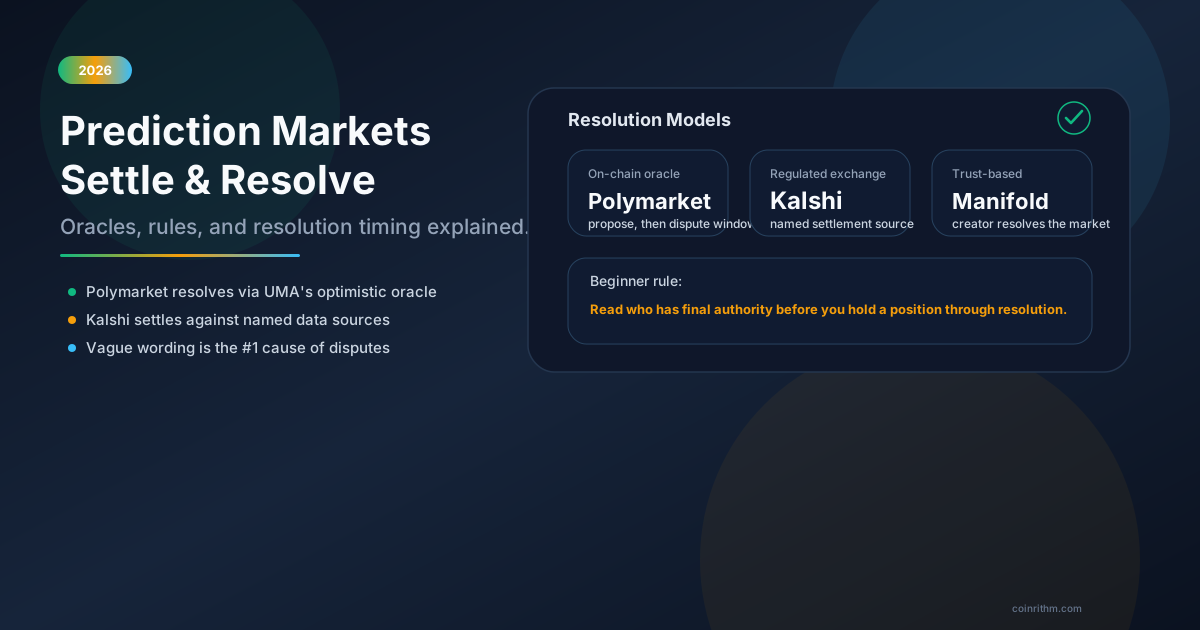
How Prediction Markets Resolve already walks through the basic flow: a proposer posts a bond with a proposed answer, a challenge window opens, and if the challenge repeats, the question escalates to a vote among holders of UMA's governance token. That escalation path — the Data Verification Mechanism, or DVM — is where the controversies below happened.
The design tradeoff is real and worth restating plainly: disputing costs a bond, so most proposed answers go unchallenged and resolve quickly and cheaply. But when a market is large enough, or contested enough, that the bond cost stops mattering, the final call shifts from "the market's written rules, mechanically applied" to "however a token-weighted vote comes out." That shift is exactly what produced the two cases below.
The Venezuela Election Dispute (2024)
Polymarket's 2024 market on Venezuela's presidential election named its resolution source in the rules: primarily official information from Venezuela, with "a consensus of credible reporting" as a fallback. Venezuela's electoral authority declared incumbent Nicolás Maduro the winner on election night. The opposition published its own parallel vote-tally data, which by multiple accounts showed a wide margin for challenger Edmundo González, and that count was echoed by a broad range of international media and governments that declined to recognize the official result.
When the market went to UMA's dispute process, token holders resolved it in González's favor — against the outcome declared by the source the market's own rules named first. Reporting on the episode (including coverage from PBS and NPR, and detailed writeups from independent outlets covering the dispute) frames it two ways depending on who's telling it: supporters of the resolution argue the "consensus of credible reporting" clause existed precisely to handle a captured or non-credible official count, and that the fallback was applied correctly. Critics counter that it set a precedent where a token-holder vote can override a market's named primary source whenever enough voters disagree with it — which, structurally, is a different risk than the source itself being wrong. Both readings are represented in reporting on the case; neither is settled fact, and CoinRithm is not taking a side on which was "more correct" here — the structural point is that the named-source rule and the vote outcome pointed in different directions, and the vote won.
The Ukraine Governance Attack (March 2025)
A separate case is more clear-cut as a description of what an "oracle incentive attack" looks like in practice, though it was also caught and does not appear to have resulted in a lasting incorrect payout across sources reviewed. In late March 2025, a Polymarket market asking whether Ukraine would agree to a mineral-rights deal with the Trump administration before April moved sharply — reported at the time as swinging from roughly 9% to 100% — and briefly resolved "Yes," despite no such deal having actually been reached.
According to coverage from CoinDesk and other outlets, the trigger was a large UMA token holder casting a very large share of votes (reported as millions of UMA tokens split across multiple accounts) in the dispute round — enough, on its own, to swing that specific vote. Polymarket itself reportedly described the episode as an "unprecedented" governance attack. The case is widely cited as the clearest illustration that UMA's token-weighted voting can, in principle, be outvoted by concentrated holdings rather than by broader consensus about what actually happened — which is a different failure mode than an honest disagreement over ambiguous wording.
The Whale-Vote Concentration Criticism
Beyond individual incidents, a broader structural criticism has built up in financial press coverage of UMA's dispute-voting activity: reporting attributed to a Wall Street Journal investigation found that, across a sample of disputed Polymarket markets, a large share of the deciding votes came from a small number of the largest token wallets, and that a meaningful minority of disputes included at least one voter who also held a position in the very market being decided.
None of that proves any single disputed outcome was wrong — a large holder voting in line with the correct outcome is still a large holder, not proof of manipulation. But it is the throughline connecting the Venezuela and Ukraine cases above to a general design concern: a dispute-resolution layer where voting power is proportional to token holdings will always carry some risk that concentrated holders, not the underlying facts, decide close calls. UMA's co-founder has publicly pushed back on this framing, arguing that voters who game outcomes damage the token's long-term value and therefore have their own incentive to rule correctly — a real counter-argument, not a dismissal of the concern, and one that reasonable people can weigh differently.
How Kalshi Handles Determination Reviews
Kalshi does not run a public dispute market at all. As a CFTC-regulated exchange, its rulebook — filed with and available through the CFTC — defines a formal determination process: each contract's own rules specify the settlement source in advance, and Kalshi's Outcome Review Committee (a standing committee established under its rulebook) is the body that applies those rules to determine the outcome. For the genuinely rare case where the underlying data simply doesn't resolve cleanly against the contract's stated payout criterion, Kalshi's rules include a specific fallback provision instructing the exchange to determine a fair payout allocation rather than leaving the contract unsettled indefinitely.
That is a different trust model from Polymarket's bonded dispute market, and it shows up differently in practice: there's no public vote to watch, and no bond to post if you disagree — a trader's recourse runs through Kalshi's own support and rules-interpretation process, not a market-based challenge.
The Cardi B Super Bowl Dispute (2026)
The clearest recent illustration of Kalshi's process — and of how differently the same real-world event can resolve across venues — is the February 2026 dispute over whether Cardi B "performed" during that year's Super Bowl halftime show. Cardi B appeared on stage alongside other guest performers and danced along to the music but, by multiple accounts, did not sing or play an instrument.
Kalshi determined the outcome was ambiguous under its own definition of "performance" (requiring visible singing or playing an instrument) and invoked its rulebook's fallback provision, settling the contract at the last traded price before trading was paused — reported at roughly $0.26 for "Yes" and $0.74 for "No," rather than a clean $1.00/$0.00 payout either way. Polymarket, whose rules for the equivalent market leaned on "a consensus of credible reporting," resolved "Yes" at a full $1.00, since most major outlets described Cardi B as having performed. The two venues, using two different rule structures on the same real-world event, paid out in opposite directions. A trader on the losing side of Kalshi's settlement reportedly filed a formal complaint with the CFTC over the outcome — a real step available to a Kalshi trader, though filing a complaint is not the same as winning one, and it does not by itself change how a specific contract settles.
The "Death Bet" Refund (2026)
A second 2026 case shows the opposite outcome: traders getting money back after a contested settlement, through a process that was not a formal appeal. A Kalshi contract asking whether Iran's supreme leader would leave office by a set date drew heavy volume — reported at more than $54 million — before Kalshi applied a settlement carve-out that a subsequent lawsuit characterized as poorly disclosed. Kalshi's CEO subsequently said the company would reimburse affected traders' net losses, at a reported cost of roughly $2.2 million, citing that the settlement criteria could have been communicated more clearly.
The distinction matters for expectations: this was not Kalshi's dispute mechanism working as designed — it was the company choosing, under legal and public pressure, to make traders whole after the fact. That is meaningfully different from a guaranteed right to a refund, and it should not be read as a precedent that any contested Kalshi settlement will be reversed.
What You Can (and Can't) Do About a Disputed Resolution
Be honest with yourself about what's actually available, because it's less than most traders assume:
- On Polymarket: you can post a challenge bond during the liveness window if you believe a proposed answer is wrong, and — if the dispute escalates — the outcome is decided by a UMA token-holder vote you do not control. Once that vote finalizes, there is no further appeal within the system.
- On Kalshi: you can contact support and raise a rules interpretation you disagree with, and Kalshi's determination team (and, per its rulebook, its Outcome Review Committee) can consider it — but this is a request, not a binding right, and there is no independent arbitrator or ombudsman outside the exchange itself. The "Death Bet" case above shows the company can still choose to make traders whole voluntarily, under enough pressure — it does not show that this happens routinely.
- On any venue: filing a regulatory complaint (as happened in the Cardi B case) is a real option for US-regulated exchanges, but it is slow, uncertain, and not a substitute for a market's own dispute window.
- What you cannot do, anywhere: treat a resolution as provisional just because you disagree with it, or expect a cross-platform standard of "correctness" to override a specific venue's own rules and process. The overwhelming majority of resolutions on every major venue are never disputed and are never revisited — that baseline reliability is real, even though the disputed minority is what makes headlines.
How to Protect Yourself Before You Trade
The most effective protection is upstream of any dispute — the same due-diligence habit How Prediction Markets Resolve recommends for reading rules generally, sharpened for dispute risk specifically:
- Prefer precisely worded markets over loosely worded ones. "Will X happen by [date]" resolves cleanly. "Will X perform," "will X be out of office," or "will X agree to a deal" invite exactly the ambiguity that produced the cases above.
- Check the named source, and whether it's singular. A market with one clearly named, verifiable source (a specific index, a specific official body) is lower-risk than one with a vague fallback like "consensus of credible reporting" — that fallback is useful, but it's also the exact clause that put the Venezuela dispute in play.
- Treat very large, very contested markets as higher dispute risk, not lower. Size cuts both ways: a market with enough volume attracts more scrutiny, but it also attracts more incentive to game the resolution if the payout is big enough — as the Ukraine governance attack shows directly.
- Be extra cautious on thin, low-liquidity markets with loosely written questions. They rarely make headlines when they resolve badly, precisely because too few traders are affected for anyone to investigate — that's a real risk, not an absence of one.
- Compare the same event across venues before you assume a probability is "correct." If Polymarket and Kalshi diverge sharply on the same real-world event close to resolution, that's frequently a sign the two venues are reading their own rules differently — as the Cardi B case shows plainly — not that one platform is simply mispriced.
- Read the exact resolution criteria, not the headline question. Every case above traces back to daylight between what a question implied in plain English and what its written rules actually said.
How CoinRithm Fits In
CoinRithm does not resolve markets, run a dispute process, or sit on any venue's determination committee — it aggregates prediction-market data across venues and offers a paper-trading sandbox for practicing with mock stakes, no real money involved.
For dispute research specifically, that shows up in two concrete places:
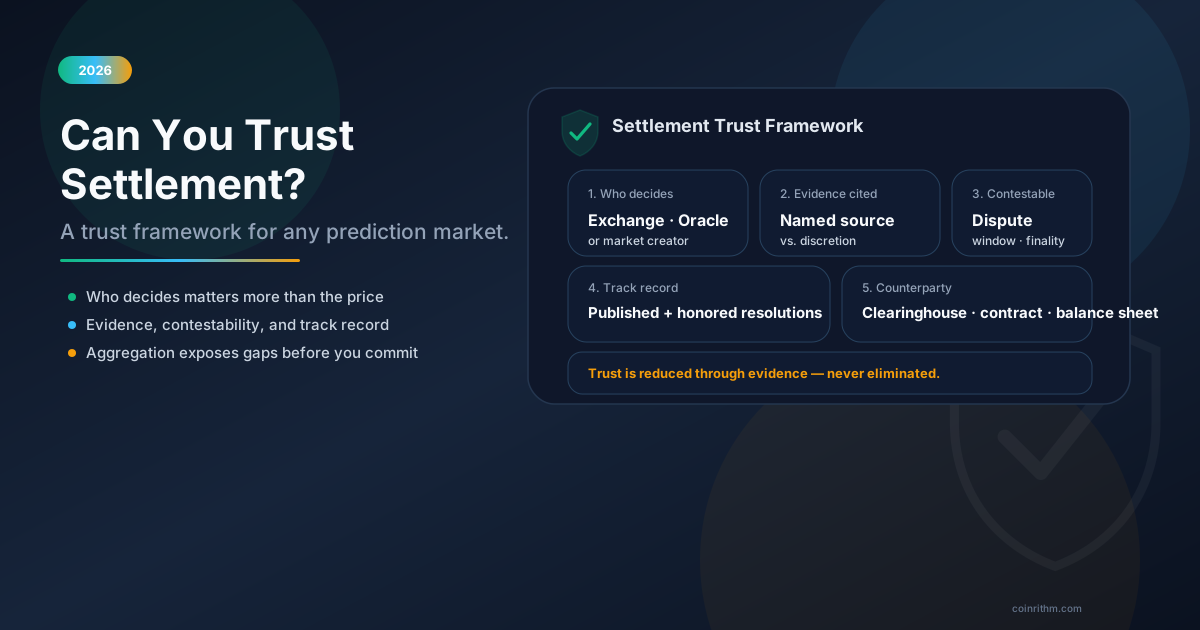
- On individual event pages, CoinRithm shows a resolution-status indicator that distinguishes provider-verified settlement evidence from cases where an outcome is claimed but not yet fully confirmed by the source, or where evidence is thin. That distinction matters most exactly when a resolution is contested — it's the difference between "this venue confirmed this outcome" and "this venue says this happened, unconfirmed."
- The sources page extends the same idea across entire venues: each source carries a resolution-evidence tier describing how much verified settlement data CoinRithm holds for it overall. That's a statement about CoinRithm's own data coverage — not a verdict on how trustworthy a venue's dispute process is, and not a promise that a given venue's resolutions are always correct.
- Because CoinRithm surfaces the same event across multiple venues side by side, it's a practical way to spot exactly the kind of cross-venue divergence the Cardi B case illustrates — if two sources disagree sharply on the same event right before resolution, that divergence is worth investigating, not ignoring.
If you want to practice watching a position move through close and resolution — including markets that end up contested — without financial risk, CoinRithm's paper trading simulator lets you take mock positions on real prediction-market events with no real money involved.
Frequently Asked Questions
Can I appeal a Polymarket resolution I think is wrong?
You can post a challenge bond during the liveness window before a proposed answer finalizes. If the dispute escalates to UMA's token-holder vote, that vote is final within the system — there is no further appeal once it resolves.
What is a UMA "whale-vote" attack?
It's the scenario where a party holding a large share of UMA's governance token uses that voting weight to push a disputed market toward an answer that favors their own position, rather than the actual facts — as reported in the March 2025 Ukraine mineral-deal case, where a large holder's votes were enough to briefly swing the outcome.
Does Kalshi have a dispute or appeals process like Polymarket's?
No, not a public one. Kalshi settles under its own CFTC-filed rulebook, with its Outcome Review Committee applying named-source rules and a fallback provision for genuinely ambiguous cases. Traders can raise concerns through Kalshi's support channels, but that is a request considered by the exchange, not a binding vote or independent appeal.
Has a prediction market ever refunded traders after a bad resolution?
Yes — in one 2026 case, Kalshi reimbursed traders' net losses (reported at roughly $2.2 million) after a settlement carve-out drew a lawsuit and public criticism. That was a discretionary decision by the company under pressure, not a guaranteed right, and it should not be assumed to apply to other disputes.
How can I tell if a market is likely to get disputed before I trade it?
Loosely worded questions, vague or multi-source resolution criteria, and unusually large or politically charged markets are the highest-risk combination — every documented case in this article involved at least one of those factors.
Does CoinRithm resolve disputes or guarantee a market resolved correctly?
No. CoinRithm aggregates resolution status and shows resolution-evidence strength per event and per venue on its sources page, but the underlying platforms — Polymarket, Kalshi, and others — are the ones that actually determine, dispute, and settle outcomes.
Conclusion
Every dispute in this article traces back to the same structural fact: a prediction market's price is only as good as the mechanism that eventually converts it into a paid-out truth, and that mechanism is run by people, incentives, and rules — not by the event itself. Polymarket's bonded dispute market and Kalshi's rules-based determination process solve that problem in different ways, and both have real, documented failure modes: concentrated voting power on one side, unilateral discretionary calls on the other.
None of this means disputes are common — the large majority of markets on every venue resolve without controversy, on schedule, against a source nobody argues about. But the minority that don't get disputed are concentrated almost entirely in markets with loose wording, contested sources, or enough size to make gaming the outcome worthwhile. Reading a market's exact resolution rules before you hold a position through settlement remains the cheapest insurance available, and it is the one step every case above shows a losing side either skipped or discovered too late.
Continue reading: Prediction Market Settlement and Trust — a deeper look at what makes traders actually trust a settlement layer, and how that trust gets built or lost across venues.
Last Updated: July 4, 2026
Disclaimer: This article is for educational and informational purposes only. It is not financial, legal, or investment advice. Names, figures, and outcomes described here reflect publicly reported coverage at the time of writing and are attributed to that reporting rather than asserted as CoinRithm's own findings; dispute processes, rulebooks, and platform policies can change — always verify a market's current rules directly with the platform before trading or holding a position through resolution.