A market can be priced with tight spreads, deep liquidity, and a track record of calm trading — and still fail you at the one moment that actually matters: the moment someone decides who won. Everything before settlement is just a quote. Settlement is the promise being kept, or not.
If you're searching prediction market trust, how reliable is Polymarket resolution, can you trust Polymarket, or is Kalshi settlement reliable, you're really asking one question with five parts: who decides, on what evidence, how contestable is the call, what's the track record, and who's actually holding the money. This page is a practical framework for answering that question about any venue — not a verdict on any single one. If you haven't read the resolution mechanics themselves yet, start with How Prediction Markets Resolve; this article is the trust layer on top of that mechanism.
TL;DR
- Settlement trust isn't one score — it's five separate questions: who decides, what evidence they cite, how contestable the call is, their track record, and the counterparty structure holding the collateral.
- A regulated exchange, a decentralized oracle, and a single market creator sit at different points on the same trust spectrum — none of them is automatically "the safe one" in every dimension.
- Prediction market oracle reliability depends on what the oracle actually checks against, not on the word "oracle" itself — a named data source beats "vibes" every time.
- Comparing the same event across venues is one of the most useful trust checks available to a retail user — a wide, late-stage probability gap between two sources is often a resolution-wording disagreement, not a mispricing. See When Prediction Markets Disagree.
- CoinRithm doesn't resolve markets or vouch for any venue — it shows resolution-evidence tiers per source and per-event trust tones (verified, limited, awaiting, unverified) on the sources page and on event pages, so you can see what's actually confirmed before you commit.
- No framework, and no aggregator, can force a venue to honor a resolution it decides not to honor. Trust here is reduced through structure and evidence — never eliminated.
Why Settlement Is the Real Test
Pricing accuracy gets most of the attention in prediction-market writing — calibration, efficiency, whether the crowd "knows" something. But calibration is only provable in hindsight, and only if the thing it's being checked against — the final, settled outcome — is itself trustworthy. If settlement is slow, ambiguous, or contested, the calibration story built on top of it doesn't mean much either.
That's the practical reason prediction market settlement trust deserves its own framework, separate from "is this venue's pricing any good." A venue can have excellent, well-calibrated pricing on 999 markets and still burn a user's trust entirely on the one market where the resolution call was unclear, late, or unresolvable to their satisfaction. Settlement risk is lumpy — it doesn't average out the way pricing noise does.
This is also where prediction market counterparty risk lives. Winning a settled market on paper means nothing if the entity holding the collateral can't or won't pay it out. Settlement trust and counterparty trust are two different failure modes that get conflated constantly, and this framework treats them as separate, explicit questions rather than one vague feeling of "is this platform legit."
The Five-Part Settlement-Trust Framework
Apply these five questions to any venue, any market type, any time you're deciding whether to hold a position through resolution rather than trade out of it early.
1. Who Decides
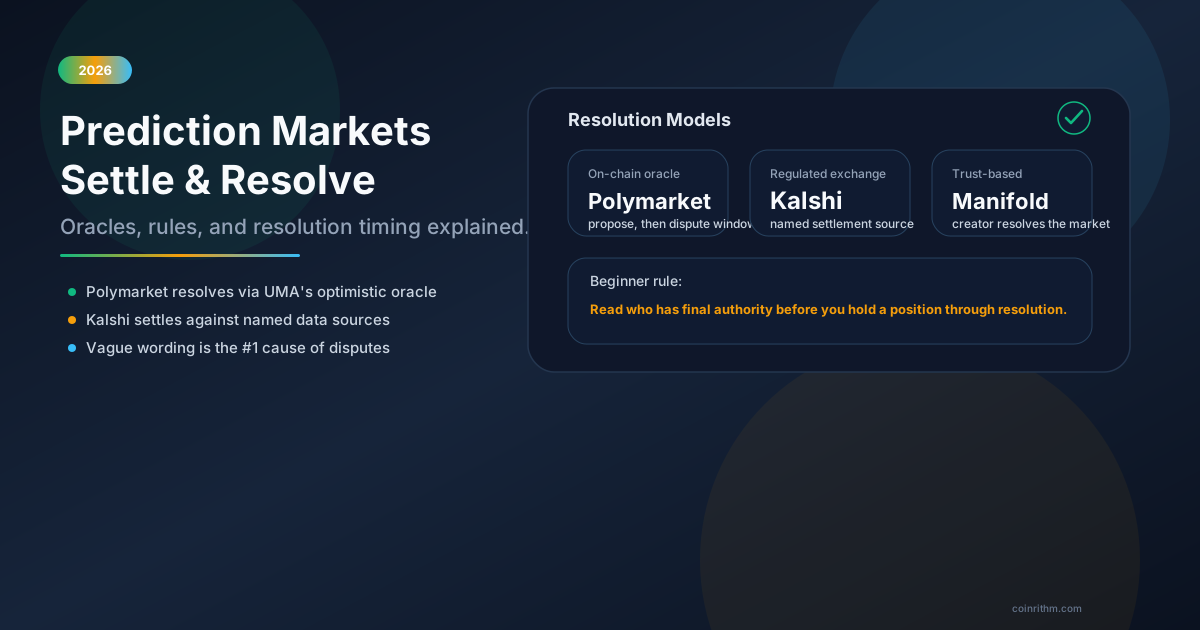
Every prediction market sits somewhere on a spectrum between three poles:
- A regulated exchange applies its own written rules, under a regulator's oversight, to determine an outcome.
- A decentralized oracle relies on an economic mechanism — proposers, bonds, dispute windows, sometimes a token-holder vote — rather than a single named authority.
- A single market creator (or their designated resolver) makes a personal judgment call about what happened.
None of these is unconditionally "the trustworthy one." A regulated exchange concentrates authority in one accountable party but removes the public dispute mechanism a bonded oracle offers. A decentralized oracle spreads out the decision but can escalate to a vote in genuinely contested cases — which is a different risk, not a smaller one. A single creator has the least structural backing of the three, which is a reasonable tradeoff for play-money forecasting but a real gap for anything with financial stakes. The point isn't to rank the three models — it's to know which one you're relying on before you hold a position through it.
2. What Evidence the Decision Cites
This is the single most diagnostic question in the whole framework: does the resolution point to something checkable, or does it rely on "it's obvious" / "everyone knows"?
A strong resolution cites a named source — a specific index provider, a specific government release, a specific governing body's published result — decided in advance, before anyone knew which side it would favor. A weak resolution leans on the market creator's or a grader's personal read of "what basically happened," decided or reinterpreted after the fact. Prediction market oracle reliability is really a proxy for this: an oracle is only as reliable as the data feed and dispute process behind it, not reliable by virtue of being called an oracle.
3. How Contestable It Is
If the initial call is wrong, is there any way to challenge it — and what does challenging cost? Look for three things: a defined dispute window (how long you have to object), a real appeal path (does disputing require posting a bond, filing with a regulator, or is there simply no mechanism at all), and clear finality (once the window closes or the appeal is exhausted, is the outcome genuinely final, or can it still be reopened later).
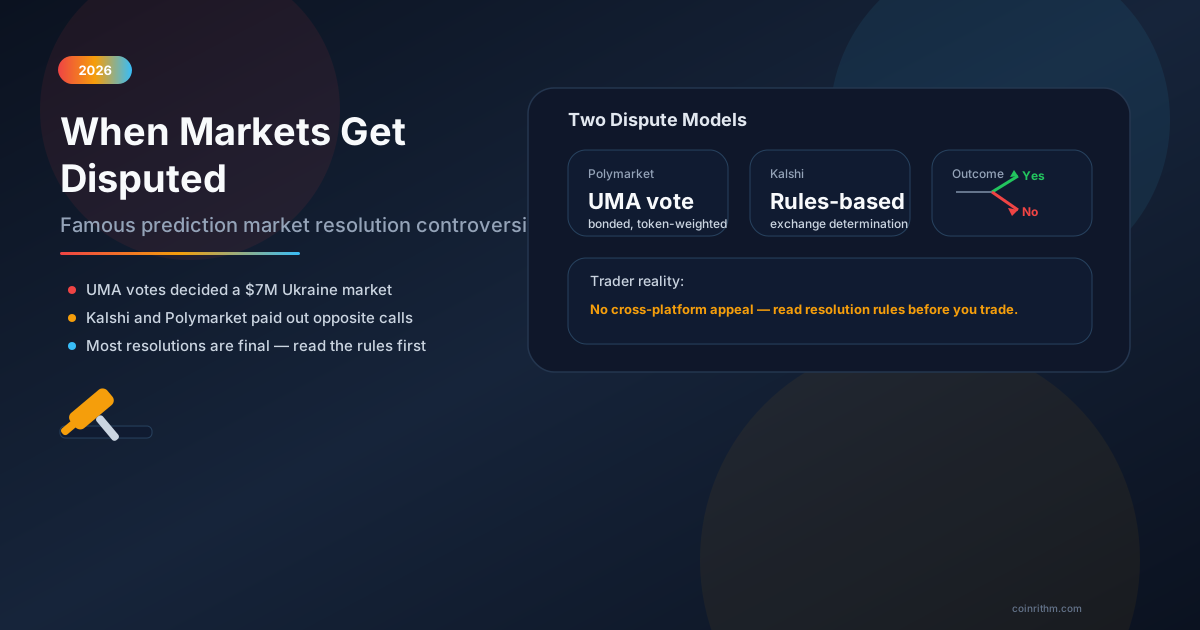
A venue with no dispute mechanism isn't automatically worse — a regulated exchange's accountability can substitute for a public dispute market. But a venue with neither a dispute mechanism nor regulatory accountability behind the decision-maker is the weakest combination on this axis, structurally, regardless of how the platform markets itself. For a closer look at what actually triggers a dispute and how escalation plays out in practice, see When Prediction Markets Get Disputed.
4. Track Record
Does the venue publish its resolutions, and does it honor them consistently over time? A long history of markets that resolved on schedule, against clearly named sources, with disputes (when they happened) handled transparently, is worth more than any claim the venue makes about itself. This is where prediction market audit thinking is most useful for an individual user: you're not conducting a formal audit, but you should be able to look at a venue's resolved-market history and form a view — does this platform's own past behavior match what its rules promise?
5. Counterparty Structure
Even a correct resolution is worthless if the payout doesn't happen. This is where settlement trust connects to plain counterparty risk, and the structures differ enormously:
- A regulated clearinghouse holds collateral under regulatory capital and custody requirements — the structure a CFTC-regulated exchange like Kalshi operates under.
- A smart contract holds collateral on-chain and pays out programmatically once the oracle finalizes an answer — no company balance sheet stands between the resolution and the payout, but the contract's own security and the oracle's finality still matter.
- A company's own balance sheet backs payouts on some platforms, which means the platform's solvency is itself part of the settlement-trust picture, separate from whether its resolution decision was correct.
Two markets can have identical resolution rules and completely different counterparty risk depending on which of these three structures sits underneath them.
Applying the Framework by Venue Class
Briefly, by venue class — not by naming any single platform as "trustworthy" or "untrustworthy," but by showing how the same five questions land differently:
Regulated US exchange (the Kalshi model). Who decides: the exchange itself, under CFTC oversight, applying rules written per contract. Evidence: a named benchmark or official data source, specified in advance. Contestability: no public bond-based dispute market — accountability runs through regulatory oversight instead. Counterparty: a regulated clearinghouse structure. The open question worth checking per-market is simply whether the named source is unambiguous for the specific event you're trading — the structure around the decision is strong, but structure doesn't fix a loosely worded question.
Crypto-native, oracle-resolved (the Polymarket/UMA model). Who decides: a proposer posts an answer, and it stands unless disputed within a challenge window; repeated disputes escalate to a token-holder vote. Evidence: whatever the proposer cites, tested by the economic incentive to dispute a wrong answer. Contestability: strong by design — that's the entire point of an optimistic oracle — but escalation to a vote is a materially different resolution path than a clean, first-round proposal, and it's worth knowing which one a given market actually needs. Counterparty: smart-contract-held collateral, which removes company-balance-sheet risk but makes contract and oracle security the relevant variable instead.
Play-money, creator-resolved (the Manifold model). Who decides: the person who wrote the question, or their designated resolver. Evidence: whatever they judge sufficient — there's no external check unless the community pushes back. Contestability: informal at best; no bond, no regulator. Counterparty: irrelevant in the traditional sense, since the stakes are play money rather than real capital. This model is a reasonable fit for its stated purpose — low-stakes calibration practice and community forecasting — precisely because the trust bar for that purpose is lower than it would need to be for a real-money venue.
None of this is an accusation that any specific venue has dishonored a settlement. It's a structural comparison: the same five questions, applied consistently, describe a genuinely different trust shape for each model — and that shape is knowable in advance, before you ever hold a position through resolution.
Why Aggregation Strengthens Trust
Here's the part that's easy to miss if you only ever look at one venue at a time: comparing the same event across multiple sources is itself a trust check.
If two venues are pricing the same real-world event and one is sitting near 90% while the other is near 60% as resolution approaches, that gap is rarely "one side is smarter." Far more often, it's the two venues' resolution rules reading the underlying event differently — different named sources, different timing assumptions, different edge-case handling. Spotting that gap before you commit to a position is exactly the value an aggregator adds that a single-venue view can't: it surfaces a resolution-wording disagreement while there's still time to read both venues' actual rules, instead of discovering the disagreement only after one of them pays out differently than you expected. See When Prediction Markets Disagree for how to read those divergence signals in practice.
This is also connected to a wider question worth understanding before trading any US-facing venue at all — regulatory status shapes which of the five trust dimensions above are even available to you. Are Prediction Markets Legal? covers that ground.
How CoinRithm Fits In
CoinRithm does not resolve markets, does not grade outcomes, and is not a broker — it's an aggregation and research layer across venues, plus a paper-trading sandbox for practicing without real stakes. What it does do, deliberately, is make the settlement-trust framework above easier to apply in practice rather than asking you to hold it all in your head:
- Per-event resolution banners. Individual event pages carry a resolution status with an explicit trust tone — verified (provider-backed winner and settlement-time evidence), limited (the recorded outcome is shown, but not every settlement field is provider-verified), awaiting (CoinRithm is waiting on provider-confirmed settlement before calling the market resolved), or unverified (the outcome is inferred or not backed by provider-grade evidence). That maps directly onto the "what evidence" question from the framework above — it tells you what CoinRithm can actually confirm, not what the venue claims.
- Source-level resolution-evidence tiers. The sources page shows, per venue, how many resolved events carry verified outcome data, verified settlement timing, and calibration-usable history — a running statement about CoinRithm's own data coverage for that venue, not a verdict on the venue's trustworthiness. A source with a thin evidence tier isn't being called unreliable; it means CoinRithm's own confirmed data for that source is still limited, and that distinction is made honestly rather than papered over.
- Cross-venue comparison in one place. Because CoinRithm tracks the same events across sources side by side, spotting the kind of late-stage probability divergence described above becomes a normal part of checking a position, not a manual exercise across five open browser tabs.
- A settlement-state taxonomy underneath it all. Conceptually, every tracked event moves through a defined lifecycle — open, closed, awaiting resolution, resolved (with the trust tone attached) — so "has this actually paid out yet" is always answerable at a glance rather than inferred from a stale-looking price.
If you want to practice applying this framework — watching how a position behaves through close, resolution, and settlement — without financial risk, CoinRithm's paper trading simulator lets you hold mock positions on real prediction-market events with no real money involved.
Honest Limits of This Framework
This framework reduces settlement-trust guesswork. It does not, and cannot, eliminate settlement risk entirely — and it's worth being direct about why.
No amount of evidence-tier labeling, cross-venue comparison, or dispute-window awareness can force a venue to honor a resolution it decides not to honor. A regulated exchange can still make a judgment call you disagree with. A bonded oracle can still escalate to a vote whose outcome you find unsatisfying. A smart contract is only as trustworthy as its own code and the oracle feeding it. Aggregation surfaces disagreement early and shows you what's actually verified — it cannot adjudicate a dispute on your behalf, and it cannot substitute for reading a specific market's own rules before you hold a position through its resolution.
Treat this framework as risk reduction through better information, not as a guarantee. The most reliable single habit it produces is a simple one: know who decides, what they're checking against, and how contestable that decision is — for the specific market you're holding, not for the venue in general — before resolution day arrives.
Frequently Asked Questions
Can you trust Polymarket's resolution process?
Polymarket's resolution runs through UMA's optimistic oracle: a proposed answer stands unless disputed within a challenge window, with repeated disputes escalating to a token-holder vote. That's a structurally strong dispute mechanism — but it's a different trust model from a regulated exchange, not a strictly "more" or "less" trustworthy one. Apply the five-part framework to the specific market you're holding rather than treating "on-chain" as a blanket trust signal.
Is Kalshi settlement reliable?
Kalshi settles as a CFTC-regulated exchange, applying each contract's own written rules to a named data source, under regulatory oversight rather than a public bond-based dispute process. That's a strong structural setup on the "who decides" and "counterparty" dimensions of this framework — the practical question for any specific Kalshi market is still whether its named source and edge-case rules are unambiguous for the event you're trading.
What does "prediction market oracle reliability" actually mean?
It means the strength of the evidence and dispute process behind an oracle's answer — not the fact that a system is labeled an oracle. A reliable oracle setup names a checkable data source in advance, has a real dispute window with a meaningful cost to disputing frivolously, and has a track record of resolving cleanly without needing escalation. "It's an oracle" alone tells you almost nothing about reliability without those specifics.
What's the biggest counterparty risk in prediction markets?
It's the gap between "the resolution was correct" and "the payout actually happened." Collateral can sit behind a regulated clearinghouse, a smart contract, or a company's own balance sheet, and each has a different failure mode — regulatory insolvency proceedings, a smart-contract or oracle exploit, or straightforward company insolvency, respectively. A correct resolution on an insolvent counterparty still doesn't pay out.
Does CoinRithm audit prediction market settlements?
No. CoinRithm aggregates resolution and settlement data from each venue and labels how much of it is provider-verified, using resolution-evidence tiers on the sources page and per-event trust tones on event pages. That's an honest statement about CoinRithm's own data confidence, not an independent audit of the underlying venues' resolution decisions.
Can a trust framework prevent a bad prediction market resolution?
No framework can force a venue to honor a resolution it won't honor — that limitation is real and worth stating plainly. What a framework like this one does is reduce the odds you're surprised by it: knowing who decides, what evidence they cite, how contestable the call is, the venue's track record, and the counterparty structure before you hold a position, rather than after something goes wrong.
Conclusion
Pricing is a probability estimate; settlement is the moment that estimate becomes a paid-out fact — and it's the part of the prediction-market stack where trust is actually built or spent. The five questions in this framework — who decides, what evidence they cite, how contestable the call is, the venue's track record, and the counterparty structure behind the payout — apply the same way whether you're looking at a regulated US exchange, a crypto-native oracle system, or a play-money community platform. None of the three models is automatically the safe one across every dimension, and none of them can be reduced to a single trust score.
What you can do is apply the framework deliberately, compare the same event across venues before you commit, and read the specific market's own rules rather than trusting a platform's reputation in the abstract. That won't make a bad resolution impossible. It will make one a lot less likely to catch you off guard.
Continue reading: Economics and the Fed in Prediction Markets — how prediction markets price Fed decisions and macro releases, and what that pricing can (and can't) tell you before the data drops.
Last Updated: July 4, 2026
Disclaimer: This article is for educational and informational purposes only. It is not financial, legal, or investment advice. No prediction market venue named here is being accused of dishonoring a settlement — this is a structural risk framework, not a reliability rating of any specific platform. Resolution mechanics, settlement sources, and platform policies can change — always verify a market's current rules directly with the platform before trading or holding a position through resolution. CoinRithm is an aggregator and paper-trading sandbox; it does not resolve markets and does not handle real money.