A market can price an outcome at 92% and still lose the trade you made at that price on the resolution itself — not the news event, not the price move, but the mechanical process of deciding who was right and paying them.
If you are searching for how do prediction markets resolve, how does Polymarket resolve, Kalshi settlement, or who decides a prediction market outcome, this page is the direct explainer. Every venue answers that question differently, and the differences are exactly where trust gets made or broken.
Resolution is where prediction markets earn or lose credibility. Pricing is just a probability estimate. Resolution is the moment that estimate gets converted into an actual, final, paid-out fact. Nobody covers this part well across venues — most guides explain pricing and stop. This one is about the mechanism that decides who was right.
If you need the category-level primer first, start with What Are Prediction Markets in Crypto?. If your confusion is about prices and odds rather than resolution, read How Prediction Market Probabilities Work instead.
TL;DR
- "Resolution" is the process of deciding a market's final outcome; "settlement" is the payout that follows. The two are related but not identical.
- Polymarket resolves through UMA's optimistic oracle: a proposer posts an answer, a challenge window opens, and disputes escalate to a token-holder vote if unresolved.
- Kalshi is a CFTC-regulated exchange that settles each contract against a named data source defined in that contract's own rules — not a blockchain oracle.
- Manifold relies on the market creator (or a designated resolver) to mark the outcome — a trust model, not an oracle or regulator.
- Metaculus, PredictIt, and Smarkets each use their own resolution authority — admin discretion, exchange grading, and governing-body results, respectively.
- The close date and the resolution date are usually different, and ambiguous market wording is the single biggest cause of resolution disputes.
- CoinRithm tracks resolution status and shows resolution-evidence strength per event and per venue on the sources page — it does not resolve markets itself.
What "Resolution" Actually Means
Two words get used loosely, and mixing them up causes real confusion:
- Resolution is the decision — determining which outcome actually happened, according to the market's stated rules and a designated authority or process.
- Settlement is the consequence — winning contracts get paid
$1.00, losing contracts get paid$0.00, and funds move.
Resolution usually happens first, settlement follows shortly after — sometimes instantly, sometimes with a delay while a platform confirms the data or waits out a dispute window.
Why this matters more than most beginners assume: a prediction market's entire value proposition is "the price reflects the truth once it's known." If resolution is slow, ambiguous, or contested, that promise breaks down regardless of how good the pricing was along the way. This is also the part of the prediction-market stack that differs most between venues — far more than pricing mechanics do, which are broadly similar everywhere (see How Prediction Market Probabilities Work for that side of it).
Resolution Date vs Close Date
These are not the same thing, and market pages usually show both:
- Close date — the last moment new trades are accepted. Trading simply stops.
- Resolution date (sometimes "expiration" or "expected resolution") — when the platform expects to have determined the outcome and finalized it.
The gap between the two varies enormously by venue and event type:
- A same-day sports or crypto-price market might close and resolve within minutes of each other.
- A market tied to an official government report, an election certification, or a slow-moving news event can sit for hours or days between close and final resolution, waiting on the underlying data source to publish.
- Optimistic-oracle systems (like the one Polymarket uses) add a built-in waiting period by design — even when the real-world answer is already obvious, the market still has to sit through its challenge window before the outcome is final.
The practical implication: "the market closed" does not mean "the market paid out." If you are holding a position through resolution, check the platform's own resolution timeline for that specific market — do not assume it settles the instant the event happens.
How Polymarket Resolves: The UMA Optimistic Oracle
Polymarket does not have a human "grader" reviewing every market. It resolves through UMA's Optimistic Oracle — a smart-contract-based system built on the principle that a proposed answer is treated as correct unless someone challenges it.
The flow, based on Polymarket's own documentation and UMA's published process:
1. Request and propose
After a market closes, an approved proposer submits a proposed answer to the oracle, backing it with a posted bond. Bond sizes and specific mechanics are set by Polymarket and UMA and can change — check current terms directly rather than treating any figure here as fixed.
2. The liveness (challenge) window
The proposed answer sits for a defined liveness period — commonly a couple of hours for most markets — during which anyone can dispute it by posting their own bond.
3. Escalation if disputed
- No dispute: the proposed answer becomes final once the window passes. This is the fastest and most common path.
- One dispute: a new proposal round runs; if that second proposal goes unchallenged, it becomes final.
- Repeated disputes: the question escalates to UMA's Data Verification Mechanism (DVM), where UMA token holders vote to decide the outcome.
The design tradeoff is explicit: most markets resolve quickly and cheaply because disputing costs a bond, which discourages frivolous challenges. But it also means that in rare, high-stakes, or genuinely ambiguous cases, the final call can end up in the hands of token-holder voting rather than the market's own stated rules being mechanically applied — which is exactly the scenario that produces the highest-profile resolution controversies. This is a real, documented tension in Polymarket's design, not a hypothetical one — do not treat "it's on-chain" as synonymous with "it's automatically undisputed."
For the platform-level walkthrough, see What Is Polymarket?.
How Kalshi Settles: Named Sources and Exchange Determination
Kalshi works differently by design — it is a CFTC-regulated exchange, not a blockchain protocol, so it does not use an oracle in the crypto sense at all.
Each Kalshi contract's own rules define, in advance:
- what data source will be used to determine the outcome
- what specific threshold or event counts as a "Yes"
- how edge cases (delayed data, revisions, ties) are handled
The settlement source is named per market category. Common examples: crypto-price markets settle against a benchmark index provider, election markets settle against official race calls, and weather markets settle against National Weather Service data. Kalshi then determines the outcome once the market closes, based on that named source's published data — determination can take anywhere from about an hour to half a day or more, depending on how quickly the underlying source publishes.
The key structural difference from Polymarket: there is no public challenge window where any trader can dispute the call by posting a bond. Kalshi, as the regulated exchange, is the determining party, applying its own written rules to third-party data. That is a different trust model — you are trusting a regulated entity to apply its own rules correctly, rather than trusting an economically-incentivized dispute market to catch errors.
How Manifold Resolves: Creator and Community Trust
What Is Manifold? covers this in depth, but the short version matters here for comparison: Manifold has no oracle and no regulator. The market creator — or a resolver they designate — manually marks the winning outcome when they judge the event has concluded.
This is a fundamentally different trust model than either of the above:
- No bonded dispute process (Polymarket)
- No regulated exchange applying named-source rules (Kalshi)
- Instead: the person who wrote the question is also the one who decides how it resolved
Because Manifold trades in play money (mana, not real cash), the stakes of a bad-faith or careless resolution are lower than on a real-money venue — but the mechanism is still worth understanding on its own terms, especially if you're comparing Manifold's community odds against a real-money platform's price on the same event. Odds calibration means less if the resolution process behind them is looser.
How Metaculus Resolves: Forecasts, Not Trades
Metaculus is not a trading venue — there's no money changing hands on outcomes, and no shares to buy or sell — but it is a real prediction market in the forecasting sense, and its resolution model is a useful contrast point.
Metaculus questions are resolved by Metaculus admins, based on resolution criteria written into the question at creation time. That criteria is supposed to point to something checkable: a third-party publication, an official statistics release, or a clearly defined discretionary standard the admins apply. Community moderators help shape and approve questions and can mediate resolution discussions, but resolution authority itself sits with admins, not a vote or a poll of forecasters.
The absence of financial settlement changes the incentive picture entirely: there's no bond to post, no dispute market, no payout on the line for the resolver. What Metaculus offers instead is a long track record of resolved forecasts you can use to judge calibration over time — a different kind of trust than an oracle or a regulator provides.
How PredictIt and Smarkets Settle
Two more models worth knowing, especially if you're comparing sources on the same event:
PredictIt grades markets against rules published with each contract, based on publicly verifiable information — official election results, confirmed government actions, and similar sources. PredictIt (the exchange operator) reviews the applicable rules and determines whether the conditions for a payout have been met. Its published terms also spell out tie-breaking conventions for edge cases, which is a good reminder that resolution rules often cover more scenarios than the plain-language question suggests.
Smarkets is a peer-to-peer betting exchange: it settles against the official result published by the relevant governing body on the day the event concludes, and it explicitly will not reopen a settled market just because an official body issues a later revision to that result. If the outcome is genuinely uncertain at settlement time, Smarkets can delay settlement, or void the market entirely if the uncertainty can't be resolved to its satisfaction. That "we settle on the record as it stood, not as it's later amended" stance is a meaningfully different policy from a platform that leaves a dispute window open — worth knowing if you're used to one model and trading on the other.
Limitless and Fast-Resolving Crypto-Native Markets
Limitless is worth a brief mention because it approaches the ambiguity problem differently than the venues above: rather than accepting freeform, user-written questions, it leans toward templated markets — mainly short-duration crypto price markets — where the resolving condition (a price level, a time window) is standardized at creation instead of hand-written per market. For those crypto-price markets, outcomes are checked against price-feed data rather than a human proposer or grader.
The tradeoff is speed for scope: templated, narrowly-defined markets leave much less room for the wording disputes that plague open-ended questions, but that same design limits Limitless to a narrower set of question types than Polymarket, Kalshi, or Manifold cover.
Why Ambiguous Wording Is the #1 Source of Disputes
Across every venue covered above, the pattern repeats: high-profile resolution controversies are rarely about the underlying event being unclear. They're about the market's question text or rules being written loosely enough that two reasonable readers land on different answers.
Common failure patterns:
- Undefined timing. "By June 30" — in which timezone, and does that mean the event must be publicly confirmed by then, or merely have happened by then?
- Undefined source hierarchy. The rules name a source, but that source hasn't published yet when a different outlet reports the outcome first. Which one governs?
- Category creep. A question about "the winner" doesn't specify what happens if there's a tie, a recount, a disqualification, or a withdrawal.
- Assumed common sense. The creator assumed everyone would read the question the same way they intended it. Traders on the other side of the position often did not.
None of this means markets are unreliable — the vast majority resolve without controversy. But the disputes that do happen are concentrated almost entirely in markets with loosely written resolution criteria, not in markets where the underlying event was genuinely hard to determine. That is the single most useful pattern to internalize from comparing resolution mechanics across venues.
How to Read a Market's Rules Before You Trade
A practical checklist, applicable to any venue:
- Find the resolution source. What specific data feed, publication, or authority determines the outcome? Is it named explicitly, or left vague ("official results")?
- Check the resolution date, not just the close date. When does the market expect to actually pay out, and how long could that reasonably slip?
- Read the edge cases. Ties, delays, disqualifications, and postponements are usually addressed in the fine print, not the headline question.
- Identify who has final authority. A bonded dispute process (Polymarket), a regulated exchange (Kalshi), a market creator (Manifold), an admin (Metaculus), or a governing body's published result (Smarkets, PredictIt) — each implies a different failure mode if something goes wrong.
- Look for a dispute mechanism, and its cost. Is there any way to contest a wrong call, and does contesting require posting a bond or accepting a fee?
- Compare against a second source when it matters. If the same event has markets on more than one venue, a large probability gap right before resolution is often a sign that the two venues are reading their own rules differently — not that one is simply "right."
This is not optional due diligence for edge-case markets only — it is the standard first step for any position you intend to hold through resolution rather than trade out of early.
How CoinRithm Fits In
CoinRithm does not resolve markets, and it is not a broker — it aggregates prediction-market data across venues as a research layer, plus a paper-trading sandbox for practicing with mock stakes.
What that means concretely for resolution research:
- Each event tracked on CoinRithm moves through a visible lifecycle — open for trading, closed, awaiting resolution, and finally resolved — so you can see at a glance whether a market you're watching has actually paid out yet or is still pending.
- On individual event pages, CoinRithm shows a resolution-status indicator that distinguishes provider-verified settlement evidence from cases where the outcome is known but not yet fully confirmed by the source, or where evidence is limited or unavailable. The point is to be honest about what CoinRithm can actually confirm, rather than presenting every recorded outcome with the same confidence.
- The sources page extends that same idea to entire venues: each source carries a resolution-evidence tier describing how much verified settlement data CoinRithm holds for that venue overall — a statement about CoinRithm's data coverage, not a verdict on the venue's trustworthiness.
- Because CoinRithm surfaces multiple venues side by side, it's a practical way to spot exactly the cross-source divergence described above — if Polymarket and Kalshi disagree sharply on the same event right before resolution, that's a signal worth investigating rather than ignoring.
If you want to practice reading resolution rules and watching how a position plays out through close and settlement without financial risk, CoinRithm's paper trading simulator lets you take mock positions on real prediction-market events with no real money involved.
Frequently Asked Questions
What's the difference between resolution and settlement?
Resolution is the decision about which outcome actually happened. Settlement is the payout that follows — winning contracts paid, losing contracts zeroed out. Resolution comes first; settlement typically follows within minutes to hours, depending on the venue.
How does Polymarket resolve disputed markets?
Through UMA's optimistic oracle: a proposed answer stands unless someone disputes it during a challenge window. Repeated disputes escalate to a vote among UMA token holders. Most markets never reach that stage — the vast majority resolve on the first undisputed proposal.
Who decides the outcome on Kalshi?
Kalshi, as the regulated exchange operator, determines the outcome by applying each contract's own written rules to data from a named settlement source (for example, a benchmark price index or an official results feed) — there is no public on-chain dispute process like Polymarket's.
Why do resolution dates differ from close dates?
Trading stops at the close date, but confirming and finalizing the actual outcome can take longer — sometimes minutes, sometimes days — depending on how quickly the underlying data source publishes and whether any dispute or challenge process has to run its course first.
Can a prediction market resolve incorrectly?
Any resolution process can go wrong — through genuinely ambiguous wording, a slow or conflicting data source, or (rarely) a contested vote outcome. This is why reading a market's specific resolution rules before trading matters more than trusting the venue's reputation alone.
Does CoinRithm decide how prediction markets resolve?
No. CoinRithm aggregates resolution data and status from each venue and shows it back to users — including how strong the verified evidence is — but the underlying platforms (Polymarket, Kalshi, Manifold, and others) are the ones that actually determine and settle outcomes.
Is Manifold's resolution process as reliable as Polymarket's or Kalshi's?
It's a different model, not a directly comparable reliability score. Manifold relies on the market creator's judgment with no bonded dispute process or regulator behind it, which is a reasonable fit for play-money forecasting but a materially different trust structure than a regulated exchange or an economically-incentivized dispute oracle.
Conclusion
Pricing gets most of the attention in prediction-market explainers, but resolution is where the real structural differences between venues show up — and where trust is actually tested. A 95% probability market and a 5% probability market both eventually run through the same mechanical process: someone or something has to decide, definitively, what happened, and that decision has to survive scrutiny.
Before you hold a position through resolution on any venue, know three things: who has final authority, what source they're checking, and whether — and how — a wrong call can be challenged. That's a five-minute read of the market's own rules, and it is consistently cheaper than finding out the hard way that "the winner" meant something different to the resolver than it did to you.
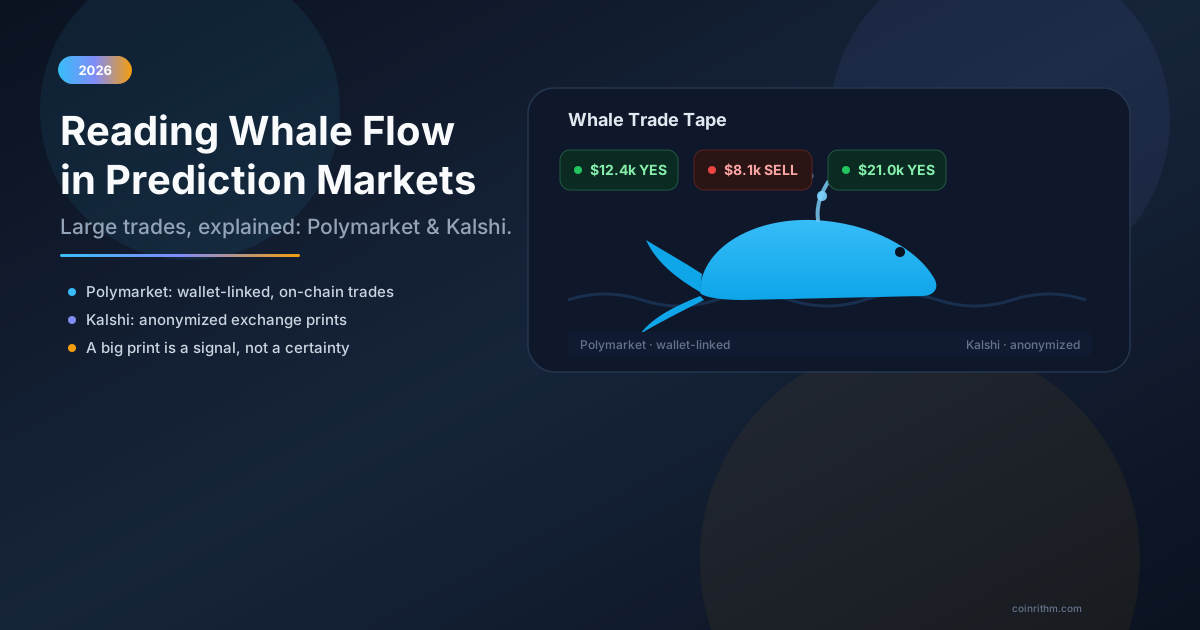
Continue reading: How to Read Prediction Market Whales — how to spot large positions and what they can (and can't) tell you before a market resolves.
Last Updated: July 4, 2026
Disclaimer: This article is for educational and informational purposes only. It is not financial, legal, or investment advice. Resolution mechanics, settlement sources, and platform policies can change — always verify a market's current rules directly with the platform before trading or holding a position through resolution.