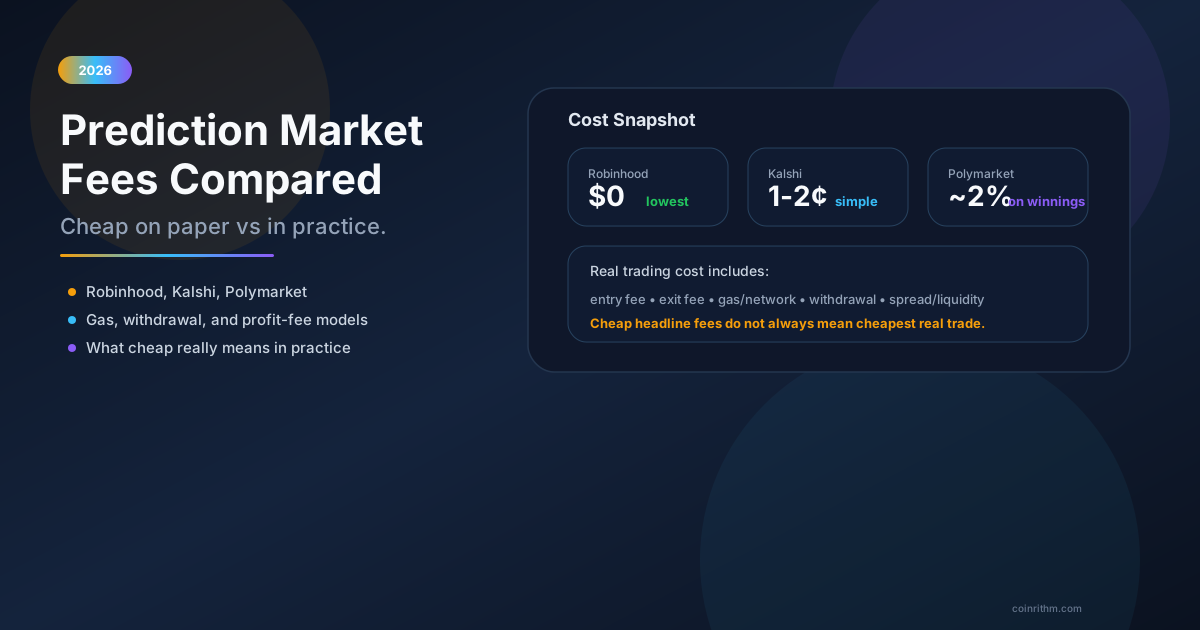
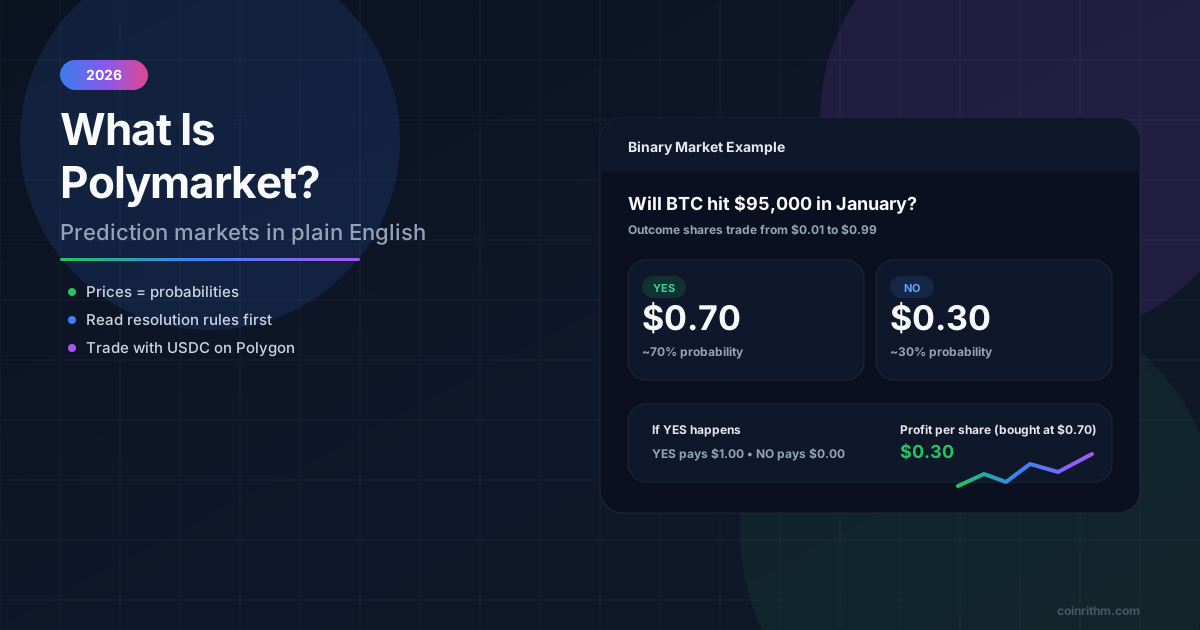
Polymarket built its reputation as the prediction market with basically no trading fee. That reputation is now only half true, and the other half changed in 2026.
Short answer: Polymarket charged no trading fee for most of its history. In 2026 it switched on a taker-only fee for most markets: shares × fee rate × price × (1 - price), with a rate of 0.04 to 0.07 depending on the category, or $1.00 to $1.75 on 100 shares bought at 50¢. Makers pay nothing, geopolitics markets are fee-free, deposits and withdrawals carry no Polymarket fee, and Polymarket's relayer pays the gas. The costs that actually catch people off guard are the spread, small conversion costs when money moves in or out, and, on Polymarket US, a separate fee schedule.
If you need the platform basics first, read What Is Polymarket?. This guide assumes you already know what Polymarket is and want the full cost picture: the trading fee, the gas cost almost nobody notices, what it costs to move money in and out, the spread, and the separate Polymarket US fee schedule. All figures were checked against Polymarket's own documentation on September 23, 2026.
TL;DR
- Polymarket's trading fee was zero for most of its history. Fees started on January 5, 2026 with 15-minute crypto markets and reached most categories on March 30, 2026.
- The fee is taker-only and set by category: 0.07 for crypto, 0.05 for sports, economics, culture, weather and other markets, 0.04 for politics, finance, tech and mentions. On 100 shares at 50¢ that is $1.75, $1.25 or $1.00.
- Makers pay nothing and share 15% to 25% of taker fees as daily rebates; geopolitics and world-events markets are fee-free.
- Gas is covered by Polymarket's relayer, so you never need POL in your wallet to trade.
- Deposits and withdrawals carry no Polymarket fee, but converting what you send or withdraw can cost a little: about 0.03% for USDC deposits in September 2026 quotes.
- Polymarket US (the CFTC-regulated app operated by QCX LLC) has its own schedule: takers pay up to $1.74 per 100 contracts, and makers earn a rebate.
- The cost most people miss entirely is the spread: crossing a wide order book often costs more than the fee.
How Polymarket's Fee Model Works
For most of Polymarket's history, its main differentiator versus regulated exchanges like Kalshi was that trading itself carried no fee: you paid the share price and nothing else. That is no longer the full picture. In 2026 Polymarket rolled out a taker fee with the same "priced-by-uncertainty" shape Kalshi uses (see Kalshi Fees Explained): fee = shares × fee rate × price × (1 - price).
In dollars, that fee is largest at 50¢, where the outcome is most uncertain, and shrinks toward 1¢ and 99¢. As a share of what you pay, it works the other way round: the fee equals fee rate × (1 - price) of your stake, so it weighs most on cheap longshots. A crypto share bought at 10¢ carries a fee of 6.3% of its cost, at 50¢ 3.5%, and at 90¢ 0.7%.
Two things still make Polymarket's model distinct:
- the fee only ever applies to the taker side of a trade, never to makers, and
- geopolitics and world-events markets remain completely fee-free by design.
Polymarket's docs say fees apply to "certain markets" and publish a fee setting for each market, so check the market you are trading rather than assuming its category rate.
The 2026 Taker Fee Rollout, by Category
Polymarket switched fees on in stages, according to its developer changelog:
- January 5, 2026: taker fees and maker rebates on 15-minute crypto markets.
- February 2026: 5-minute crypto markets launched with fees (February 12), and NCAAB college basketball and Serie A markets followed (February 18).
- March 6, 2026: all new crypto markets, including hourly, daily and weekly ones.
- March 30, 2026: "Fee Structure V2" extended fees to crypto, sports, finance, politics, economics, culture, weather, tech, mentions and other markets. Geopolitics stayed fee-free.
- July 10, 2026: the sports rate rose from 0.03 to 0.05, and the sports maker rebate fell from 25% to 15%.
As of September 23, 2026, Polymarket's fee documentation lists these rates:
| Category | Taker fee rate | Fee on 100 shares at 50¢ | Share of the $50 cost | Maker rebate |
|---|---|---|---|---|
| Geopolitics and world events | 0 | $0.00 | 0% | None (fee-free) |
| Finance, Politics, Tech, Mentions | 0.04 | $1.00 | 2.0% | 25% |
| Sports | 0.05 | $1.25 | 2.5% | 15% |
| Economics, Culture, Weather, Other / General | 0.05 | $1.25 | 2.5% | 25% |
| Crypto | 0.07 | $1.75 | 3.5% | 20% |
Sources: Polymarket's fee documentation and help center (updated July 10, 2026).
The same trade costs less in dollars away from 50¢. On 100 shares:
| Price | Politics, finance, tech, mentions (0.04) | Sports, economics, culture, weather, other (0.05) | Crypto (0.07) |
|---|---|---|---|
| 10¢ or 90¢ | $0.36 | $0.45 | $0.63 |
| 30¢ or 70¢ | $0.84 | $1.05 | $1.47 |
| 50¢ | $1.00 | $1.25 | $1.75 |
Worked example. You buy 100 Yes shares at 30¢ in a crypto market with a market order, which makes you the taker:
- Cost of the shares: 100 × $0.30 = $30.00
- Taker fee: 100 × 0.07 × 0.30 × 0.70 = $1.47
- Total paid: $31.47
- If Yes wins, the shares pay $100.00: a profit of $100.00 minus $31.47 = $68.53.
- If No wins, you lose the full $31.47.
Post the same order as a limit order that rests on the book until someone fills it, and the fee is $0.00. Selling before resolution with a market order is another taker trade and pays the formula again at the sale price. Fees are rounded to five decimal places, so very small trades near 1¢ or 99¢ can pay nothing at all.
The rates have already changed during 2026, most recently for sports on July 10, so treat these tables as a snapshot and check Polymarket's fee page for your market before trading.
Maker vs Taker: Who Actually Pays
Only takers, meaning orders that execute immediately against the book, pay the fee above. Maker orders, meaning limit orders that rest on the book until someone else fills them, are never charged. Polymarket also hands part of the fees back:
- Maker rebates. A share of each market's taker fees goes to the makers whose resting orders were filled, in proportion to the fee value of their fills: 20% in crypto, 15% in sports and 25% in the other fee-charging categories. Rebates are paid daily in pUSD once you have accrued at least $1 (Maker Rebates Program).
- Taker rebates. Since May 28, 2026, the Taker Rebate Program returns part of the fees to active takers. Tiers run from Bronze (3% back, from $2,000 of 30-day "weighted volume") to Obsidian (50% back, from $10 million). Weighted volume is trade size × (1 - entry price) × a category weight, so crypto trades count most and geopolitics trades not at all.
- Holding rewards. Polymarket's help center (updated June 1, 2026) lists a variable 3.25% annualized reward on positions in eligible markets, such as 2028 US presidential races, the 2026 midterms and some crypto price markets, funded by the Polymarket Treasury.
The practical lesson: if you can be patient and post a limit order rather than cross the book, you pay no fee on Polymarket and may earn a small rebate. On Kalshi, resting orders are free on most markets too, although some Kalshi series charge makers a quarter of the taker rate.
Gas and the Relayer: The On-Chain Cost You Don't See
Polymarket runs on Polygon. Orders are signed and matched on Polymarket's order book, and matched trades settle on Polygon; wallet actions such as approvals, claiming winnings and withdrawals are on-chain transactions too, which would normally cost gas in POL. Polymarket removes that friction with a relayer: you sign, Polymarket's relayer submits the transaction on-chain and pays the gas itself, and you never need to hold POL in your wallet to trade.
That is genuinely useful, but it is worth understanding it as a cost Polymarket absorbs rather than a cost that doesn't exist. It is one reason the platform needs revenue (see below), not evidence that blockchains are free.
Getting Money onto Polymarket: The Cost Before You Trade
The fee schedule above only starts once your funds are inside Polymarket. Getting them there no longer means bridging to Polygon yourself: on September 23, 2026, Polymarket's bridge accepted crypto on 15 networks, including Polygon, Ethereum, Base, Arbitrum, Solana and BNB Smart Chain, and it converts deposits automatically to pUSD, its balance token backed 1:1 by USDC.
Polymarket charges no deposit fee, but two small costs remain:
- Your sending fee. Your wallet or exchange charges its normal network or withdrawal fee to send.
- Conversion. In quotes from Polymarket's bridge on September 23, 2026, $100 of USDC arrived as about $99.96 to $99.97 of pUSD (about 0.03%), $100 of USDT on Tron or BNB Smart Chain as about $99.70 (about 0.3%), and USDC.e on Polygon converted 1:1.
Buying crypto with a card through MoonPay, where offered, carries MoonPay's own fees. Minimums start at $2 on most networks, and the deposit screen shows the one that applies to you. For every network and minimum, read Polymarket Deposit Methods and Supported Chains. For deposits over $50,000 from a chain other than Polygon, Polymarket's docs recommend a third-party bridge; How to Bridge USDC to Polygon for Polymarket covers that route.
Spread: The Cost No Fee Schedule Shows You
None of the numbers above capture the most common way traders overpay: the spread between the best bid and best ask on a thin order book. On an illiquid market, crossing a wide spread to get filled can cost far more than any taker fee, and it never shows up on a fee page because it isn't a fee; it's the market.
Before assuming a market is "cheap" because its category has a low taker rate, check the actual order book depth, not just the fee schedule.
Withdrawal Costs
On polymarket.com, withdrawing carries no Polymarket fee, and the relayer covers the network gas. What you can lose is a small conversion or routing cost, because your pUSD balance is converted back to USDC or another token for the network you pick. In Polymarket's bridge quotes on September 23, 2026, a $100 withdrawal cost under $0.01 as USDC on Polygon, $0.13 to $0.16 as USDC on Arbitrum, Optimism, Base or Solana, $0.56 as USDC on Ethereum and $1.06 as USDT on Tron, and most routes were estimated to arrive in under a minute. Send USDC rather than pUSD to an exchange, because some exchanges no longer accept pUSD.
Two other things decide when money is actually yours to move. Winnings become withdrawable only after the market resolves and you claim them: an undisputed outcome resolves about 2 hours after it is proposed to UMA's oracle, while a disputed one takes about 4 to 6 days. And converting USDC to cash on an exchange adds that exchange's own fees and timing, which sit outside Polymarket's fee structure. On Polymarket US, withdrawals are free and go back to your debit card or bank account, or out by wire.
See How to Withdraw from Polymarket for the full cash-out flow.
Polymarket US: A Separate Fee Schedule
"Polymarket" and "Polymarket US" are two different products with two different legal statuses, covered in full in Is Polymarket Legal in the US?, and they run two different fee schedules.
Polymarket US, the CFTC-regulated Designated Contract Market operated by QCX LLC, uses the same price × (1 - price) shape but one rate for every market, under a fee schedule effective September 17, 2026:
- Takers pay 0.0695 × contracts × price × (1 - price): at most $1.74 on 100 contracts at 50¢ (0.0695 × 100 × 0.50 × 0.50 = $1.7375, rounded to the nearest cent).
- Makers receive a rebate of 0.0125 × contracts × price × (1 - price), paid at the time of the fill: $0.31 on the same trade.
- High-volume takers get part of their taker fees back, based on the prior calendar month's taker volume: 10% from $250,000, 25% from $1 million and 50% from $10 million, paid weekly.
- Fees and rebates are rounded to the nearest cent with banker's rounding, and cancelled or expired orders pay nothing.
So the main differences from polymarket.com are a single rate instead of category rates, a maker rebate on every filled resting order instead of a share of a daily pool, and dollar accounts instead of pUSD. If you use Polymarket US, check its own schedule directly rather than assuming it matches either polymarket.com or Kalshi.
How Does Polymarket Make Money?
Trading fees are now the clearest answer. Since the 2026 rollout, takers pay the category fee on most markets, and Polymarket passes part of it back to makers and active takers through the rebate programs described above. Polymarket US and Polymarket Perps charge their own trading fees, and under a data deal, ICE (the owner of the New York Stock Exchange) distributes Polymarket signals and sentiment data to institutional investors.
Money also flows the other way: the relayer's gas, the rebates and the treasury-funded holding rewards are costs Polymarket carries. Deposits, withdrawals and geopolitics markets stay fee-free.
How CoinRithm Fits In
CoinRithm is an independent aggregator, not a broker, exchange, or wallet, and it is not affiliated with Polymarket, Polymarket US, or QCX LLC. What it is useful for here:
- checking the live Polymarket hub for real prices and volume before you decide whether a fee or a spread is actually worth paying,
- using the Compare view to see the same event priced across venues, since a lower headline fee on one platform means little if its price on that specific market is worse, and
- practicing sizing and order types in a paper-trading sandbox before any of this touches real funds.
Frequently Asked Questions
Is Polymarket free to trade on?
Not on most markets. Since 2026, orders that fill immediately (takers) pay shares × fee rate × price × (1 - price). The rate is 0.07 for crypto, 0.05 for sports, economics, culture, weather and other markets, and 0.04 for politics, finance, tech and mentions, so 100 shares bought at 50¢ cost $1.00 to $1.75 in fees. Resting limit orders and geopolitics markets pay nothing.
What are Polymarket's gas fees?
Effectively zero for the trader. Polymarket runs on Polygon, and its relayer submits your account's wallet transactions and pays the gas, so you never need to hold POL to trade. You only pay a network fee when you send crypto to Polymarket from your own wallet or an exchange, and that fee goes to the sending network, not to Polymarket.
Does Polymarket charge a withdrawal fee?
No. Polymarket charges no withdrawal fee and its relayer covers the gas, although converting your balance for the network you choose can cost a little. In Polymarket's bridge quotes on September 23, 2026, withdrawing $100 as USDC cost under $0.01 on Polygon and about $0.13 to $0.56 on Arbitrum, Optimism, Base, Solana or Ethereum. An exchange may charge its own fee to turn USDC into cash.
Is there a Polymarket deposit fee?
No. Polymarket charges no deposit fee, and you no longer have to bridge to Polygon yourself: it accepts crypto on 15 networks and converts it to pUSD automatically. You still pay your wallet's or exchange's network fee, and conversion cost about 0.03% for USDC and about 0.3% for USDT in quotes from September 23, 2026. Card purchases through MoonPay, where offered, carry MoonPay's own fees.
How does Polymarket make money?
Mainly from trading fees. Since 2026, takers pay a category-based fee on most markets, and Polymarket passes part of it back: 15% to 25% to makers as daily rebates, and 3% to 50% to active takers through its Taker Rebate Program. Polymarket US and Polymarket Perps charge their own trading fees, and ICE distributes Polymarket signals data to institutional investors under a data deal.
Are Polymarket US fees the same as Polymarket's?
No. Polymarket US, the CFTC-regulated exchange operated by QCX LLC, uses one rate for every market: takers pay 0.0695 × contracts × price × (1 - price), at most $1.74 per 100 contracts at 50¢, and makers receive a rebate of $0.31 on the same trade. That schedule took effect on September 17, 2026. Polymarket.com instead charges category rates from 0 to 0.07 and never charges makers.
Conclusion
Polymarket's fee story changed in 2026: the "free to trade" reputation is now "free if you make, a formula fee if you take, and still free on geopolitics." The fee line is not the only number that matters, though. Gas is hidden behind a relayer, deposits and withdrawals can carry small conversion costs, the spread can outweigh every fee on this page, and Polymarket US runs an entirely separate schedule.
Check the live numbers before you size a trade, and compare them against Kalshi Fees Explained and Prediction Market Fees Comparison if you are deciding between platforms.
Next Step
Need the platform basics first? Read What Is Polymarket?.
Deciding between platforms on cost? Read Prediction Market Fees Comparison or Kalshi Fees Explained.
Still need to fund your account? Read Polymarket Deposit Methods and Supported Chains.
Not sure Polymarket is accessible to you? Read Polymarket Countries and Availability and Is Polymarket Legal in the US?.
Want to see live markets before any of this matters? Start on the Polymarket hub.
Continue reading: Kalshi Alternatives.
Last Updated: September 23, 2026
Disclaimer: This article is for educational purposes only and is not financial advice. CoinRithm is an independent aggregator and is not affiliated with Polymarket, Polymarket US, or QCX LLC. Fee schedules, especially Polymarket's 2026 taker fees and rebates, can and do change, and the conversion quotes above are estimates from September 23, 2026. Always confirm current fees directly on Polymarket's own documentation before trading.