Prediction-market fees look small on paper, but they can change which platform is actually worth using.
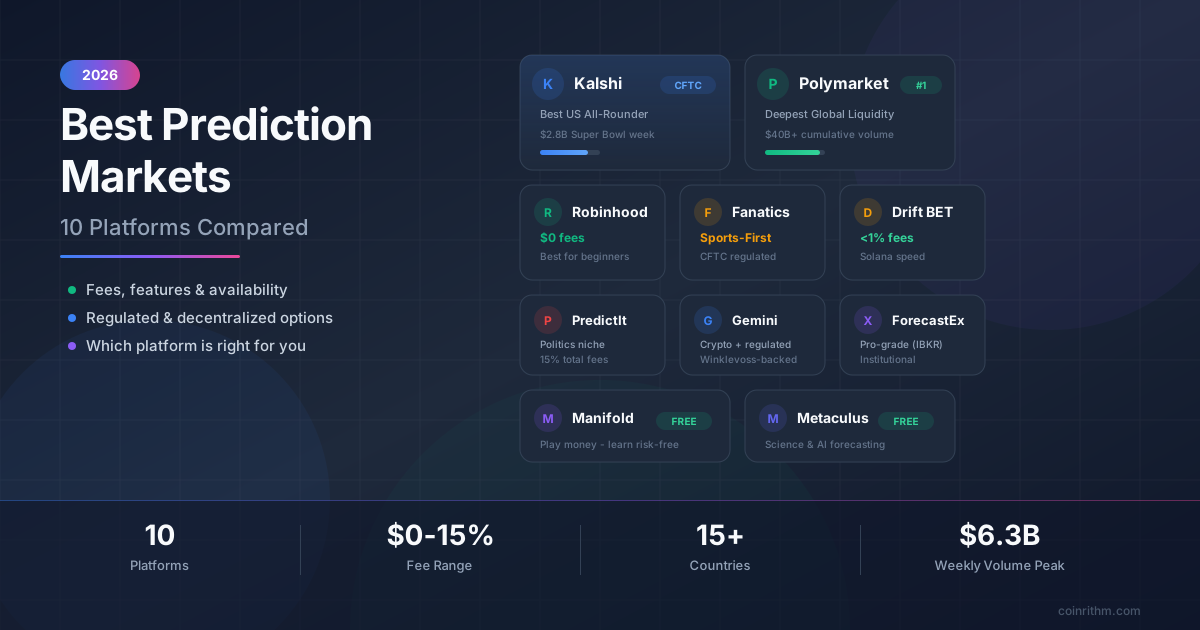
Short answer: Polymarket is usually the cheapest where you can use it, and PredictIt costs the most on a winning trade. On a $50 position (100 contracts bought at 50¢), polymarket.com charges takers $0 to $1.75 depending on the market category, Polymarket US $1.74, Kalshi and Gemini $1.75, and Robinhood and Fanatics Markets up to $2.00 (Robinhood's figure includes the exchange fee). PredictIt charges nothing to buy but takes 10% of your profit: $5.00 if that position wins. Resting limit orders are the cheapest way to trade: free on polymarket.com and most Kalshi markets, and paid a rebate on Polymarket US.
If you are searching for a direct prediction market fee comparison, this page is the practical answer page for that intent.
This guide compares the fee models used by the main prediction-market platforms and explains what those fees mean in practice. The goal is not just to list numbers. It is to show which cost model fits your style, trade size, and platform choice. All fees below were checked against each platform's own fee pages or help center on September 23, 2026.
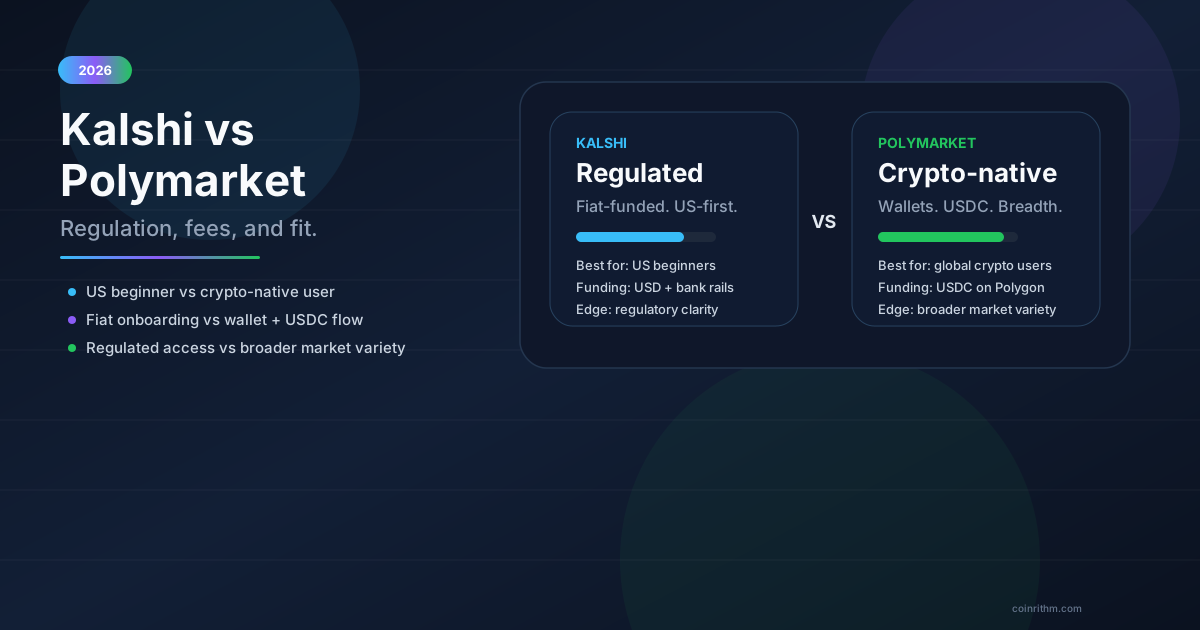
If you need the category explainer first, read What Are Prediction Markets in Crypto?. If you are deciding specifically between the two biggest names, read Kalshi vs Polymarket.
TL;DR
- Robinhood is convenient if you already use it, but it is no longer commission-free: since June 1, 2026 it charges up to 1¢ per contract, and the exchange adds up to 1¢ more.
- Polymarket (polymarket.com) is usually the cheapest where you can use it: makers pay nothing, and takers pay a category rate from 0 (geopolitics) to 0.07 (crypto) x shares x price x (1 - price), as Polymarket Fees Explained details. It is not open everywhere: Polymarket's help center lists 39 restricted countries, including the US.
- Kalshi, Polymarket US and Gemini charge takers about the same at 50¢, $1.74 to $1.75 per 100 contracts, and limit orders are free on most Kalshi markets and earn a rebate on Polymarket US.
- PredictIt is the most expensive on winning trades because it takes 10% of your profit, although it charges nothing to buy and standard withdrawals are free.
- The cheapest platform is not always the best platform if access, liquidity, and onboarding are worse for your situation.
Quick Answer: Which Prediction Market Has the Lowest Fees
In broad terms:
- Robinhood is no longer commission-free: counting the exchange fee, it can cost up to $2.00 on 100 contracts at 50¢, as can Fanatics Markets
- Polymarket is usually the cheapest where it is available: limit orders are free, and takers pay nothing on geopolitics markets and at most $1.75 per 100 shares elsewhere
- Kalshi, Polymarket US and Gemini charge takers about the same, $1.74 to $1.75 per 100 contracts at 50¢, and Kalshi remains competitive for users who want a regulated, fiat-funded exchange
- PredictIt is the most expensive platform in this group on a winning trade
But that answer needs context.
Because fee structure is only one part of total cost. You also need to think about:
- deposit friction
- withdrawal cost
- network cost
- spread and liquidity
- whether the platform actually has the market you want
Fastest Fee Summary
| User Type | Lowest-Friction Answer |
|---|---|
| Regulated US beginner | Kalshi or Polymarket US |
| US user who wants direct exchange access | Kalshi |
| Crypto-native user outside the US and Polymarket's restricted countries | Polymarket |
| User most likely to overpay | PredictIt |
Why Fee Models Matter More Than They Look
A platform can market itself as “cheap” and still cost you more in practice.
That happens when:
- spreads are wider
- withdrawal fees are high
- deposit methods are expensive
- you trade too often and let small fees compound
- the platform is cheap but the liquidity is worse
So when comparing prediction-market fees, the real question is not only:
“What does this platform charge?”
It is also:
“What does a real trade cost me from entry to exit?”
That is why fee comparison matters so much in this niche. Small edges disappear quickly if you are paying the wrong fee model for how you trade.
Quick Comparison Table
| Platform | Trading Fee | Deposit Cost | Withdrawal Cost | Network Cost | General Cost Profile |
|---|---|---|---|---|---|
| Robinhood | Commission of 10% x price x (1 - price) per contract (5% with Gold), capped at 1¢, plus an exchange fee of up to 1¢: up to $2.00 per 100 at 50¢ | Usually low friction | Standard platform flow | None | Convenient for Robinhood customers; no longer commission-free |
| Kalshi | Takers: 0.07 x contracts x price x (1 - price), rounded up ($1.75 per 100 at 50¢); makers free on most markets | ACH free; debit card up to 2% | No Kalshi fee (bank, card, PayPal, Venmo, crypto) | None, except network fees on crypto deposits | Competitive, simple, regulated |
| Polymarket (polymarket.com) | Takers: category rate (0 to 0.07) x shares x price x (1 - price) ($0 to $1.75 per 100 at 50¢); makers pay $0 | No Polymarket fee; conversion to pUSD cost about 0.03% (USDC) to 0.3% (USDT) in September 2026 quotes | No Polymarket fee; conversion cost under $0.01 to $1.06 per $100 by network in September 2026 quotes | Covered by Polymarket's relayer, no POL needed | Cheapest where available, especially with limit orders; closed to US residents |
| Polymarket US | Takers: 0.0695 x contracts x price x (1 - price) ($1.74 per 100 at 50¢); makers earn a rebate ($0.31 on the same trade) | No fee listed in its funding docs (debit card, ACH or wire) | Free | None | Kalshi-level taker cost; limit orders earn a rebate; US residents only |
| Gemini Predictions | Takers 0.07 and makers 0.0175 x contracts x price x (1 - price), rounded up ($1.75 or $0.44 per 100 at 50¢) | Per Gemini's transfer fee schedule | Per Gemini's transfer fee schedule | None | Kalshi-level taker cost, but makers pay too; US users only |
| Fanatics Markets | $0.00034 to $0.02 per contract bought or sold, highest near 50¢ (up to $2.00 per 100) | ACH free; debit card, Apple Pay, PayPal or Venmo up to 2% | Free by ACH or debit card | None | Up to 2¢ per contract on entry and again on exit |
| PredictIt | 10% of profit on a winning trade; $0 on losing or break-even trades | Bank transfer free; credit card 3% (first deposit up to $1,000 free) | No fee on standard withdrawals | None | Most expensive on winning trades |
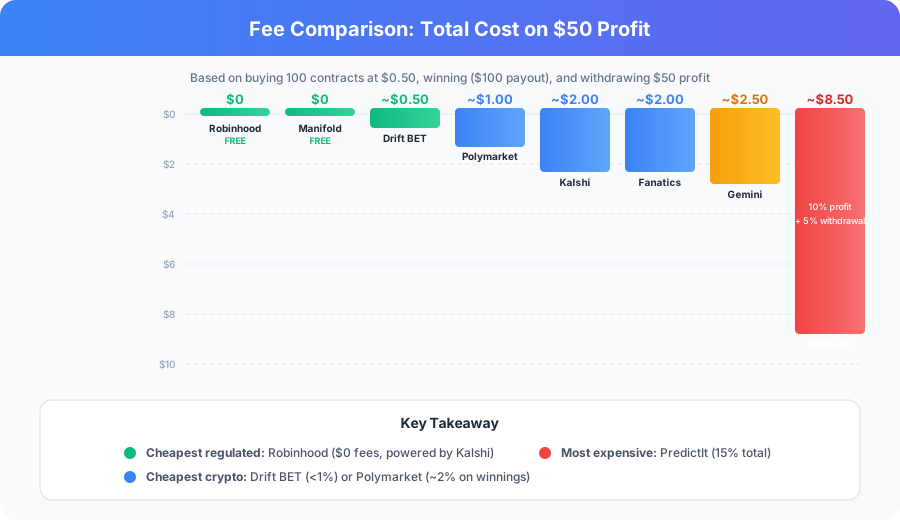
Worked example. You buy 100 contracts at 50¢ ($50) with an order that fills immediately (a taker order), hold them, and they win: the payout is $100, a $50 profit before fees.
| Platform | Fee on this trade | Arithmetic | Profit after fees |
|---|---|---|---|
| Polymarket, geopolitics market | $0.00 | Rate 0 | $50.00 |
| Polymarket, politics market | $1.00 | 100 x 0.04 x 0.50 x 0.50 | $49.00 |
| Polymarket, sports market | $1.25 | 100 x 0.05 x 0.50 x 0.50 | $48.75 |
| Polymarket US | $1.74 | 100 x 0.0695 x 0.50 x 0.50 = $1.7375, rounded to the cent | $48.26 |
| Kalshi, Gemini, or a Polymarket crypto market | $1.75 | 100 x 0.07 x 0.50 x 0.50 | $48.25 |
| Robinhood | $1.00 to $2.00 | $1.00 commission (capped at 1¢ per contract) plus an exchange fee of up to $1.00 | $48.00 to $49.00 |
| Fanatics Markets | Up to $2.00 | Up to $0.02 x 100 | $48.00 or more |
| PredictIt | $5.00 | 10% x $50 profit | $45.00 |
Selling before resolution is another trade, so it pays the trading fee again (at the sale price on formula-based venues), and PredictIt takes 10% of any profit on the sale.
What changed in 2026: Kalshi, Polymarket, Polymarket US and Gemini now all charge takers the same shape of fee, rate x contracts x price x (1 - price), which peaks at 50¢ and shrinks toward 1¢ or 99¢, and Robinhood's new commission uses it too, with a 1¢ cap. Polymarket switched on taker fees in stages from January 5 to March 30, 2026 and raised its sports rate from 0.03 to 0.05 on July 10, 2026. Robinhood replaced its flat commission on June 1, 2026, Kalshi's current schedule took effect on July 7, 2026, and Polymarket US's on September 17, 2026. For Polymarket's rebates and what still costs nothing there (gas, deposits and withdrawals), see Polymarket Fees Explained.
Fee structure matters, but it only becomes meaningful when you combine it with your actual workflow.
How Each Platform Charges Users
Robinhood
Robinhood is no longer commission-free. Since June 1, 2026, it charges a commission of 10% x price x (1 - price) per contract, or 5% with Robinhood Gold ($5 a month), rounded up to the cent and capped at 1¢ per contract. The exchange that lists the contract (Kalshi, ForecastEx or Rothera) typically adds a fee of up to 1¢ per contract.
- At 50¢ the cap applies with or without Gold: a $1.00 commission on 100 contracts, plus up to $1.00 in exchange fees.
- At 90¢, Robinhood's own example puts 100 contracts at $90.00 plus a $1.00 exchange fee plus a $0.90 commission ($91.90), or a $0.45 commission with Gold ($91.45).
- Only US residents can trade, Maryland residents cannot trade sports contracts, and Nevada residents cannot open new sports positions.
Robinhood still offers easy regulated onboarding if you already have an account, but it is no longer the obvious low-cost choice, so compare its all-in cost with trading on Kalshi directly.
Kalshi
Kalshi charges takers (orders that fill immediately) 0.07 x contracts x price x (1 - price), rounded up to the cent, under a fee schedule effective July 7, 2026. On 100 contracts that is $1.75 at 50¢, $1.47 at 30¢ or 70¢, and $0.63 at 10¢ or 90¢. Resting maker orders are free on most markets; a listed set of series, mostly sports and major economic markets, charges makers 0.0175 x the same, a quarter of the taker rate. There is no settlement or membership fee. Bank (ACH) deposits are free, debit card deposits cost up to 2%, and withdrawals by bank, card, PayPal, Venmo or crypto carry no Kalshi fee.
That tends to work well for:
- US users, and users in the many other countries Kalshi accepts
- traders who want clearer regulatory framing
- users who prefer bank-account onboarding over wallets
Kalshi may not always look like the absolute cheapest option on paper, but it often wins on the mix of:
- reasonable cost
- strong liquidity
- cleaner beginner experience
Polymarket
Polymarket built its reputation on charging effectively no trading fee. That changed in 2026. On polymarket.com today only takers pay: shares x fee rate x price x (1 - price). The rate is 0.07 for crypto, 0.05 for sports, economics, culture, weather and other markets, 0.04 for politics, finance, tech and mentions, and 0 for geopolitics and world events, so 100 shares at 50¢ cost $1.75, $1.25, $1.00 or nothing in fees. Maker orders (limit orders that rest on the book) pay nothing and share 15% to 25% of taker fees as daily rebates. Deposits and withdrawals carry no Polymarket fee, and gas is covered by Polymarket's relayer, so you never need POL in your wallet to trade. For the full category-by-category breakdown, read Polymarket Fees Explained.
This often works well for:
- crypto-native users, especially those posting maker (limit) orders instead of crossing the book
- traders already comfortable with crypto (balances are held in pUSD, backed 1:1 by USDC)
- users outside the US and Polymarket's restricted countries who want broad market variety
Polymarket is often one of the most cost-efficient ways to trade if:
- you already know how to move crypto
- you use limit orders where possible to avoid the taker fee entirely
- you are not adding unnecessary funding friction
- you care about broader market variety as much as raw cost
Note that Polymarket US, the CFTC-regulated app for US residents operated by QCX LLC, has its own schedule, effective September 17, 2026, with one rate for every market. Takers pay 0.0695 x contracts x price x (1 - price), at most $1.74 on 100 contracts at 50¢, and makers receive a rebate of 0.0125 x the same, $0.31 on that trade. Withdrawals are free. See Polymarket Fees Explained for that breakdown too.
Gemini Predictions and Fanatics Markets
Gemini Predictions, which is open to US users only, uses the same rates as Kalshi for contracts listed from March 18, 2026: takers pay 0.07 x contracts x price x (1 - price) and makers 0.0175 x the same, both rounded up to the next cent. On 100 contracts at 50¢ that is $1.75 for a taker and $0.44 for a maker (0.0175 x 100 x 0.50 x 0.50 = $0.4375, rounded up), so resting orders are not free there.
Fanatics Markets, offered through a CFTC-registered broker in 22 US states and four territories, charges a total trading fee of $0.00034 to $0.02 per contract each time you buy or sell, highest for contracts near 50¢: up to $2.00 on 100 contracts, and again if you sell before resolution. ACH deposits and ACH or debit card withdrawals are free, while debit card, Apple Pay, PayPal and Venmo deposits can cost up to 2% (fee disclosure effective September 2, 2026).
PredictIt
PredictIt is the clearest example of why “familiar” can still be expensive. It charges nothing to buy, but it takes 10% of your profit whenever you sell a share for more than you paid or a share pays out $1 at resolution. There is no fee on losing or break-even trades and no fee on standard withdrawals. Bank transfers are free, and credit card deposits cost 3%, except the first deposit of up to $1,000.
Its fee model can become painful because:
- the 10% profit fee is the highest headline rate here on a winning trade: $5.00 on a $50 position bought at 50¢ that wins, against $1.75 on Kalshi
- on cheap long shots the fee grows with the profit: 100 contracts bought at 10¢ ($10) that win pay $90 of profit and a $9.00 fee
That makes it meaningfully worse for anyone who cares about keeping returns on winning trades.
What Fees Mean in Real Trading
A good beginner rule:
- low fees help
- but low fees only matter if the market is worth trading in the first place
Example:
- A “cheap” platform with weak liquidity can still cost you more through bad fills.
- A slightly more expensive platform with better liquidity can still be the better trade.
This is why you should separate:
- headline fee from
- real trading cost
Real trading cost includes:
- entry cost
- exit cost
- deposit friction
- withdrawal friction
- network costs
- spread
If you trade frequently, this matters even more. Small recurring costs can quietly erase your edge.
Worked Example Mindset
Think about fee comparison at three levels:
| Scenario | What Matters Most |
|---|---|
| One small beginner trade | Simplicity and low friction matter more than perfect fee optimization. |
| Frequent event trading | Small recurring fees, spreads, and withdrawal friction compound fast. |
| Crypto-native user already holding stablecoins | On-chain cost efficiency matters more than fiat onboarding. |
Cheapest Platform by User Type
For regulated US beginners
Best fee fit:
- Kalshi
- Polymarket US
Why:
- simple onboarding
- low obvious friction
- no wallet complexity
- taker fees of at most $1.75 per 100 contracts, and limit orders that are free on most Kalshi markets or earn a rebate on Polymarket US
Robinhood is also simple if you already have an account, but it now charges a commission, and typically an exchange fee, on every trade.
For crypto-native users
Best fee fit:
- Polymarket, if you live outside the US and its restricted countries
Why:
- no Polymarket deposit or withdrawal fee, and gas paid by its relayer
- better fit if you already hold and move stablecoins
- using maker (limit) orders avoids the taker fee entirely, and geopolitics markets are fee-free even for takers
For users who care most about cost discipline over time
Avoid:
- high-withdrawal-fee models
- profit-based fees that take a share of every win
- platforms where the fee math is small but the spreads are ugly
That is why a platform like PredictIt, which charges nothing to buy but 10% of every profit, can feel fine at first and then look much worse once you consider total return drag.
How to Compare Fees with CoinRithm
Use CoinRithm Prediction Markets before funding a platform. If you want a faster platform-level view first, start with Prediction Market Sources and the compare page.
That helps with the part fee tables do not show:
- whether the platform has the markets you care about
- whether the market is active enough to justify the trade
- whether the opportunity is even worth paying fees on
Best workflow:
- Open CoinRithm Prediction Markets.
- Find the type of market you actually want to trade.
- Check whether the market is active and worth your attention.
- Then decide whether a regulated platform like Kalshi or a crypto-native one like Polymarket fits better, and if access is the main constraint check the availability guide.
If your main question is platform choice overall, read Best Prediction Markets in 2026.
If your main question is only the head-to-head between the two biggest names, read Kalshi vs Polymarket.
Frequently Asked Questions
Which prediction market platform has the lowest fees?
It depends on the market and how you trade. On a $50 position (100 contracts at 50¢), polymarket.com charges takers nothing on geopolitics markets and $1.00 to $1.75 elsewhere, Polymarket US $1.74, Kalshi and Gemini $1.75, Robinhood up to $2.00 with exchange fees, and Fanatics Markets up to $2.00. Limit orders that rest on the book are free on polymarket.com and most Kalshi markets, and earn a rebate on Polymarket US.
What is the cheapest prediction market site?
Where you can use it, polymarket.com is usually the cheapest: makers pay nothing, and takers pay a category fee that is zero on geopolitics markets and at most $1.75 per 100 shares. It is not open everywhere, though: its help center lists 39 restricted countries, including the US. In the US, Kalshi and Polymarket US cost takers about the same ($1.75 and $1.74 per 100 contracts at 50¢), and Polymarket US pays makers a rebate.
Is Kalshi cheaper than Polymarket?
Usually not. Both charge takers rate x contracts x price x (1 - price). Kalshi's rate is 0.07, the same as Polymarket's crypto rate, while Polymarket charges 0.05 on sports, economics, culture, weather and other markets, 0.04 on politics, finance, tech and mentions, and nothing on geopolitics. At 50¢ that is $1.75 per 100 contracts on Kalshi against $0 to $1.75 on Polymarket. Makers pay nothing on Polymarket and on most Kalshi markets. US residents cannot use polymarket.com, so for them the comparison is Kalshi against Polymarket US ($1.74).
Why is PredictIt considered expensive?
Because it takes 10% of your profit on every winning trade, the highest headline rate among the platforms here: a $50 position bought at 50¢ that wins pays a $5.00 fee, against $1.75 on Kalshi. PredictIt charges nothing to buy, nothing on losing or break-even trades and nothing on standard withdrawals, but credit card deposits cost 3%, except the first deposit of up to $1,000.
Are low fees enough reason to pick a platform?
No. Liquidity, onboarding, legality, and market availability still matter.
Do gas fees matter much on Polymarket?
Not for the trader in practice: Polymarket's relayer submits your account's wallet transactions and pays the gas, so you never need to hold POL. You only pay a network fee when you send crypto to Polymarket from your own wallet or an exchange. The costs actually worth watching are the category-based taker fee and the bid-ask spread on the market you're trading; see Polymarket Fees Explained for both.
Does Robinhood charge prediction market fees?
Yes. Since June 1, 2026, Robinhood charges a commission of 10% x price x (1 - price) per contract, or 5% with Robinhood Gold, rounded up to the cent and capped at 1¢ per contract, and exchanges typically add up to 1¢ per contract. On 100 contracts at 50¢ that is a $1.00 commission plus up to $1.00 in exchange fees.
Are Polymarket and Polymarket US fees the same?
No. Polymarket.com charges takers a category rate from 0 to 0.07 and never charges makers. Polymarket US, the CFTC-regulated exchange operated by QCX LLC, uses one rate for every market: takers pay 0.0695 x contracts x price x (1 - price), at most $1.74 per 100 contracts at 50¢, and makers receive a rebate, $0.31 on the same trade. See Polymarket Fees Explained for the full breakdown.
Conclusion
The cheapest prediction-market platform is not always the best one for you.
But the fee hierarchy is still useful:
- Robinhood is convenient for existing customers, but it is no longer commission-free
- Kalshi is a strong low-friction regulated option
- Polymarket is one of the strongest cheap crypto-native options where you can use it, especially with maker (limit) orders under its 2026 fee model
- PredictIt is the most expensive of the mainstream platforms covered here on a winning trade
The best way to use this information is simple:
- compare fee models
- compare platform fit
- compare actual market availability
Then choose the cheapest platform that still matches your location, workflow, and market needs.
Next Step
Need the broad platform comparison? Read Best Prediction Markets in 2026.
Browse by source: Kalshi · Polymarket · PredictIt. Each source hub shows live markets so you can judge activity before comparing fees.
Need the direct two-platform decision page? Read Kalshi vs Polymarket.
Want the full Polymarket fee breakdown? Read Polymarket Fees Explained.
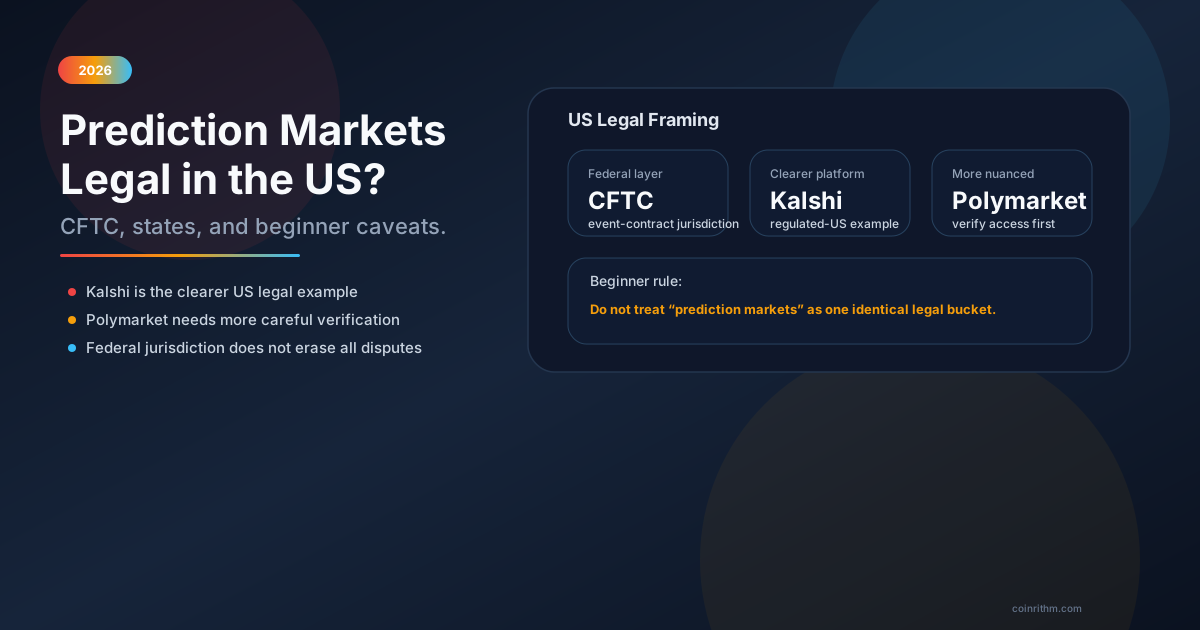
Need the legality and access context first? Read Are Prediction Markets Legal in the US? and Polymarket Countries and Availability.
Want to browse live markets before paying any fees anywhere? Start on CoinRithm Prediction Markets.
Last Updated: September 23, 2026
Disclaimer: This article is for educational purposes only and is not financial advice. Platform fees, access rules, and product details can change. Always verify current pricing directly before trading.