Polymarket not working for you, or just want to know what else is out there before you commit funds?
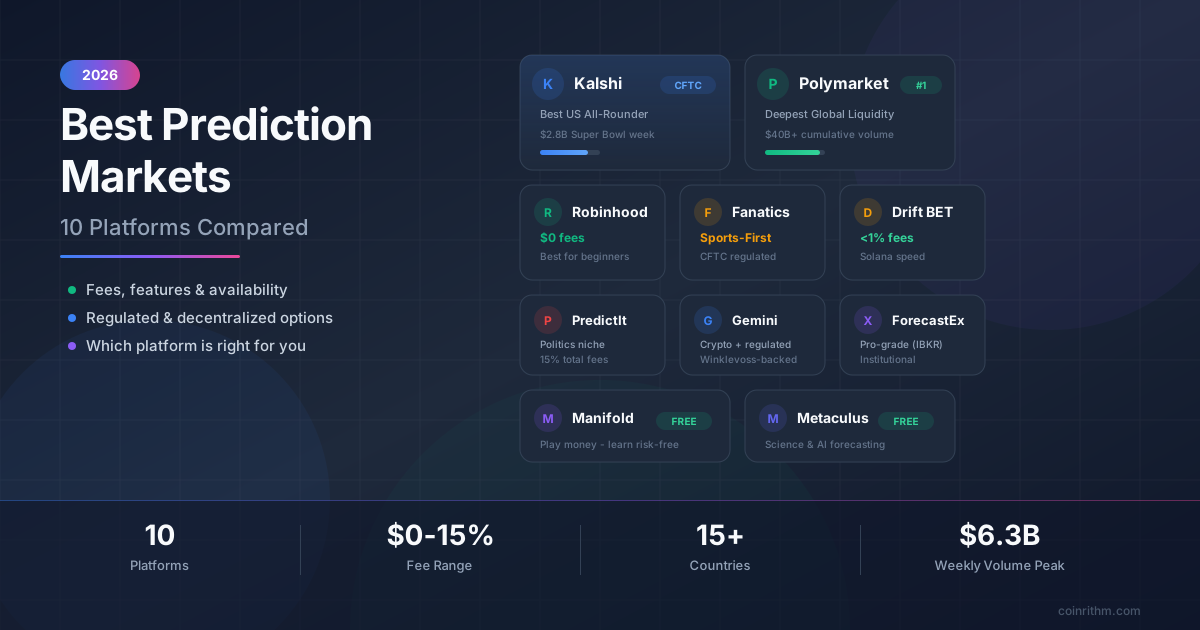
If you searched for polymarket alternatives, sites like polymarket, polymarket competitors, or apps like polymarket, this is the page for that intent. It is not another "best overall" ranking. For the full ranked comparison across 17 platforms, read Best Prediction Markets in 2026 instead. This article starts from Polymarket as the reference point and asks a narrower question: what should you actually use instead, and why?
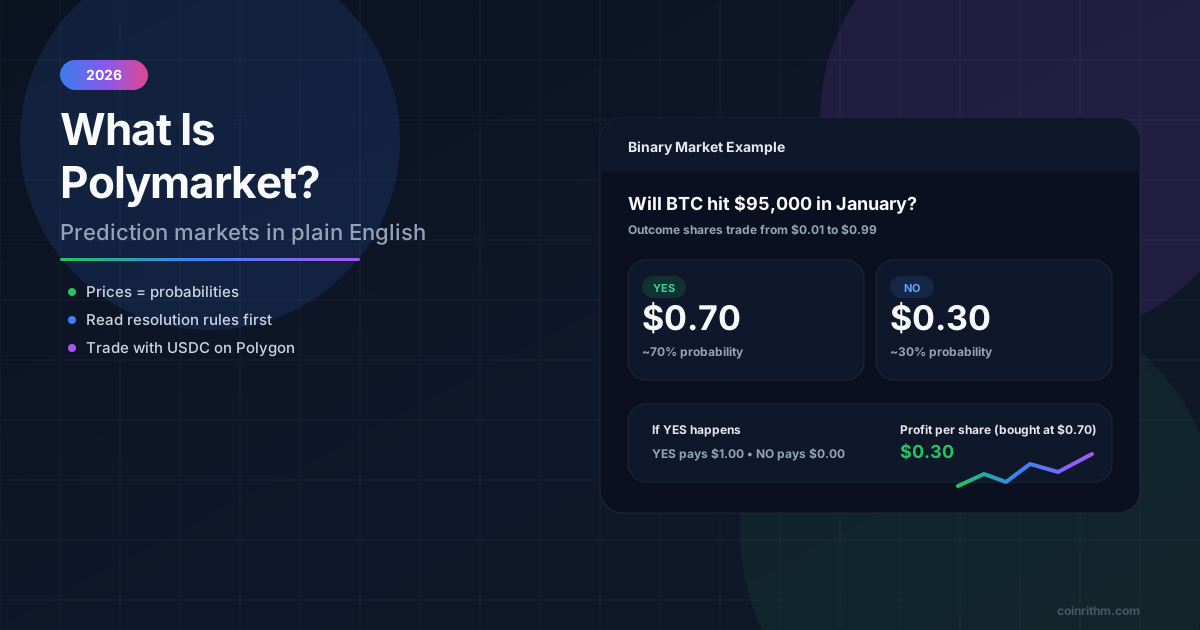
If you have not read the Polymarket basics yet, start with What Is Polymarket? first - it will make the comparisons below easier to follow.
TL;DR
- People look for Polymarket alternatives for a handful of specific reasons: US access history, wanting a regulated venue, wanting fiat instead of crypto, wanting to practice with play money first, or wanting different market coverage.
- Want US regulation and fiat funding: Kalshi - CFTC-regulated exchange.
- Want long-running US politics, no crypto, small stakes: PredictIt, a legacy not-for-profit platform under a CFTC no-action framework.
- Want a UK or Irish exchange-style venue: Smarkets, a peer-to-peer back/lay betting exchange.
- Want zero-risk practice with huge topic breadth: Manifold - play-money community markets.
- Want research-grade forecasting, not trading: Metaculus, reputation-based with no money staked.
- Want crypto-native, fast-resolving markets: Limitless - on-chain, crypto-settled.
- There is no single "best" alternative - each solves a different problem Polymarket doesn't. Compare them side by side on CoinRithm's comparison page before choosing.
Why Look for a Polymarket Alternative
"Sites like Polymarket" is a broad search, but the underlying reasons people land on it tend to fall into a short list. Being specific about which one applies to you is the fastest way to pick the right platform, instead of just trying the first name that comes up in a listicle.
1. US access history. Polymarket's US availability has evolved over time, and it now runs two separate products. Polymarket.com is closed to US residents, who cannot deposit or place trades there; they are directed to Polymarket US, a separate CFTC-regulated app that trades in US dollars and whose accounts are not connected to polymarket.com. Polymarket's help center also lists 39 restricted countries, including the US, the UK, Germany, France and Australia, plus four Canadian provinces. If you are in the US and want a platform with a clearer regulatory story from day one, that is a different search than "which platform has the most markets." Read Polymarket Countries and Availability for the specific access picture before assuming Polymarket does or doesn't work for you. This section is about what to do if you want an alternative regardless.
2. Wanting a regulated venue. Polymarket.com settles on-chain through smart contracts and a decentralized oracle, and it is not regulated by the CFTC, which is a different trust model than a government-regulated exchange. Some traders specifically want the latter: segregated funds, a formal regulator, a compliance framework they can point to. Polymarket US is CFTC-regulated, but it is open only to US residents.
3. Wanting fiat, not crypto. Polymarket.com runs on crypto: you fund it by sending crypto or, where offered, by buying crypto with a card through MoonPay, and your balance is held in pUSD, a token on Polygon backed 1:1 by USDC. If acquiring and managing crypto is the actual barrier - not the trading concept - you want a platform that takes a bank card or bank transfer directly.
4. Wanting to practice with play money first. Some people are not ready to risk real money (crypto or fiat) on any platform yet. They want to learn how prices move, how resolution rules work, and how markets close - without financial stakes.
5. Wanting different market coverage. Polymarket's catalog skews toward politics, crypto, sports, and global news. If your interest is UK/EU politics and sports through an exchange model, or long-range scientific and technology forecasting, Polymarket's catalog is simply not built for that.
Each of these five reasons points somewhere different. There is rarely one "Polymarket alternative" - there is your reason, and the platform that was built to answer it.
Quick Answer: Which Alternative Fits Your Need
| If your main reason is... | Go to... | Why |
|---|---|---|
| US access and a regulated exchange | Kalshi | CFTC-regulated Designated Contract Market, fiat funding |
| Long-running US politics, fiat only, small stakes | PredictIt | Operates under a CFTC no-action framework, USD accounts |
| UK or Irish exchange-style access to politics and sports | Smarkets | Peer-to-peer back/lay betting exchange, licensed in the UK and Ireland |
| Zero financial risk while learning | Manifold | Play-money (mana), no real currency at stake |
| Long-range or scientific forecasting, not trading | Metaculus | Reputation-based, nothing to stake or trade |
| Crypto-native, fast-resolving, on-chain markets | Limitless | On-chain settlement, shorter-duration markets |
| Not sure yet - want to see live markets across all of them first | CoinRithm Prediction Markets | Aggregated view before you pick a platform |
If none of these map cleanly to your situation, the broader ranked comparison in Best Prediction Markets in 2026 covers additional platforms (including Polymarket US, Robinhood, Fanatics Markets, Gemini Predictions and ForecastEx) that this page does not focus on.
The Alternatives, One by One
Kalshi - The Regulated US Alternative
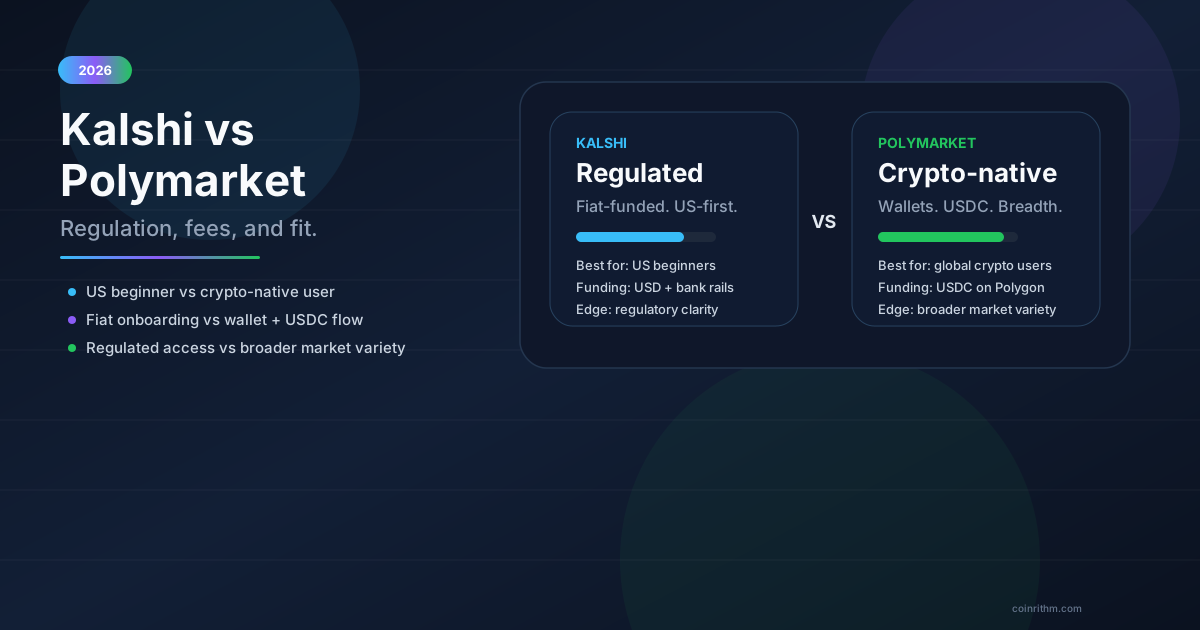
Kalshi is a US event-contract exchange regulated by the CFTC as a Designated Contract Market (DCM) - the same regulatory classification used by major US futures exchanges. That is the core reason people move from Polymarket to Kalshi: it trades real-world event outcomes the same way Polymarket does, but inside a formally regulated exchange with fiat (bank transfer, debit card) funding instead of a crypto wallet.
Markets are binary Yes/No contracts settling at $0.00 or $1.00, and Kalshi has expanded well beyond its original macro-economic focus into sports, politics, culture, and weather.
Read the full explainer: What Is Kalshi?
Honest caveats: Kalshi is not US-only, but it is not open everywhere either. It accepts users in the US and many other countries, while its Member Agreement (September 20, 2026) restricts 55 jurisdictions, including the UK, Canada, Australia, France, Italy, Ireland and Switzerland, so check Kalshi Countries and Availability before counting on it outside the US. It also has a narrower catalog for niche or global topics than Polymarket. If you want exact current fee figures, do not rely on secondhand numbers - check kalshi.com directly, or read our dedicated fee-comparison coverage.
PredictIt - The Legacy US Political Market
PredictIt is one of the longest-running real-money political prediction markets in the US. It is run as a project of the not-for-profit Prediction Market Research Consortium, with Aristotle International handling identity verification and clearing, under a CFTC no-action letter granted in October 2014. That regulatory arrangement is the reason for almost everything distinctive about the platform: politics-only market focus, a cap of $3,500 per trader in any single contract, and an educational, not-for-profit framing rather than a pure commercial-trading one.
People move to PredictIt from Polymarket specifically when they want US-accessible political markets funded in USD, and they are comfortable trading at a much smaller scale than Polymarket allows.
Read the full explainer: What Is PredictIt?
Honest caveats: Politics only - no crypto, sports, or general-interest markets. The $3,500 cap is small by design, and only U.S. persons (US citizens living anywhere, or resident aliens) can trade. PredictIt's no-action letter has been legally contested before, and regulatory status for no-action-letter platforms can change - verify PredictIt's current operating status directly before depositing funds.
Smarkets - The UK/EU Betting Exchange
Smarkets is a UK-based peer-to-peer betting exchange covering politics, sports, and current affairs. Like Polymarket, it matches you against other users' orders rather than a bookmaker, but the format differs: instead of buying a share that resolves to $1 or $0, you back or lay an outcome at betting odds. Smarkets' standard commission is 2% of your net winnings in each market, while polymarket.com charges a category-based fee on orders that fill immediately and nothing on resting orders.
This is the natural move for a UK or Irish user who wants exchange-style odds without a crypto wallet (polymarket.com restricts both countries), and who is comfortable with betting-exchange mechanics (back and lay) rather than the buy/sell-shares model Polymarket uses.
Read the full explainer: What Is Smarkets?
Honest caveats: Smarkets is not a Europe-wide option. It is licensed by the UK Gambling Commission and in Ireland, and its terms bar residents of, or people located in, countries including the US, Australia, France, Italy, the Netherlands, Switzerland and Turkey. Coverage skews toward UK/EU politics and sports rather than the global and crypto-specific markets Polymarket lists. Commission tiers and regional availability can change, so verify directly at smarkets.com or check CoinRithm's availability page for your country.
Manifold - The Play-Money Practice Ground
Manifold is a free, community-driven prediction market that uses a virtual currency called mana instead of real money. Anyone can create a market on any topic, which produces an enormous breadth of markets, at the cost of lighter curation and no financial incentive backing the accuracy of any given price.
This is the answer for the "wanting to practice with play money first" reason above: you can learn how prices move, how resolution rules read, and how a market closes, without financial stakes of any kind.
Read the full explainer: What Is Manifold?
Honest caveats: No real money means no real profits, and no real skin in the game backing the crowd's collective estimate - treat Manifold prices as directional community sentiment, not a financial signal with the same weight as Polymarket or Kalshi. Market quality varies since anyone can create one.
Metaculus - Reputation-Based Forecasting, Not Trading
Metaculus is not a trading venue at all - it is a reputational forecasting platform. Forecasters submit probability estimates on questions and are scored on accuracy over time. There are no shares to buy and no money at stake: forecasts are scored rather than paid out, although some tournaments award cash prizes to the most accurate forecasters.
People land here from a Polymarket search when what they actually want is long-range or scientific forecasting - AI milestones, climate questions, technology timelines - the kind of multi-year question that a liquidity-dependent trading market struggles to price well.
Read the full explainer: What Is Metaculus?
Honest caveats: If what you actually want is to trade - buy a position, watch it move, close it for profit or loss - Metaculus does not do that. It is a complementary research tool, not a Polymarket substitute for anyone who wants to place a wager.
Limitless - Crypto-Native and Fast-Resolving
Limitless is an on-chain prediction market built for crypto-native participants. Like Polymarket, it settles fully on-chain through smart contracts rather than a company custodian - but it leans toward shorter-duration, faster-resolving markets than Polymarket's typically longer-running event contracts.
This is the move for someone who is not trying to leave crypto behind (unlike the Kalshi or PredictIt paths above) but wants a different market cadence: shorter cycles, quicker resolution, and a platform built assuming the user is already comfortable with wallets and gas fees.
Read the full explainer: What Is Limitless?
Honest caveats: This does not solve the "I want fiat, not crypto" reason - it assumes the same crypto-wallet fluency Polymarket does, arguably more so. It also does not solve the "I want a regulated venue" reason - it is decentralized like Polymarket, not a CFTC-regulated alternative. It does not solve the US access reason either: its terms (updated September 15, 2026) close trading to users from the United States and from the Canadian provinces of Ontario and Alberta.
Side-by-Side Comparison Table
| Venue | Model | Currency | Best For |
|---|---|---|---|
| Polymarket (polymarket.com) | Decentralized, on-chain (Polygon) | Crypto (pUSD, backed 1:1 by USDC) | Broad market variety outside the US and its other restricted countries; the reference point |
| Kalshi | Centralized, CFTC-regulated exchange (DCM) | Fiat (USD) | US traders, and eligible traders in many other countries, who want a regulated, fiat-funded venue |
| PredictIt | Centralized, CFTC no-action framework | Fiat (USD) | Long-time US political traders comfortable with a $3,500 per-contract cap |
| Smarkets | Peer-to-peer betting exchange (back/lay) | Fiat (GBP and others) | UK and Irish users who want exchange-style odds |
| Manifold | Play-money community market | Mana (virtual, no cash value) | Risk-free practice and the widest topic breadth |
| Metaculus | Reputation-based forecasting, no trading | None (nothing is staked; some tournaments pay cash prizes) | Long-range, scientific, and research-grade forecasting |
| Limitless | Decentralized, on-chain (Base), crypto-native | Crypto (USDC) | Fast-resolving, short-duration on-chain markets outside the US |
For exact, current fee figures on any of these platforms, do not rely on numbers quoted in articles - check each platform directly, since fee schedules change. If cost is genuinely your deciding factor, read Prediction Market Fees Comparison for the dedicated breakdown.
What Actually Changes When You Switch From Polymarket
Moving off Polymarket is rarely a strict upgrade or downgrade - it is a trade-off along a few consistent axes:
- Regulation vs. decentralization. Kalshi and PredictIt hand you a formal regulatory framework in exchange for narrower catalogs and (for PredictIt) small position caps. Polymarket.com and Limitless hand you on-chain access with no identity check at sign-up, in exchange for no regulator to appeal to, and both still close trading to US users and some other jurisdictions.
- Fiat vs. crypto. Kalshi, PredictIt, and Smarkets remove the crypto wallet entirely. Limitless assumes crypto fluency at least as much as Polymarket does.
- Real money vs. reputation vs. play money. Manifold and Metaculus both remove financial risk, but for different reasons - Manifold keeps the trading mechanic with fake stakes, Metaculus removes the trading mechanic entirely in favor of a scored forecast.
- Market cadence and catalog. Smarkets and PredictIt are narrower by design (politics/sports and politics-only, respectively). Limitless trades breadth for speed. None of them attempt to replicate Polymarket's broad, global, always-on catalog one-for-one.
Understanding which axis matters to you is more useful than asking "which is the best Polymarket alternative" in the abstract - the honest answer depends entirely on which of the five reasons in the first section applies to you.
There Is No Single Best Alternative
If you came here wanting one clean answer, the honest one is that there isn't one. A US trader who wants CFTC regulation, a UK bettor who wants exchange-style odds, a beginner who wants to practice risk-free, and a researcher who wants long-range forecasts are looking for four different things - and four different platforms answer them correctly. Picking based on your actual reason (from the first section) will get you to the right venue faster than picking based on hype or headline volume.
How CoinRithm Fits In
CoinRithm is a prediction market aggregator, not a trading venue for any of the platforms above. It lets you research markets across Polymarket, Kalshi, Limitless, and other sources in one place - before deciding which platform to actually trade on.
What you can do on CoinRithm:
- Browse without an account or a wallet. See markets, prices, and trends across sources without signing up anywhere.
- Compare platforms directly. Use the prediction market comparison page to see venues side by side, or the sources directory for the full platform list CoinRithm tracks.
- Read resolution rules before committing anywhere. Every market's settlement rules are shown regardless of which underlying platform it comes from.
- Paper-trade prediction market events with mock USD (minimum 10 mock USD per position), with no real money at risk: a practice step that sits between Manifold's play money and an actual funded account on Kalshi or Polymarket.
CoinRithm does not execute real trades on any of these platforms. It is a research and comparison layer - you still open an account directly with whichever platform actually fits your need.
Frequently Asked Questions
What is the best alternative to Polymarket?
It depends entirely on why you're looking for one. For US regulation and fiat funding, Kalshi is the closest structural match. For zero-risk practice, Manifold fits best. For crypto-native traders who just want faster-resolving on-chain markets, Limitless is closer to Polymarket's model than any fiat platform. There is no universal "best" - see the quick answer table above.
Is there a regulated alternative to Polymarket?
Yes. Kalshi is a CFTC-regulated Designated Contract Market, and PredictIt operates under a CFTC no-action framework. Both are meaningfully different regulatory arrangements from polymarket.com's decentralized, on-chain settlement model. US residents also have Polymarket's own separate, CFTC-regulated app, Polymarket US, which trades in US dollars.
Are there Polymarket alternatives that don't require crypto?
Yes. Kalshi, PredictIt, and Smarkets all accept fiat funding directly - no crypto wallet or stablecoin required. Manifold and Metaculus also require no money at all, real or crypto.
Is there a free or play-money version of Polymarket?
Manifold is the closest match - it keeps the buy/sell-shares trading mechanic but uses a virtual currency (mana) with no cash value. Metaculus is also free but works differently: it is reputation-based forecasting, not a tradeable market. CoinRithm's own paper trading is another no-real-money option, using mock USD stakes.
What's the difference between Polymarket and a betting exchange like Smarkets?
Both match you against other users rather than a bookmaker. Polymarket has you buy and sell outcome shares priced between $0.00 and $1.00, settled by a decentralized oracle, and charges a category-based fee only on orders that fill immediately. Smarkets uses a back/lay model where you bet for or against an outcome at betting odds, and charges a commission on net winnings, 2% per market on its standard tier. The underlying idea, prices reflecting crowd-estimated probability, is similar; the mechanics and regulatory framing differ.
Can I compare Polymarket alternatives before signing up anywhere?
Yes. Use CoinRithm's prediction market comparison page or the sources directory to see live markets across platforms without creating an account on any of them, then decide where to actually trade.
Why did people start looking for Polymarket alternatives in the first place?
Mainly a handful of recurring reasons: polymarket.com is closed to US residents, who must use the separate Polymarket US app, and it restricts dozens of other countries; some traders specifically want a regulated venue instead of decentralized settlement; some want fiat funding instead of a crypto wallet; some want to practice with no financial risk first; and some simply want different market coverage (UK/EU exchange odds, or long-range scientific forecasting) that Polymarket's catalog doesn't serve. See the full breakdown above.
Conclusion
"Sites like Polymarket" is not one question - it's at least five different ones wearing the same search query. Figure out which of them is actually yours (regulation, fiat, practice, coverage, or access) and the right platform becomes obvious: Kalshi or PredictIt for regulated US fiat access, Smarkets for a UK or Irish exchange, Manifold for risk-free practice, Metaculus for research-grade forecasting, and Limitless if you want to stay fully crypto-native but trade faster-resolving markets.
Before you commit to any of them, compare live markets across platforms on CoinRithm - and if you want a risk-free trial run first, CoinRithm's paper trading lets you practice with mock USD before your first real deposit anywhere.
Continue reading: How to Use Kalshi - the step-by-step walkthrough for the most common regulated Polymarket alternative.
Want the full ranked comparison instead? Read Best Prediction Markets in 2026.
New to Polymarket itself? Read What Is Polymarket?.
Wondering if Polymarket works in your country? Read Polymarket Countries and Availability.
Last Updated: September 23, 2026
Disclaimer: This article is for educational and informational purposes only. It is not financial, legal, or investment advice. Prediction markets involve financial risk - you can lose your entire investment. Verify the legal status of any platform in your jurisdiction, and confirm current fees, position limits, and regional availability directly with each platform before depositing funds. Platform features and terms change over time.