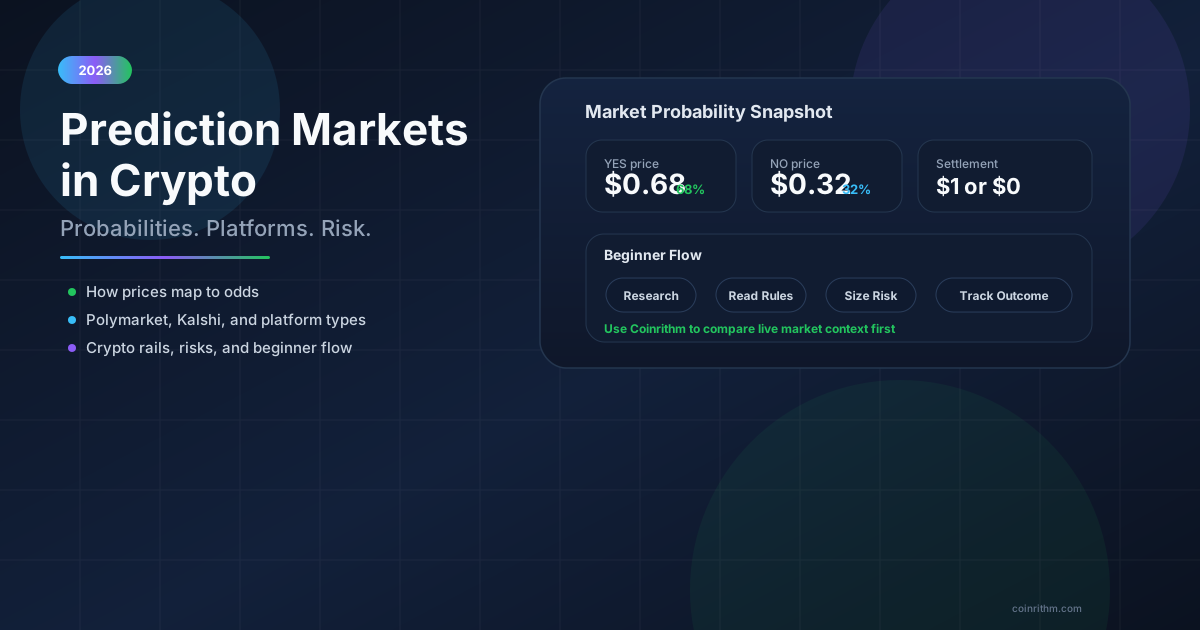
Every election cycle, the same question trends: what are the odds this candidate actually wins? Increasingly, the answer people reach for isn't a poll average — it's a live, tradable price on a prediction market.
If you are searching election prediction markets, polymarket election, election betting odds, kalshi election markets, or who will win election odds, this page is the category-level explainer. It is not tied to one race, one country, or one candidate — it explains how election markets work in general, so it stays useful whichever election sent you here.
If you have not read the category primer yet, start with What Are Prediction Markets in Crypto? first. This guide assumes you already know the basic idea — price as implied probability — and want the election-specific version of it.
TL;DR
- Election prediction markets are just prediction markets applied to political races: contract prices act as the crowd's implied probability that a candidate or party wins.
- Markets can move faster than polls because anyone can trade the instant news breaks, but they carry their own failure modes — favorite-longshot bias, thin liquidity outside major races, and manipulation attempts.
- The main venues are Polymarket (crypto-native, global), Kalshi (US-regulated exchange), PredictIt (legacy, capped contract sizes), and Smarkets (peer-to-peer betting exchange).
- Election markets exist far beyond the US presidential race — parliamentary elections, mayoral races, and party leadership contests all get priced.
- Resolution for elections usually distinguishes a media-called race from the certified official result, and the gap between the two matters.
- Prices are estimates, not guarantees — markets have been wrong before and will be wrong again.
- Use CoinRithm's Elections and Politics topic hubs, the Today digest, and the calendar to track live odds across venues.
What Are Election Prediction Markets
An election prediction market is a contract that pays out based on the outcome of a political race — who wins a presidency, which party takes a parliamentary majority, who becomes mayor, who wins a party leadership contest.
Structurally, it works exactly like any other prediction market:
- a
Yesshare on "Candidate X wins" trades somewhere between$0.00and$1.00 - winning shares settle at
$1.00 - losing shares settle at
$0.00 - the price in between is the market's live, tradable estimate of the odds
What makes election markets distinct is not the mechanism — it's the subject matter. Elections have hard deadlines, defined resolution sources (official results), heavy news flow, and often multiple competing outcomes rather than a clean binary. That combination makes them some of the highest-volume, highest-attention markets on every major platform.
If prices and payouts themselves are still unclear, read How Prediction Market Probabilities Work before continuing — everything below builds on that.
How Election Odds Are Priced
The core idea carries over directly from any other prediction market: price is implied probability.
If a Kalshi or Polymarket contract on "Candidate A wins" trades at $0.62, the market is roughly saying there is a 62% chance, given everything currently known, that Candidate A wins. That price moves continuously as:
- new polling data is published
- debates, scandals, endorsements, or campaign events happen
- large traders take new positions
- the race gets structurally closer to its resolution date
For races with more than two realistic contenders — a primary, a multi-party parliamentary election, a crowded mayoral race — the same probability logic applies across every candidate's contract simultaneously. All the "Yes" prices across candidates in a well-formed multi-outcome market should roughly sum to $1.00, because exactly one candidate can win.
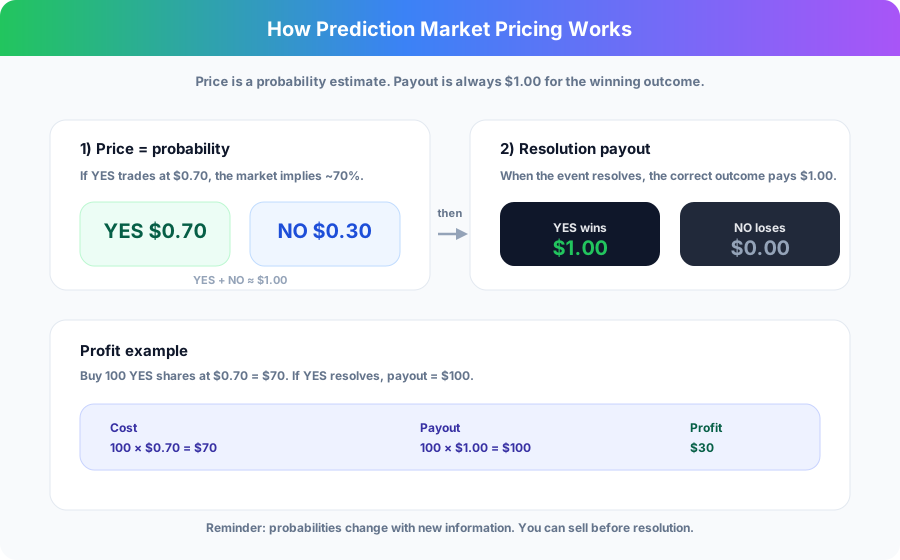
The same $0.00–$1.00 pricing logic applies whether the event is a rate decision or an election.
None of this makes the price a forecast in the scientific sense — it is a real-time snapshot of what people are willing to trade on, nothing more.
Election Markets vs Polls
Polls and prediction markets are often compared, and confused for each other, but they measure different things.
A poll asks a sample of people what they intend to do or who they support, then extrapolates. A prediction market asks people to put money behind what they think will actually happen — including their read on turnout, momentum, and events a poll can't fully capture.
Why markets can move faster than polls
Polls are published on a schedule — daily trackers, weekly polls, occasional big surveys. A prediction market repricing has no schedule at all: it can move within seconds of a debate moment, a legal ruling, a resignation, or a viral clip, because traders can act immediately rather than waiting for the next survey wave. That speed is the main practical reason people watch markets alongside polls rather than instead of them — a market can reflect a fast-moving news cycle before polling has had time to catch up.
The honest limits of that speed advantage
Faster does not mean more accurate. Academic and industry research comparing prediction-market prices to polling averages over past elections has produced a mixed record — markets have sometimes tracked outcomes well and have sometimes been confidently, badly wrong, and the quality of that record varies a lot by election, by market liquidity, and by how tightly the question was worded. Treat any specific accuracy percentage you see cited elsewhere with skepticism unless the source names its methodology, sample of elections, and time period — this page deliberately does not invent one.
Where Election Markets Can Go Wrong
Three failure modes come up repeatedly in how election markets get discussed, and all three are worth knowing before you read a price as a fact:
- Favorite-longshot bias. This is a well-documented pattern across betting and prediction markets generally: heavy favorites can be slightly overpriced and long-shot outcomes can be slightly overpriced too, relative to what actually happens over many markets. It's a structural tendency in how crowds price extreme probabilities, not proof that any single market is wrong.
- Thin liquidity outside marquee races. A US presidential contract can have deep, competitive trading. A regional runoff, a lower-profile parliamentary seat, or an election in a country with less trading interest can have a handful of active traders and a price that one or two large orders can move — treat thin markets as noisier signals, not weaker versions of the same signal.
- Manipulation attempts. Because prices are visible and sometimes get cited as if they were neutral polling data, large trades placed specifically to move a visible number (rather than to express a genuine view) are a recognized risk, particularly in less liquid markets. Liquidity and open interest are worth checking before treating a price move as informative.
None of this means election markets are unreliable by default — most trade in line with available information most of the time. It means the honest framing is "markets can be wrong, and here's roughly how," not "markets are magic" or "markets are noise." For the deeper version of this same idea, see How Prediction Market Probabilities Work.
Where to Trade Election Prediction Markets
Several platforms run election markets, and they differ in structure, regulation, and reach.
Polymarket
Polymarket is the largest crypto-native prediction market, running on Polygon with USDC-funded, wallet-based trading. Election markets are consistently among its highest-volume categories, spanning presidential races, primaries, and international elections. See the Polymarket hub for what's live right now.
Kalshi
Kalshi is a CFTC-regulated US derivatives exchange offering election-related event contracts through a fiat-funded, regulated onboarding flow rather than a wallet. See the Kalshi hub.
PredictIt
PredictIt is a long-running, legacy US election-focused market operating under an academic no-action arrangement, historically known for per-trader contract caps that limit position size compared to newer venues.
Smarkets
Smarkets is a peer-to-peer betting exchange, more established in UK and European political markets, that settles against official results published by the relevant governing body.
If you want the full platform comparison rather than the election-specific summary above, read Best Prediction Markets in 2026 or Kalshi vs Polymarket.
Not Just the US Presidential Race
The single highest-traffic election market in most cycles is the US presidential race, but framing "election prediction markets" as only that undersells how broad the category actually is.
Markets exist, in varying depth and liquidity, for:
- National parliamentary elections — general elections that decide a governing party or coalition, common on Polymarket, Smarkets, and Kalshi depending on the country.
- Mayoral and local races — high-profile city elections (a mayoral race in a major city, for example) regularly get their own dedicated markets, especially on Polymarket.
- Party leadership contests — internal party votes that decide a new leader, which can matter as much to policy direction as a general election.
- Primaries and nomination contests — multi-candidate races within one party, where the pricing logic across candidates works the same way described above.
If you searched for odds on a specific country's election rather than the US race, the same reading skills apply: check which venue is actually running a market for that specific race, check its liquidity before trusting the price, and read the resolution rules for that market rather than assuming they match a US-style example. Browse Elections and Politics on CoinRithm to see which races currently have active markets across venues.
How Election Markets Resolve
Election markets have a resolution quirk that trips up more traders than any pricing mechanic: a race being "called" is not the same as a race being certified.
- Called race — media organizations, using projections from vote counts, exit polling, and historical patterns, declare a winner before every vote is formally counted. This is fast, and it's what most people mean when they say "the election was decided."
- Certified result — the official, final tally, confirmed through whatever legal certification process the jurisdiction requires. This can take days to weeks longer than the media call, and in rare cases the two can diverge, or a race can remain legally contested after being called.
Each venue defines, in its own contract rules, which of these it actually resolves against — some name a specific media consortium's call, some wait for official certification, and some handle recounts and legal challenges differently. That difference is exactly the kind of resolution-rule detail worth reading before you hold a position through election night rather than trading out of it early. For the full mechanics — including how Polymarket's oracle, Kalshi's named-source model, and other venues each make that determination — read How Prediction Markets Resolve.
Is Trading Election Markets Legal?
Legality for prediction markets, including election markets specifically, varies by country and by platform — there is no single global answer, and election contracts in particular have drawn extra regulatory attention in some jurisdictions precisely because they involve political outcomes.
Rather than duplicate that analysis here, read the dedicated breakdown: Are Prediction Markets Legal? covers the country-by-country picture, including how election contracts specifically have been treated by regulators in the US, UK, EU, Canada, and elsewhere.
How CoinRithm Fits In
CoinRithm is a prediction-markets aggregator and paper-trading sandbox — not a broker, not an oracle, and not a party to any venue's election-market rules. It exists to make tracking election odds across venues easier than checking each platform separately.
For election-specific research, three surfaces matter most:
- Elections topic hub and Politics topic hub — browse active election and political markets across Polymarket, Kalshi, and other venues side by side, filterable by category.
- Today — a daily digest surfacing what's moving right now, useful on days when a debate, court ruling, or major poll just dropped.
- Calendar — scheduled election dates and other event deadlines, so you can see what's coming rather than only what's already trading.
A practical workflow:
- Start on the Elections or Politics topic hub for the race you care about.
- Check which venues actually have an active market for that specific election, and how liquid each one is.
- Read that market's resolution rules — called vs certified, named source, dispute process.
- Only then decide whether a price looks informative or is likely just thin and noisy.
If you want to build intuition for how election odds move without risking real money, CoinRithm's paper trading simulator lets you take mock positions on real prediction-market events, including political ones, with no financial risk.
Frequently Asked Questions
What does a 62% election market price actually mean?
It means the market currently estimates roughly a 62% chance that outcome happens, based on everyone currently willing to trade at that price. It is not a guarantee, and it is not the same claim a poll makes — see How Prediction Market Probabilities Work for the full explanation.
Are election prediction markets more accurate than polls?
There's no single honest answer to that — the comparative record is mixed across past elections, and it depends heavily on which election, which market, and how liquid that specific market was. Be skeptical of any specific accuracy claim that doesn't cite its methodology and sample.
Can I trade on any country's election, or just the US?
Coverage varies by platform and by race. Major national elections and high-profile city races are the most likely to have deep, liquid markets; smaller or less-followed elections may have thin markets or none at all on a given venue. Check the Elections hub for what's currently active.
What's the difference between a called race and a certified result for market resolution?
A called race is a media projection made before the official count is finished; a certified result is the final, legally confirmed tally. Each market defines which one it resolves against in its own rules — read How Prediction Markets Resolve for the mechanics.
Is it legal to trade election prediction markets?
It depends on your country and the specific platform — election contracts have drawn particular regulatory attention in some jurisdictions. See Are Prediction Markets Legal? for the full picture rather than assuming a blanket answer.
Why do favorites sometimes look overpriced on election markets?
This lines up with a broader, well-documented pattern in betting and prediction markets called favorite-longshot bias, where heavy favorites and heavy underdogs can both be mispriced slightly relative to what actually happens across many markets. It's a general tendency, not proof any one market is currently wrong.
Does CoinRithm let me bet real money on elections?
No. CoinRithm aggregates live prediction-market data across venues for research and offers a paper-trading sandbox with mock stakes. It does not custody funds or place real-money bets — you would trade directly on a platform like Polymarket or Kalshi if you choose to.
Conclusion
Election prediction markets take the same core idea — price as implied probability — and apply it to the highest-attention events in politics. That makes them fast, information-dense, and genuinely useful as a real-time signal, but not a substitute for understanding polls, resolution rules, or the market's own well-known blind spots.
Before you trust any election odds you see cited, ask: which venue, how liquid, called or certified, and compared against what. Those four questions cut through most of the confusion this category produces.
Start on CoinRithm's Elections or Politics topic hub to see what's active right now, check the Today digest for what's moving, and use the calendar to track upcoming election dates.
Continue reading: Sports Prediction Markets — the same pricing and resolution logic applied to sports outcomes, another high-volume market category worth understanding.
Last Updated: July 4, 2026
Disclaimer: This article is for educational and informational purposes only. It is not financial, legal, or political advice. Prediction markets involve real financial risk, prices can be wrong, and legal status varies by country. Always verify a platform's current rules and your own jurisdiction's legal position before trading.