Searched sports prediction markets because a game contract on Kalshi or a World Cup market on Polymarket looked like a bet, but the mechanics felt off — no fixed odds line, a price that keeps moving, and an option to close the position hours before kickoff instead of waiting for a final whistle?
That instinct is correct, and it is the whole subject of this guide. If you are searching kalshi sports, polymarket sports, nba prediction markets, nfl prediction market, or world cup prediction market, you have landed on markets that borrow the shape of a bet — a yes/no outcome, a price, a payout — but run on very different plumbing. If you have not read the category-level explainer yet, start with What Are Prediction Markets in Crypto?, which covers how prediction-market pricing and settlement work in general. This guide goes one layer deeper into the sports-specific corner of that world: what these contracts look like, why sports betting vs prediction markets is a real structural question and not just marketing language, and where the current regulatory friction sits.
TL;DR
- Sports contracts on Kalshi and Polymarket cover game winners, championship futures, season-long props, and tournament brackets — priced by traders, not set by a bookmaker.
- The core structural difference from a sportsbook: prices move continuously like a market, and you can usually exit a position before the event ends instead of holding a locked bet slip to the final result.
- There is no built-in bookmaker vig baked into the price the way there is at a sportsbook — pricing comes from a peer-to-peer order book instead.
- Sports event contracts specifically are in the middle of an active, unresolved US legal fight between federal regulators and state gaming regulators — see Is Kalshi Legal? State-by-State Guide for the details.
- Beyond game winners, sports prediction markets also cover off-field culture questions — cover athletes, draft picks, awards — that a traditional sportsbook rarely lists.
- CoinRithm does not host sports contracts itself. It aggregates them for research on the sports topic hub and lets you study price behavior in a paper-trading sandbox before you decide whether to trade anywhere real.
What Sports Markets Look Like on Prediction Market Platforms
Sports contracts on prediction-market venues generally fall into four shapes:
- Single-game winners — will Team A beat Team B in a specific matchup.
- Championship futures — who wins the league, conference, or tournament outright, priced weeks or months ahead of the final.
- Season-long props — win totals, division outcomes, and other questions that resolve over a stretch of the season rather than a single night.
- Tournament brackets — advancement questions tied to a bracket structure, common around events like March Madness or the World Cup knockout stage.
The two platforms most people search for approach this differently.
Kalshi's Sports Contracts
Kalshi lists sports as CFTC-regulated event contracts, structured as single-game "will Team X win" markets alongside parlay-style contracts that combine multiple legs into one priced instrument. Because Kalshi is a Designated Contract Market, these are traded on an exchange model — you are matched against another trader's opposite position, not against the house.
Polymarket's Sports Events
Polymarket's sports markets tend to run at the event level — a world cup prediction market asking who lifts the trophy, a league-championship market running the length of a season, or a single-elimination bracket market for a major tournament. Pricing is peer-to-peer and denominated in stablecoins, following the same on-chain mechanics covered in the category-level prediction-markets guide.
Both approaches share the same underlying logic: a contract resolves to $1.00 if the specified outcome happens and $0.00 if it does not, and the current price in between reflects what traders collectively think the odds are right now.
The Structural Difference: Order Book vs. Sportsbook
This is the part worth understanding carefully, because it is the actual differentiator between sports betting vs prediction markets — not just tone or branding.
A sportsbook works like this: the bookmaker sets a line, bakes a vig (its built-in margin) into both sides of that line, and takes your bet. Once your slip is placed, it is usually locked. You wait for the game to finish, and you either collect a fixed payout or lose your stake. Some sportsbooks offer a "cash out" feature, but it is a discretionary offer priced by the house, not a live market you are trading into and out of.
A prediction market works differently in three specific ways:
- Peer-to-peer pricing, not a bookmaker line. Your counterparty is another trader on the other side of the contract, matched through an order book. There is no single party setting the number and profiting from a structural edge on every trade the way a bookmaker's vig does.
- The price moves continuously, like any other market. As money and information flow in — an injury report, a lineup change, a shift in public sentiment — the contract price adjusts in real time, the same way a stock or a crypto asset re-prices on news.
- You can exit before the event ends. Because the contract is a tradable position rather than a settled slip, you can sell out of it hours or days before the final outcome, locking in a gain or cutting a loss based on where the price has moved — not just on how the game ultimately finishes.
That third point is the practical difference beginners feel first. A sportsbook bet is a decision you make once and then wait on. A prediction-market contract is a position you can manage — add to, trim, or close — right up until the market itself is no longer trading. Whether that is a meaningful advantage depends entirely on how you use it: it gives you more control, but it does not remove the underlying risk that your original view on the game could still be wrong.
The Regulatory Tension Around Sports Event Contracts
Sports contracts specifically — not prediction markets in general — sit at the center of the most contested legal question in this space right now.
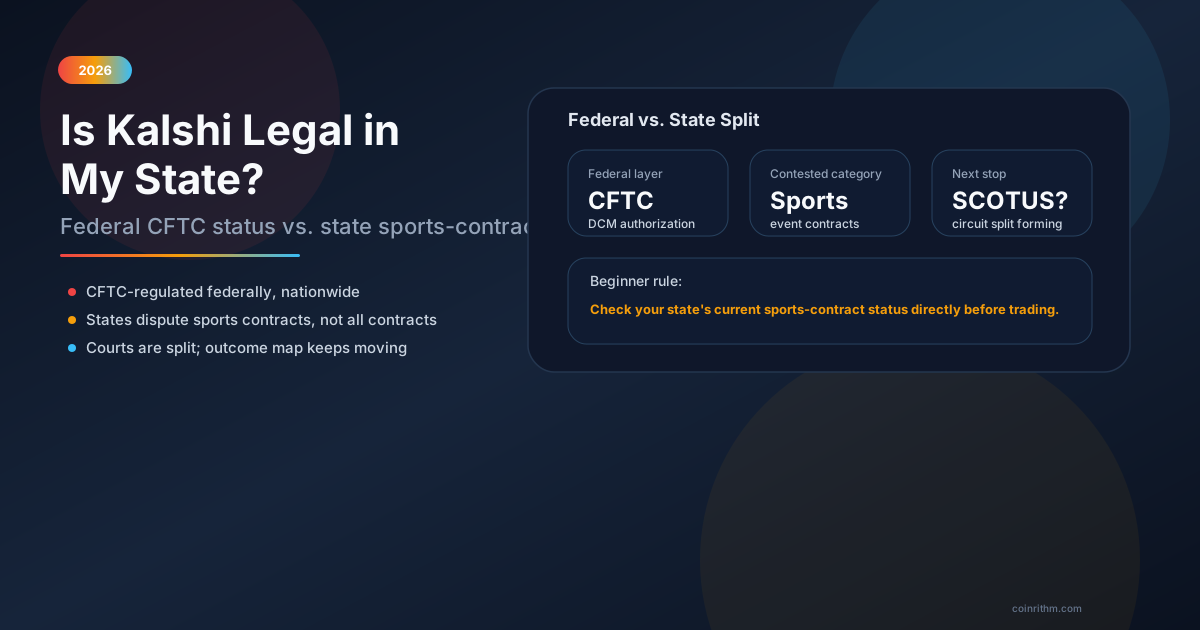
In the US, Kalshi's sports event contracts are federally authorized: Kalshi is a CFTC-regulated Designated Contract Market, and that federal status does not change from state to state. But several state gaming regulators argue that a contract paying out based on which team wins is functionally a sports bet, regardless of the federal wrapper it arrives in, and that their state licensing and taxing authority over sports wagering still applies. That disagreement has produced cease-and-desist orders, geofencing requirements, and lawsuits running in parallel across multiple states, with courts reaching different conclusions depending on the jurisdiction.
Crucially, this fight is concentrated almost entirely on the sports category. Non-sports event contracts — economics, politics, weather — are largely untouched by it, which is exactly why the dispute keeps getting described as a "sports contracts" problem rather than a "prediction markets" problem. If you want the full state-by-state breakdown of where this currently stands and how to check your own situation, read Is Kalshi Legal? State-by-State Guide — that article covers the federal-versus-state split in depth and is kept current as court rulings change. Availability and legal status for sports contracts can shift quickly and vary by platform and location, so verify directly with the platform before assuming a market is open to you.
Popular Sports Market Types (Beyond Game Winners)
Game winners and championship futures get most of the attention, but sports prediction markets also cover a wider band of questions than a typical sportsbook menu:
- Championship odds markets — who wins the title outright, tracked continuously across an entire season rather than as a single pre-season line.
sports futures markets— division winners, playoff qualification, win totals, and other outcomes that resolve over months instead of one event.- Draft and roster questions — where a specific player lands, or whether a trade happens before a deadline.
- Awards markets — MVP, Rookie of the Year, and similar season-long recognition questions.
- Sports-culture and off-field markets — a growing long-tail category that includes questions like which athlete appears on a video game's cover for the next release, or other pop-culture-adjacent sports questions that a traditional sportsbook simply does not list. Searches like "NBA 2K27 cover athlete predictions" sit in this bucket — they are sports-adjacent forecasting questions with real trading interest, even though no game outcome is involved.
This off-field category is worth calling out specifically because it is the clearest illustration of what makes these venues different from a sportsbook: they are pricing any question with a resolvable outcome and enough trader interest, not just wins and losses.
Reading Sports Market Probabilities
The same pricing logic from general prediction markets applies here, with a few sports-specific patterns worth knowing:
- Favorites price high, longshots price low. A team priced near
$0.85is the market's heavy favorite; a team near$0.05is considered a longshot. Neither number is a guarantee — it is the crowd's current estimate, and upsets happen at every price level. - Time decay toward game day. As a single-game contract approaches its start time, prices tend to compress around the market's best current estimate and liquidity often deepens, since less new information is left to arrive before resolution. Season-long futures behave differently — they can stay volatile for months as the underlying situation (injuries, standings, trades) keeps changing.
- Live repricing on news. An injury report, a lineup announcement, or a weather delay can move a sports contract's price within minutes, the same way breaking news moves any other prediction market. That speed is a feature for research — it is a live read on how new information is being weighed — but it also means a price you saw an hour ago may already be stale.
- Championship futures move on cumulative evidence, not single games. A team's title-odds contract typically drifts gradually as results accumulate over a season, rather than swinging entirely on any one outcome.
Treat every sports price the same way you would treat any other prediction-market price: as a real-time estimate built from available information, not a certainty.
Is Trading Sports Prediction Markets Gambling?
Honestly: it overlaps with gambling in the sense that real money is placed at risk on an uncertain sports outcome, and no amount of market-structure explanation changes that basic fact. Where it differs is in mechanism and purpose. These are exchange-traded or peer-to-peer contracts rather than bookmaker wagers, and the pricing itself functions as a live probability estimate that some traders use for research and hedging rather than pure entertainment. That said, this framing should not be read as a claim that sports prediction markets are risk-free, universally legal, or a safer alternative to a sportsbook — they are not automatically any of those things. As covered above, the legal status of sports event contracts specifically is genuinely unresolved in several US states right now, and money at risk is money at risk regardless of the wrapper. If the "is this legal where I am" question matters to your decision, read Is Kalshi Legal? State-by-State Guide rather than relying on a general summary.
How to Follow Sports Prediction Markets on CoinRithm
If you want to track sports contracts without committing to a platform first, CoinRithm gives you three entry points:
- The sports topic hub — a filtered view of active sports markets aggregated across sources, so you can scan what is trading without opening each platform separately.
- The Today digest — a daily cross-platform roll-up of what just moved, opened, or resolved, useful for catching a sports contract that repriced sharply overnight.
- The calendar — a forward-looking view of upcoming game dates and season milestones, so you can see what is coming before it starts trading heavily.
A practical workflow: start on the sports topic hub to see what is active, use the calendar to spot the next major date on your radar, then check the Today digest for anything that has moved sharply in the last day.
How CoinRithm Fits In
CoinRithm is not Kalshi, not Polymarket, and not a sportsbook. It is an aggregator and research layer that lets you study sports contracts — including markets sourced from Kalshi and Polymarket — in one place, before you decide anything about an account on either platform.
Use the sports topic hub to browse live sports markets and price movement without needing an account anywhere. From there:
- Compare the same event's pricing across sources on the Compare page.
- Scan the daily cross-platform roll-up on the Today digest.
- Check what is coming up next on the calendar.
- Practice how a sports position would have played out using CoinRithm's paper-trading sandbox with mock funds — no real money, and no exposure to the legal-access questions covered above.
This research-first approach matters more for sports than for most other categories, precisely because the legal landscape for sports contracts is still moving. Study the market structure and the price action here first; make platform-access decisions separately and directly with the platform.
Frequently Asked Questions
What are sports prediction markets?
They are contracts on prediction-market platforms — such as Kalshi and Polymarket — that pay out based on sports outcomes: game winners, championship futures, season-long props, and tournament brackets. Instead of a bookmaker setting fixed odds, prices are set by trading activity and move continuously like a market.
How is a sports prediction market different from a sportsbook bet?
The pricing mechanism and the ability to exit early. A sportsbook sets a line with a built-in vig and generally locks your bet until the game resolves. A prediction market prices contracts through a peer-to-peer order book, the price moves in real time as new information arrives, and you can usually close your position before the event ends rather than holding it to a final result.
Are Kalshi's sports contracts legal?
Kalshi is federally authorized as a CFTC-regulated Designated Contract Market, and that status is nationwide. Whether individual states can additionally regulate Kalshi's sports contracts under state gambling law is an active, unresolved legal dispute that varies by state and is currently working through the courts. See Is Kalshi Legal? State-by-State Guide for the current picture.
Can I trade NBA or NFL markets on prediction market platforms?
Yes — nba prediction markets and an nfl prediction market for a given matchup, season, or championship are common listings on both Kalshi and Polymarket, alongside futures for other major leagues and tournaments, including World Cup markets during major international events.
What are the off-field sports markets — like cover athlete predictions?
Some platforms list sports-culture questions beyond wins and losses, such as which athlete will appear on the cover of an upcoming sports video game, award predictions, or draft-related questions. These trade the same way as game-outcome contracts — priced by traders, resolved against a defined outcome — but do not require an actual game result to settle.
Is trading sports prediction markets considered gambling?
It overlaps with gambling in that real money is at risk on an uncertain sports outcome. Where it differs is in structure: pricing comes from a peer-to-peer market rather than a bookmaker line, and the price itself functions as a live probability estimate some traders use for research. That distinction does not make it risk-free or automatically legal everywhere — verify your own situation before trading.
Where can I research sports prediction markets without opening a platform account?
Use CoinRithm's sports topic hub, the Today digest, and the calendar to track live markets, price movement, and upcoming dates across sources, then use paper-trading to practice with mock funds before deciding whether to trade anywhere real.
Conclusion
Sports prediction markets look like bets at first glance — a yes/no outcome, a price, a payout — but the machinery underneath is closer to a trading market than a sportsbook. Prices are set by other traders instead of a bookmaker line, they move continuously on new information, and you can typically manage a position instead of holding a locked slip to the final whistle. That difference matters most in the sports category specifically, both because it changes how you think about entering and exiting a position, and because sports event contracts are the exact category currently caught in an unresolved legal fight between federal and state regulators in the US.
The useful next step is research, not a trade. Start on the sports topic hub to see what is active, use the Today digest and calendar to track what's moving and what's coming up, and read Is Kalshi Legal? State-by-State Guide before assuming a sports contract is available where you live.
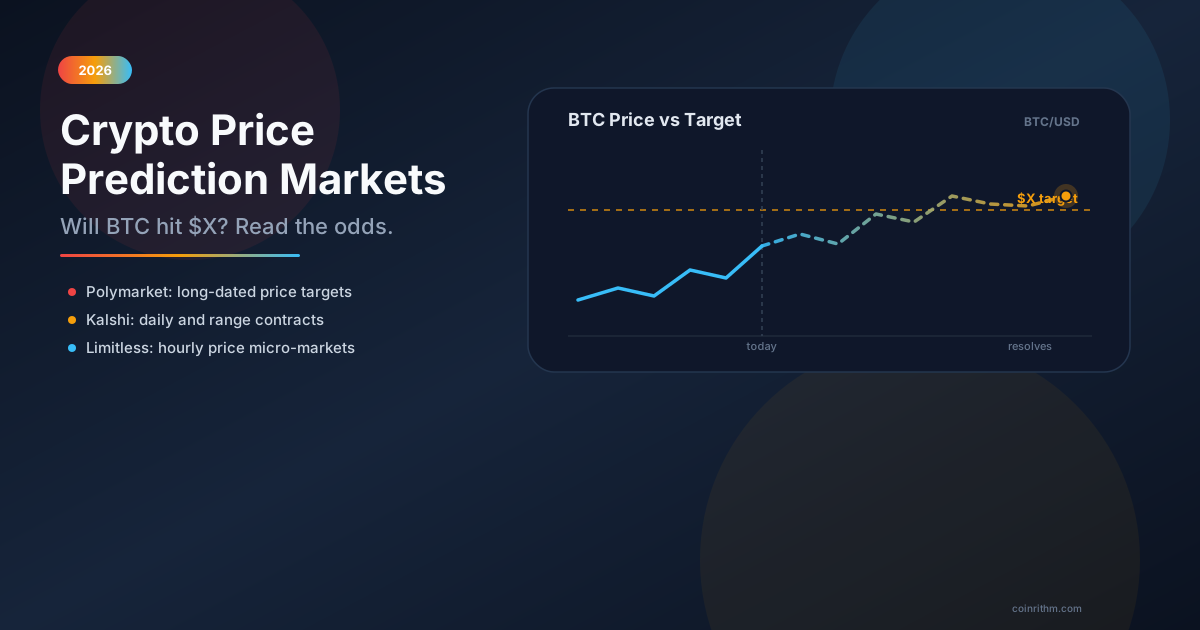
Continue reading: For how crypto price milestones get priced on the same platforms, read Crypto Price Prediction Markets.
Last Updated: July 4, 2026
Disclaimer: This article is for educational and informational purposes only. It is not financial, legal, or investment advice. Sports event contracts involve real financial risk, and legal availability varies by platform and jurisdiction and is actively changing. Always verify current terms, fees, and legal access directly with the platform before trading.