Want to understand what Smarkets is and how a betting exchange actually works?
If you searched for what is smarkets, how does smarkets work, or smarkets review, this is the main explainer.
If you want the broad prediction market category first, start here: What Are Prediction Markets in Crypto?.
If your main question is how odds translate into probabilities, read How Prediction Market Probabilities Work.
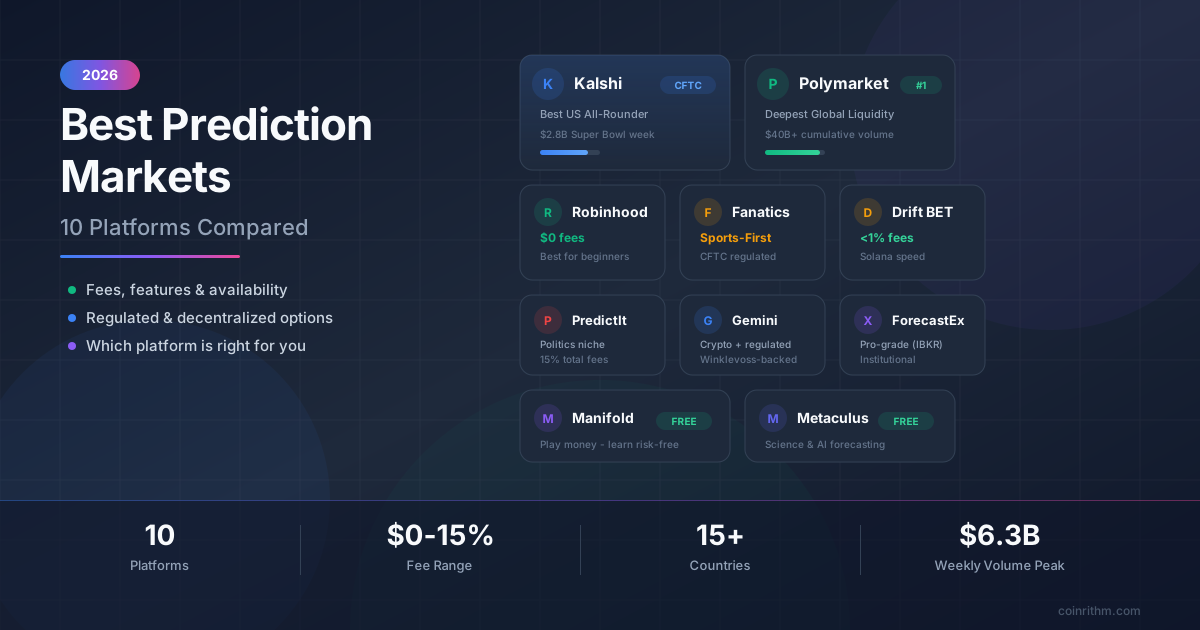
If your question is which platform fits your needs, read Best Prediction Markets in 2026 or the dedicated Kalshi vs Polymarket comparison.
Smarkets is a UK-based peer-to-peer betting exchange covering politics, sports, and current affairs. Unlike a bookmaker, Smarkets does not set the odds: you trade against other users' back and lay orders, and the platform charges commission, 2% of net winnings per market on its default tier. Exchange odds map directly to implied probabilities, which makes Smarkets useful not just for wagering but for reading crowd sentiment on real-world events.
CoinRithm aggregates Smarkets' politics markets, tracks their odds, and lets you compare them against other prediction platforms, all without an account. You can also paper-trade prediction market events on CoinRithm with mock USD before risking real money anywhere.
TL;DR
- Smarkets is a UK-based peer-to-peer betting exchange, not a bookmaker.
- You back an outcome (bet it happens) or lay an outcome (bet it does not happen).
- Exchange odds translate cleanly to implied probabilities.
- Smarkets covers politics, sports, current affairs, and other event categories.
- CoinRithm aggregates Smarkets' politics markets so you can research odds and compare sources before deciding where to trade.
- CoinRithm is not Smarkets, cannot place trades on Smarkets, and offers simulated (paper) trading only.
What Is Smarkets
Smarkets is a peer-to-peer betting exchange founded in the UK that allows users to trade on the outcomes of events in politics, sports, and current affairs.
The core difference from a traditional bookmaker is structural. A bookmaker sets odds and takes the opposite side of every bet, building in a margin. An exchange connects buyers and sellers directly. Smarkets sits in the middle, matches opposing positions, and charges a commission on net winnings rather than embedding a margin in the odds. Smarkets also says that market makers, including its own proprietary market maker, support liquidity on the exchange, so the order that matches yours can come from one of them.
The result is that odds on an exchange tend to be closer to the true implied probability of an outcome than bookmaker odds, which carry an embedded overround.
Smarkets was founded in 2008 and is headquartered in London. Its operator, Smarkets (Malta) Limited, is licensed by the UK Gambling Commission for UK customers, by the Gambling Regulatory Authority of Ireland (GRAI) for Irish customers, and by the Malta Gaming Authority for customers registered elsewhere. As of 2026, it is one of the established alternatives to Betfair Exchange in the UK and Ireland. Check the official Smarkets website for current licence details, available regions, and terms.
Ground truth note: Commission rates, currencies and country rules in this article come from Smarkets' terms (version 4.14, last modified August 14, 2026), help center and licensing page, checked on September 23, 2026. This article does not state minimum deposit figures, which Smarkets publishes per payment method. These details change, so check Smarkets directly before you trade.
How the Exchange Model Works
The flow on a betting exchange is different from buying a prediction market share on Polymarket or placing a bet with a bookmaker.
1. A market opens: Smarkets creates a market around an upcoming event (election, match, etc.) with defined outcomes and a resolution date.
2. Users submit orders: Backers submit bids to back an outcome at a certain price. Layers submit offers to lay (oppose) that outcome at a price.
3. Orders match: When a backer and a layer agree on a price, the bet is matched and confirmed.
4. Liquidity builds: As more users enter, more orders match and the order book deepens. Unmatched orders sit in the queue.
5. Event resolves: At resolution, winnings are distributed to the correct side. Smarkets calculates and charges commission when the market settles.
6. Commission charged: On the default Standard Tier, commission is 2% of your net winnings in each market, not your stake, so you pay no commission on a market you lose. The Pro and Select tiers for high-volume and very profitable users charge on each settled bet, winning or losing (see Fees and Costs).
Because commission is charged at settlement rather than built into the odds, the exchange's commission income depends on trading activity rather than on which side wins.
Back and Lay Explained
The back/lay model is the defining feature of any betting exchange. Understanding it is essential before placing any order.
Backing an outcome
When you back an outcome, you are betting that it will happen. This is the familiar direction, equivalent to placing a bet with a bookmaker. If the outcome occurs, you win. If it does not, you lose your stake.
Example: You back "Labour wins the next UK general election" at 2.00 (decimal odds). You stake £50. If Labour wins, you receive £100 total (£50 profit before commission, or £49 after the standard 2% commission). If Labour does not win, you lose £50.
Laying an outcome
When you lay an outcome, you are betting that it will not happen. You become the bookmaker for that position. If the outcome does not occur, you collect the backer's stake. If it does occur, you pay out the winnings.
Example: You lay "Labour wins the next UK general election" at 2.00. The backer stakes £50. If Labour does not win, you collect £50. If Labour wins, you pay out £50 to the backer (your liability).
Liability
The liability on a lay bet is the key number to check before placing the order. At higher odds, laying an outcome carries a larger potential payout if the event occurs. On Smarkets, your unmatched liability is held in your account balance until the bet is matched or cancelled.
Most casual users on exchanges only back outcomes. Laying is more often used by experienced traders who want to take a position against a specific outcome or hedge an existing back position.
Odds as Implied Probabilities
Exchange odds in decimal format convert cleanly to implied probability. This is one reason exchange platforms are useful for reading crowd sentiment, not just for wagering.
The conversion:
Implied probability = 1 / decimal odds
Examples:
| Decimal Odds | Implied Probability |
|---|---|
| 1.25 | 80% |
| 2.00 | 50% |
| 4.00 | 25% |
| 10.00 | 10% |
| 100.00 | 1% |
A Smarkets market priced at 2.00 on "Yes" is the crowd saying there is roughly a 50% chance that outcome happens.
Because exchanges do not embed a bookmaker margin in the same way, the implied probabilities across all outcomes in an exchange market sum closer to 100% than in a typical bookmaker market. The remaining gap is the exchange's overround, usually smaller than a bookmaker's.
For the deeper explainer on how market probabilities work and what they actually mean, read How Prediction Market Probabilities Work.
What Markets Smarkets Covers
Smarkets primarily covers:
| Category | Example Markets |
|---|---|
| Politics | UK, US and European elections, party leadership contests, by-elections |
| Sports | Football, horse racing, tennis, cricket, golf, darts, American football |
| Current Affairs | Major global events, the Nobel Peace Prize, AI model release dates |
| Entertainment | Oscars, Grammys, Strictly Come Dancing, box office |
| Economics and business | UK GDP growth, a UK recession, IPOs and acquisitions (listed under current affairs) |
The depth of coverage varies by category. On September 23, 2026, Smarkets' political markets ran from the next UK general election and party leadership contests to the 2028 US presidential election and the US midterms. Sports coverage is broad, from football and horse racing to tennis, cricket and darts.
Coverage can change. For current live markets, check Smarkets directly; the Smarkets hub on CoinRithm shows the politics markets CoinRithm tracks.
Who Can Use Smarkets
Smarkets serves customers under three licences held by Smarkets (Malta) Limited: the UK Gambling Commission for UK customers, the Gambling Regulatory Authority of Ireland (GRAI) for Irish customers, and the Malta Gaming Authority for customers registered anywhere else. Accounts are opened in GBP, EUR or SEK.
What Smarkets' terms and licences say, as of September 2026:
- United Kingdom: available. UK customers are licensed and regulated under Smarkets' UK Gambling Commission licence.
- Ireland: available. Smarkets holds a GRAI exchange licence (a remote betting intermediary licence) valid until August 11, 2029, and its terms include an Irish addendum; for example, Irish customers cannot pay by credit card.
- Restricted countries: clause 2.2 of the terms says residents of, or people located in, Australia, France, Hong Kong, Switzerland, China, South Africa, Denmark, the Czech Republic, Belgium, Turkey, the United States, Italy, Portugal, Russia, Belarus, Ukraine, Kazakhstan, Norway and the Netherlands cannot register. The list is "not necessarily limited to" those countries. Italy's gambling regulator (ADM) also lists smarkets.com among blocked gambling sites.
- United States: restricted, as above. The only US licence on Smarkets' licensing page is in Indiana, and it covers SBK, Smarkets' separate sportsbook app, not the exchange.
- Other countries, such as Germany, Spain, Canada or Singapore: not named in the terms, but no official Smarkets source confirms that residents can register, so treat access as unconfirmed.
- Age and identity: you must be 18 or over, and Smarkets must verify your identity and address before you can place bets.
Availability and access rules change. CoinRithm's prediction market availability page shows Smarkets' documented status country by country, for example for the United Kingdom and Ireland. If you are outside the UK and Ireland, verify your jurisdiction's rules and Smarkets' current terms before attempting to register. CoinRithm can show you Smarkets odds and market data regardless of your location, since CoinRithm is a research and aggregation tool, not a gambling platform.
Fees and Costs
Betting exchanges charge commission rather than embedding a margin in the odds. Smarkets calls itself "the original 2% commission exchange", and its terms (version 4.14, last modified August 14, 2026) set three commission tiers:
| Tier | Commission | Who it applies to |
|---|---|---|
| Standard (default) | 2% of net winnings in each market | Everyone by default, up to 1,500 bets or £1,000,000 staked per calendar month |
| Pro | 1% on winnings or losses per bet | Users who opt in, which is required to keep trading past the Standard limits; no limit on bets or stakes |
| Select | 3% on winnings or losses per bet | Users with more than £25,000 net profit over the previous 12 calendar months, who may be moved to it after 7 days' email notice |
Commission is calculated and charged when a market settles. On the Standard Tier, a £50 back bet at 2.00 that wins pays £1 in commission.
What to keep in mind:
- On the Standard Tier, commission comes out of your net winnings in each market, not your stake, and you pay nothing on a market you lose. On the Pro and Select tiers, you also pay commission on losing bets.
- Spread between back and lay prices is a real cost even on exchanges.
- In thin markets, the spread can be wide enough to eliminate edge.
- For high-frequency or high-volume trading, commission adds up, so model it carefully.
How CoinRithm Uses Smarkets Data
CoinRithm aggregates Smarkets' politics markets, covering UK, US and European contests, alongside data from other prediction platforms; it does not track Smarkets' sports markets. This lets you research Smarkets odds and compare them with other sources in one place, without needing a Smarkets account.
What you can do on CoinRithm:
- Browse active Smarkets politics markets from the Smarkets source hub
- View implied probabilities derived from Smarkets odds
- Track odds history on individual markets
- Compare Smarkets odds against equivalent markets on other platforms via the prediction market compare page
- Browse all aggregated prediction platforms in the sources directory
- Use the full prediction markets hub to filter across categories and sources
What CoinRithm does not do:
CoinRithm is not Smarkets. CoinRithm cannot place bets, open exchange positions, or transfer funds to Smarkets on your behalf. CoinRithm is a research and aggregation tool.
Paper trading on CoinRithm:
CoinRithm offers simulated (paper) trading on prediction market events using mock USD. The minimum is $10 per position. This lets you practise reading markets and making decisions before risking real money on Smarkets or any other platform. Paper trading on CoinRithm uses simulated funds only and has no connection to your Smarkets account or balance.
To start browsing Smarkets markets, go to the Smarkets hub on CoinRithm.
Smarkets vs Other Prediction Platforms
Smarkets sits in a different category from platforms like Polymarket or Kalshi. The structural differences matter for choosing where to trade.
| Feature | Smarkets | Polymarket | Kalshi |
|---|---|---|---|
| Model | Peer-to-peer exchange (back/lay) | Peer-to-peer order book | Centralized exchange (USD) |
| Regulation | UK Gambling Commission, GRAI (Ireland), Malta Gaming Authority | International crypto-based site; US residents use Polymarket US, a separate CFTC-regulated app | CFTC-regulated (US) |
| Currency | GBP, EUR or SEK | pUSD, backed 1:1 by USDC (crypto) | USD |
| Primary audience | UK and Irish users | Crypto users outside its 39 blocked countries | US users and many other countries (not the UK) |
| Politics coverage | Strong (especially UK) | Strong (US and global) | Strong (US-focused) |
| Sports coverage | Broad | Broad | Broad (about half of open events) |
| Crypto required | No | Yes | No |
The right platform depends on your location, what you want to trade, and how you prefer to fund. Smarkets is generally the most natural fit for UK users who want to trade on UK political or sports events with GBP without needing a crypto wallet.
For the full comparison, use the CoinRithm prediction market compare page. For the dedicated Kalshi vs Polymarket breakdown, read Kalshi vs Polymarket.
Common Mistakes with Exchange Betting
1. Not understanding lay liability
New users often place lay bets without checking the liability figure. At odds of 10.00, laying £10 stake means a potential £90 payout if the event occurs. Always check your maximum liability before submitting a lay order.
2. Trading in thin markets
Low-liquidity markets on Smarkets can have wide back/lay spreads. Wide spreads mean you are paying more to enter and exit a position. Stick to markets with visible depth in the order book.
3. Leaving orders unmatched
On an exchange, your order is only live when it is matched. An unmatched back or lay order sits in the queue. If the event starts and your order is still unmatched, it does nothing. Check matched status before assuming a position is open.
4. Confusing decimal odds with probability directly
Decimal odds of 2.00 do not mean "50/50 certain." They mean the market currently implies 50%. The market can still be wrong. Treat implied probabilities as estimates, not facts.
5. Ignoring the overround
Even on exchanges, the sum of implied probabilities across all outcomes exceeds 100%. The difference is the overround. On an exchange it comes from the gap between the back and lay prices that participants set, not from a margin Smarkets builds in; Smarkets earns its commission separately. Factor this into your thinking when assessing whether a price represents real value.
6. Not reading resolution rules
Every market has specific rules about how it resolves. An outcome that seems obvious can still resolve differently depending on the exact wording. Read the rules before placing any order.
Frequently Asked Questions
What is Smarkets in simple terms
Smarkets is a UK-based betting exchange where you trade on the outcomes of political events, sports, and current affairs against other users rather than against a bookmaker. Prices reflect the crowd's implied probability for each outcome. The platform charges commission, 2% of net winnings per market on its default tier, instead of embedding a margin in the odds.
Is Smarkets a bookmaker
No. Smarkets is a peer-to-peer exchange. It does not set the odds: prices come from the back and lay orders on the exchange, your bet is matched with an opposing order, and Smarkets takes a commission when the market settles. Smarkets says market makers, including its own proprietary market maker, support liquidity on the exchange.
What is the difference between backing and laying on Smarkets
Backing means betting an outcome will happen. Laying means betting it will not happen. When you lay, you take the bookmaker role for that position and are liable to pay the backer's winnings if the outcome occurs. Most casual users only back outcomes.
Can I use Smarkets in the US
No. Smarkets' terms say residents of, or people located in, the United States cannot register. In the US, the usual options are Kalshi and Polymarket US, both CFTC-regulated; polymarket.com itself is not available to US residents. See Best Prediction Markets in 2026 for a broader comparison.
How does Smarkets make money
Smarkets charges commission instead of embedding a margin in the odds. On the default Standard Tier it takes 2% of your net winnings in each market and nothing on a market you lose; high-volume users on the Pro Tier pay 1%, and very profitable users on the Select Tier pay 3%, on winnings or losses per bet. Smarkets also runs SBK, a separate sportsbook app.
What are Smarkets' fees
Smarkets' terms (version 4.14, August 14, 2026) set three commission tiers. The default Standard Tier charges 2% of net winnings in each market, and nothing on a market where you make a net loss. To keep trading beyond 1,500 bets or £1,000,000 staked in a calendar month, users must opt in to the Pro Tier, which charges 1% on winnings or losses per bet. Users with more than £25,000 net profit over the previous 12 calendar months may be moved to the Select Tier, which charges 3% on winnings or losses per bet. Check Smarkets directly for current pricing.
How do Smarkets odds relate to probability
Smarkets shows decimal odds by default, and you can switch to percentage or American odds. The implied probability is 1 divided by the decimal odds. Odds of 2.00 imply 50%, odds of 4.00 imply 25%, odds of 1.25 imply 80%. For the full explanation, read How Prediction Market Probabilities Work.
Can I see Smarkets markets on CoinRithm
Yes. CoinRithm aggregates Smarkets' politics markets and displays their odds and implied probabilities. You can browse and compare without a Smarkets account. Open the Smarkets hub on CoinRithm to see current data.
Does CoinRithm let me bet on Smarkets
No. CoinRithm is a research and aggregation tool. It shows Smarkets odds and lets you paper-trade prediction markets with simulated funds, but it cannot place real bets or connect to your Smarkets account. To place real-money trades, go to Smarkets directly.
What is paper trading on CoinRithm
CoinRithm's paper trading feature lets you simulate prediction market positions using mock USD ($10 minimum per position). It is risk-free practice: no real money is involved and no connection is made to any external platform. It is useful for understanding how prediction market positions work before committing real funds anywhere.
Is Smarkets safe
Smarkets was founded in 2008 and is headquartered in London. Its operator, Smarkets (Malta) Limited, is licensed by the UK Gambling Commission, the Gambling Regulatory Authority of Ireland and the Malta Gaming Authority, and it must verify every user's identity and address before they can place bets. As with any gambling or trading platform, there are inherent risks: market risk on positions, account security, and regulatory changes affecting access. Only use funds you can afford to lose, and verify the current regulatory status if you are outside the UK.
Conclusion
Smarkets is a peer-to-peer exchange, not a bookmaker. Its back/lay model, exchange-derived odds, and commission structure make it a different type of platform from most prediction market tools, and a natural fit for UK and Irish users who want to trade on politics, sports, and current affairs in a regulated environment without needing cryptocurrency.
The core concepts to take away:
- Exchange odds are set by the market, not by a bookmaker building in a margin.
- Implied probability = 1 / decimal odds. A price of 2.00 means the crowd implies 50%.
- Backing means betting something happens. Laying means betting it does not.
- Lay liability is real, so always check your maximum exposure before placing a lay order.
- Resolution rules define exactly how a market settles. Read them before trading.
Using CoinRithm for Smarkets research:
Browse the Smarkets source hub on CoinRithm to see current markets and odds. Compare Smarkets against other platforms on the prediction market compare page. Use the full prediction markets hub to filter by category and source across all aggregated platforms.
If you want to practise reading and trading prediction markets before using real money, use CoinRithm's paper trading feature ($10 minimum per position, simulated funds only).
Next Step
Browse live Smarkets markets: CoinRithm Smarkets Hub.
Compare platforms: Prediction Market Compare or Best Prediction Markets in 2026.
Understand the probability side: How Prediction Market Probabilities Work.
Explore the category: What Are Prediction Markets in Crypto?.
Last Updated: September 23, 2026
Disclaimer: Prediction markets and betting exchanges involve financial risk. This article is for educational purposes only and is not financial, legal, or gambling advice. Verify the legal status of betting exchanges in your jurisdiction before participating. Only use money you can afford to lose. CoinRithm does not offer real-money betting or investment services.