Every Federal Reserve meeting now comes with two live readouts: the actual policy decision, and the price of a contract that had been trading on that exact outcome right up until the announcement. The monthly jobs report, the CPI print, and the quarterly GDP release each get the same treatment — a tradable market attached to the number, repricing continuously as new data lands.
If you're searching fed rate prediction market, fomc prediction market, cpi prediction market, recession odds market, or kalshi economics, this page is the category-level explainer. It isn't tied to one FOMC meeting or one CPI release — it explains how economic and Fed-focused prediction markets work in general, so it stays useful whichever data release sent you here.
If you haven't read the category primer yet, start with What Are Prediction Markets in Crypto? first. This guide assumes you already know the basic idea — price as implied probability — and want the macroeconomic version of it.
Economic and Fed prediction markets are event contracts priced against scheduled government and central-bank data — a rate decision, an inflation print, a jobs report — rather than against an election result or a sports score. That distinction matters more than it looks: these are some of the only markets in the entire prediction-market space that resolve against an official, publicly published number instead of a judgment call.
TL;DR
- Economic prediction markets cover FOMC rate decisions, CPI/inflation prints, jobs reports, GDP, recession-by-date questions, and debt-ceiling or government-shutdown events.
- They resolve against official published data — Fed statements, BLS, BEA — among the cleanest resolution sources in the prediction-market space, unlike the judgment calls that can decide culture markets or contested election calls.
- Kalshi runs the deepest lineup of US economic event contracts as a CFTC-regulated exchange; other venues list Fed and macro questions too, typically with less depth and liquidity.
- An interest rate betting market's price is a different measure than a futures-implied tool like CME Group's FedWatch — both estimate the same thing from different markets, and neither is a guaranteed forecast.
- These markets run on a public calendar — FOMC dates and CPI/jobs release dates are scheduled months ahead — so price action clusters around known catalysts rather than random news.
- Liquidity concentrates around marquee events (a live FOMC meeting, a headline CPI print); secondary or off-cycle contracts can be thin.
- CoinRithm aggregates these markets for research; it does not predict rates, inflation, or recessions, and is not a broker.
What Economic Prediction Markets Cover
"Economic prediction markets" is a broad label for a handful of recurring, scheduled question types, most of them tied to a specific US government agency or the Federal Reserve itself:
- FOMC rate decisions. At each Federal Open Market Committee meeting, contracts price whether the Fed cuts, holds, or hikes the target range — often broken into separate contracts for each plausible outcome (hold, 25bp cut, 50bp cut, and so on).
- CPI and inflation prints. The Bureau of Labor Statistics' monthly Consumer Price Index release gets threshold and range contracts — will headline or core CPI land above, below, or within a stated band.
- Jobs reports. The monthly nonfarm payrolls report (and sometimes the unemployment rate alongside it) gets the same threshold treatment, usually resolving the same morning the data is released.
- GDP. The Bureau of Economic Analysis's quarterly growth-rate estimate gets range contracts, typically less densely traded than CPI or jobs given the slower release cadence.
- Recession-by-date markets. Contracts asking whether a recession will be declared, or specific recession-adjacent conditions will be met, by a stated date. These are structurally different from the releases above because there is no single scheduled print that settles them — resolution usually depends on a named authority's determination, so it is worth reading that specific contract's rules closely.
- Debt-ceiling and government-shutdown events. Contracts tied to a legislative deadline — will the debt ceiling be raised by a date, will a shutdown occur or end by a date — which behave more like a political-calendar market than a data-release market, even though they sit in the same economic category.
Browse what's currently listed across these types on CoinRithm's Economy topic hub, Economics topic hub, and Finance topic hub — venues and providers split this category differently, so checking all three surfaces more of what's active than checking just one.
Why These Markets Resolve Against Official Data
Every prediction market eventually has to answer one question mechanically: who decides what actually happened. For most categories, that answer involves some amount of judgment — a media call in an election, a moderator's ruling in a culture-and-entertainment market, a community vote on a forecasting platform.
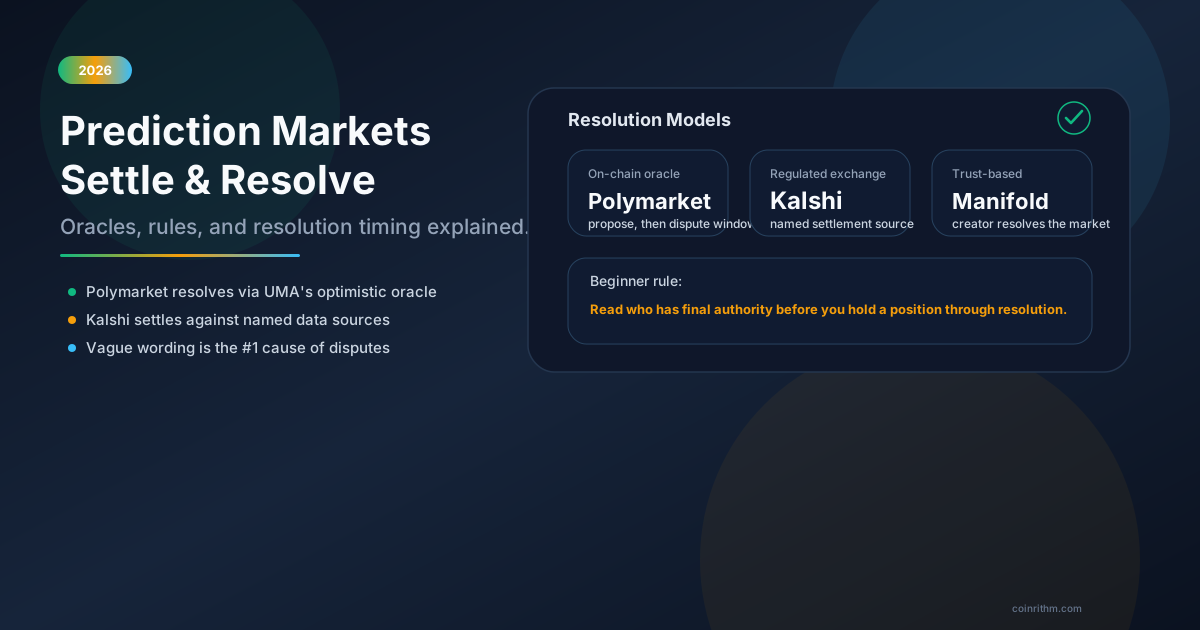
Economic and Fed markets are the exception. A CPI contract resolves against the number the Bureau of Labor Statistics publishes. An FOMC contract resolves against the rate decision the Federal Reserve itself announces in its policy statement. A jobs-report contract resolves against the payrolls figure the BLS releases that same morning. There is no proposer-and-dispute process to watch, no media consortium to wait on, no community vote — the resolving fact is a specific number from a specific government release, published on a schedule set well in advance.
That makes this corner of the prediction-market world about as close to a clean resolution source as the category gets. It doesn't mean these contracts are risk-free or perfectly worded — ambiguity still creeps in around exactly which print, which revision, and which agency release a given contract references. For the general mechanics of how different venues determine outcomes, and how that compares to categories with far more resolution ambiguity, read How Prediction Markets Resolve.
Event Contracts vs Futures-Implied Odds
If you've followed Fed policy at all, you've probably seen probability percentages attached to a rate decision before any prediction-market contract even existed for it — most commonly from CME Group's FedWatch tool. It's worth being precise about what that is and how it differs from an event-contract price, because they're often quoted interchangeably and they aren't the same instrument.
Futures-implied odds (the FedWatch-style approach) are derived, not traded directly. The tool takes prices from an existing, unrelated market — fed funds futures, which trade for hedging and speculation reasons that have nothing to do with predicting outcomes — and backs out an implied probability from the math of how those futures are priced relative to the current policy rate.
Event-contract odds (a Kalshi or Polymarket "cut in July" contract) are a direct market built for exactly this purpose. Someone buys Yes because they think a cut happens; someone buys No because they don't; the price between them is a first-hand probability estimate, not a probability backed out of a different instrument.
Both are legitimate ways to estimate the same thing, and both have known limitations — futures-implied measures can be distorted by term-premium and liquidity effects unrelated to Fed expectations, while event contracts can be distorted by thin books outside the most-watched meetings. Neither is definitively more accurate than the other, and this article isn't making that claim. Traders and researchers who watch both generally treat a meaningful gap between the two as more informative than either number in isolation — a reason to ask why the two markets disagree, not a reason to declare a winner.
The Scheduled-Catalyst Rhythm
Unlike a market that can reprice on any random headline, economic and Fed markets live and die on a public calendar. The FOMC schedules its roughly eight meetings a year well in advance and publishes the dates. The BLS publishes its CPI and jobs-report release dates for the year ahead. The BEA does the same for GDP estimates. None of this is a surprise to anyone tracking it — the surprise, when there is one, is in the number itself, not in the timing of when it arrives.
That rhythm shows up directly in how these markets trade: relatively quiet in between releases, then a sharp repricing window in the minutes around a CPI print, a jobs report, or an FOMC statement, as new information gets absorbed almost immediately. Because the dates are public, you can see what's coming rather than only reacting to what already happened — CoinRithm's calendar lists upcoming economic release dates and FOMC meetings alongside other prediction-market deadlines, so you can check what's scheduled before a data day rather than after.
How to Read Fed and Economic Odds
The core reading skill is the same one that applies to every prediction market: price is implied probability. A contract asking "Will the Fed cut rates at the July meeting?" trading at $0.78 on its Yes side is saying the market currently estimates roughly a 78% chance of a cut, given everything known at that moment. That's it — not a guarantee, not an official forecast, just where the current pool of buyers and sellers has settled.
Two additional reading skills matter more in this category than in most others:
Term structure across meetings. Because FOMC meetings are scheduled and recurring, the same threshold question often exists for multiple future meetings simultaneously — a "cut by July" contract alongside a "cut by September" contract on the same underlying question. Comparing the two tells you something a single contract can't: whether the market expects the move to happen soon, later, or is genuinely split on timing. A big gap between near-dated and far-dated pricing on the same question is often more informative than either price alone.
Repricing on data releases. These markets can move hard and fast at a specific, known moment — the instant a CPI print or jobs number crosses the wire, well before the next FOMC meeting even happens, because that data directly changes the market's read on what the Fed is likely to do next. Watching a rate-decision contract reprice around an inflation surprise is a good illustration of how directly these markets translate new information into an updated probability, in real time.
Who Actually Uses These Markets
A few recurring users show up across this category more than others:
- Macro researchers who want a market-derived probability alongside their own models, as one more input rather than a replacement for analysis.
- Journalists and commentators who cite live odds as color for a piece on an upcoming Fed decision or data release, the same way they might cite a polling average in a political story.
- Traders hedging event risk — someone with exposure to a rate-sensitive position who wants a defined-payout way to hedge specifically against a Fed surprise, separate from adjusting their core position.
- Curious retail participants who simply want a number attached to "will this happen" ahead of a release they're going to be watching anyway.
None of that changes what the price actually is: a live, tradable estimate, not a certified forecast from any of the institutions being priced.
Reading Caveats: Liquidity and Resolution Timing
Two honest caveats are worth knowing before you treat any of these prices as more solid than they are.
Thin books outside marquee events. A live FOMC decision or a headline CPI print draws deep, competitive trading. A GDP-range contract, an off-cycle recession question, or a less-followed shutdown market can have a handful of active participants and a price a single sizable order can move. Check liquidity and open interest before reading a thin market's price the same way you'd read a deep one.
First print vs data revision. Economic data gets revised — CPI components, jobs numbers, and GDP estimates are all routinely restated in later releases. Most contracts we've seen are built to resolve against the initial published print rather than any later revision, which is generally the cleaner and more common design for a market that needs to settle promptly. But that isn't a universal rule, and it isn't something this article can guarantee for every contract on every venue — some markets explicitly reference a different release or a specific revision window in their own wording. Read the specific contract's resolution rules before holding a position through a data day, and treat "resolves on the first print" as the common framing to verify rather than an assumption to trade on blind.
How CoinRithm Fits In
CoinRithm is a prediction-markets aggregator and paper-trading sandbox — not a broker, not a government data source, and not a party to any venue's contract rules. It doesn't forecast Fed decisions, inflation, or recessions; it surfaces what markets across venues are currently pricing so you can research with better inputs.
For Fed and economic-market research specifically, three surfaces matter most:
- Economy, Economics, and Finance topic hubs — browse active Fed, inflation, jobs, and recession markets across venues side by side, since categorization varies by source.
- Today — a daily digest surfacing what's moving right now, useful on a CPI or jobs-report morning when several contracts reprice at once.
- Calendar — scheduled FOMC meetings and economic release dates, so you can see what's coming rather than only what's already trading.
A practical workflow:
- Start on the Economy or Economics topic hub for the release or decision you care about.
- Check which venue actually has an active contract for that specific event, and how liquid it is.
- Read that contract's resolution rules — which release it references, first print or revision, named source.
- Only then decide whether the price looks informative or is likely just thin and noisy.
If you want to build intuition for how Fed and economic odds move without risking real money, CoinRithm's paper trading simulator lets you take mock positions on real prediction-market events, including economic ones, with no financial risk.
Frequently Asked Questions
What is a Fed rate prediction market?
It's a contract that pays out based on the actual decision the Federal Open Market Committee makes at a given meeting — cut, hold, or hike, and often a specific size of move. The price between contracts trading on the different outcomes reflects the market's current implied probability for each.
How do I read a CPI prediction market price?
The same way as any other prediction-market contract: price is implied probability. A Yes share on "core CPI above X% by [release date]" trading at $0.35 means the market estimates roughly a 35% chance of that outcome, based on everyone currently willing to trade at that price — not a certified BLS forecast.
Are Fed prediction market odds the same as CME FedWatch odds?
No, though they estimate the same underlying question. FedWatch-style tools derive an implied probability from fed funds futures pricing — a market built for other reasons, repurposed as a probability signal. Event contracts on venues like Kalshi are direct yes/no markets built specifically to price the outcome. Both are legitimate; neither is proven more accurate than the other, and a meaningful gap between them is usually more informative than either number alone.
How do recession-by-date markets work?
They ask whether a recession, or a specific recession-adjacent condition, will be declared or met by a stated date. Unlike CPI or jobs markets, there's typically no single scheduled print that settles the question — resolution usually depends on a named authority's determination, so read that specific contract's resolution source and timeline carefully before trading it.
Does a market resolve on the first data print or a later revision?
Most economic-data contracts we've seen are built to resolve against the initial published print rather than a later revision, since that's generally the cleaner design for a market that needs to settle promptly after release. That said, this isn't a universal guarantee across every venue and every contract — always check the specific market's stated resolution source, particularly if you're holding a position into a data day where revisions are expected.
Are Fed and economic prediction markets legal in the US?
Legality depends on the platform and your jurisdiction. Kalshi operates as a CFTC-regulated exchange in the US specifically for event contracts like these. For the fuller country-by-country and platform-by-platform picture, read Are Prediction Markets Legal? rather than assuming a blanket answer.
Can I practice trading Fed and economic markets without real money?
Yes. CoinRithm's paper trading sandbox supports mock stakes on prediction-market events, including Fed and economic-data contracts, so you can practice reading odds and sizing positions before deciding whether to trade anywhere with real funds.
Conclusion
Fed and economic prediction markets take the same core idea as every other category — price as implied probability — and apply it to some of the cleanest resolution sources in the entire space: official rate decisions, published inflation prints, and government jobs and growth data. That official-data backing is a genuine structural advantage over categories that resolve on judgment calls, but it doesn't make these markets liquid everywhere, immune to thin-book noise, or a substitute for reading each contract's specific rules on which release and which print it actually settles against.
Before you trust any Fed or economic odds you see cited, ask: which venue, how liquid, which specific data release, and first print or something else. Those questions cut through most of the confusion this category produces.
Start on CoinRithm's Economy, Economics, or Finance topic hub to see what's active right now, check the Today digest for what's moving, and use the calendar to track upcoming FOMC meetings and data releases.
Continue reading: Election Prediction Markets — the same pricing and resolution logic applied to political races, another scheduled-catalyst category worth understanding.
Last Updated: July 4, 2026
Disclaimer: This article is for educational and informational purposes only. It is not financial, economic, or investment advice. Prediction market prices are not official forecasts of Fed policy, inflation, employment, or GDP, and CoinRithm does not predict macroeconomic outcomes. Always verify a market's specific resolution rules and reference data source directly with the platform before trading or holding a position through a release date.