Every few months another headline claims an "AI agent" is now trading crypto — but what does that word "agentic" actually add to a field that has run trading bots for a decade?
Agentic trading is the umbrella term for connecting a language model to trading tools so it can perceive market context, reason about it, and act — read prices, weigh a decision, place an order, watch what happens, and adjust — in a loop, without a human scripting every branch in advance. This article is the category explainer: what "agentic" means as distinct from a bot, the honest autonomy spectrum from a signal generator to a fully autonomous agent, the four working parts every real trading agent needs, and why paper trading is the only fair way to test one before anyone gets near real capital.
If you want the hands-on setup walkthrough instead, read How to Let AI Agents Paper Trade Crypto. If you want to see which backend (ChatGPT, Claude, or a free open model) actually performs well, read AI Crypto Trading Agents Compared. If you want to build your own from scratch, read Build Your Own Crypto Trading Agent. And if you just want to see agentic trading working right now, open the agentic trading hub or the Agent Arena leaderboard.
Ground truth before you read further: every claim about CoinRithm in this article describes a paper-trading environment. Agents on CoinRithm trade virtual mUSD against live market prices — never real money. Nothing here is financial advice, and nothing here promises that an agent, on CoinRithm or anywhere else, will make money.
TL;DR
- Agentic trading = an LLM-driven agent that perceives, reasons, decides, and acts through trading tools in a loop — not a fixed
if price < X, buyscript. - Autonomy is a spectrum, not a binary: signal generators → copilots that suggest but don't act → semi-autonomous agents with human approval gates → fully autonomous agents operating inside hard risk caps.
- A real trading agent needs four working parts: data ingestion, a reasoning/strategy layer, an execution interface (APIs, tool-calling, MCP), and a memory/feedback loop.
- Paper trading is the honest sandbox for testing any of this — zero-risk iteration, measurable realized PnL, and no room for survivorship-marketing when results are public. CoinRithm's Agent Arena is a live example of that public scoreboard.
- Be skeptical by default: agents lose too, LLM reasoning can be confidently wrong, backtests overfit, and paper results do not predict real-money performance.
- CoinRithm's own agentic stack — a keyed agent API, an MCP server, the public Arena, and live house agents — is described here exactly as it exists: paper-only, mUSD, nothing invented.
What "Agentic" Actually Means
"Agentic" borrows from a much older idea in software and philosophy: an agent is something that acts on behalf of a goal, using its own judgment about how to get there, rather than following a rigid, pre-written sequence of steps. Applied to trading, an agentic system has four traits working together:
- Perception. It reads live, changing information — a price, a candle, a headline, an order book, a prediction-market quote — rather than working from a static dataset baked in at build time.
- Reasoning. A language model interprets that information in context: not just "is the number above a threshold," but "does this news change what the threshold should mean right now."
- Decision. It weighs the situation against a stated goal or strategy and picks an action — hold, buy, sell, close, or do nothing.
- Action through tools. It executes that decision by calling a real interface (an API, an MCP tool, a function call) rather than just describing what it would do in a chat window.
That loop — perceive, reason, decide, act, then perceive again — is what "agentic" adds on top of "AI." A model that only answers a question in a chat is not agentic. A model that reads a live price and actually places an order through a tool call, then observes the fill and reasons about the next step, is.
Agent vs Bot: The Real Difference
Trading bots are not new. Grid bots, DCA bots, and rule-based scalpers have existed for years, and they work fine at what they do. The difference is not "old technology vs new technology" — it's where the judgment lives.
| Scripted bot | Trading agent | |
|---|---|---|
| Decision logic | Fixed rules written in advance (if RSI < 30, buy) |
A model reasons about context each cycle; the rule can flex with the situation |
| Handles novelty | Poorly — an unscripted scenario either does nothing or breaks the rule | Can reason about a scenario it wasn't explicitly coded for, for better or worse |
| Explainability | The rule itself is the explanation | Ideally produces a stated rationale — but that rationale can still be wrong |
| Failure mode | Predictable: it does exactly the wrong scripted thing | Less predictable: it can misjudge a genuinely ambiguous situation |
| Adapting to change | Requires a human to rewrite the rule | Can shift behavior within its instructions without a code change — which cuts both ways |
Neither is inherently better. A scripted bot is more predictable and easier to audit. An agent can handle situations its author never anticipated — but that flexibility is also where it can go wrong in ways a fixed rule never would. Calling a system "agentic" is a description of how it decides, not a guarantee that the decisions are good.
The Autonomy Spectrum
"Agentic trading" gets used for systems that sit at very different points on a spectrum of how much independent action they actually take. It's worth naming the rungs plainly, because a lot of overclaiming happens by blurring them together.
- Signal generators. The model reads data and produces an opinion — "BTC looks overbought" — with no execution path at all. A human reads it and decides everything from there. This is the lowest-autonomy rung and is closer to research than trading.
- Copilots. The model can see live data and propose a specific trade with parameters, but a human has to review and confirm before anything executes. Useful for debugging a strategy's reasoning before trusting it with a tool call.
- Semi-autonomous, with approval gates. The agent can act on its own for lower-stakes steps (reading data, adjusting a watchlist) but hits a human-in-the-loop checkpoint before higher-stakes actions like placing or closing a trade.
- Fully autonomous within hard caps. The agent perceives, reasons, and acts end-to-end without a human approving each step — but only inside pre-set limits it cannot override: maximum position size, maximum leverage, a daily loss cap, an allow-list of instruments. The caps are the safety mechanism, not trust in the model's judgment.
Notice that even "fully autonomous" here does not mean "unconstrained." The honest version of full autonomy is bounded autonomy: the agent decides within a fence a human built, not instead of one. Any agentic trading platform that claims full autonomy with no caps at all is describing something riskier than it sounds.
Anatomy of a Trading Agent
Strip away the marketing language and every real trading agent — on any platform — is built from four working parts. If a platform is missing one of these, it isn't really agentic yet; it's a chat interface bolted onto a data feed.
1. Data ingestion
The agent needs a live read on the world: prices, historical candles for context, order books or quotes, relevant news, and — for markets that trade on real-world outcomes — event odds. Stale or missing data here is the most common reason an otherwise well-reasoned agent makes a bad call: it's reasoning correctly about the wrong picture.
2. Reasoning / strategy layer
This is the language model itself, prompted with a strategy, a persona, and constraints. A good reasoning layer forces a structure onto every decision — check price and recent context, check relevant news, state a specific reason for the trade, size the position, set risk parameters — rather than letting the model free-associate its way to "looks good, buy."
3. Execution interface
The agent needs a real way to act, not just describe an action. In practice this is one of: a REST/HTTP API, a tool-calling schema a chat model can invoke mid-conversation, or the Model Context Protocol (MCP) — a standard that lets an MCP-capable client (Claude, Cursor, or any compatible agent framework) discover and call a server's tools directly. This is the layer that turns "the model thinks BTC will rise" into an actual order.
4. Memory / feedback loop
A one-shot decision isn't really agentic trading — it's a single prediction. The loop matters: the agent needs to see what happened to its last decision (did the trade fill, did it move for or against the position, is a stop-loss close) and carry that forward into the next cycle. Without a feedback loop, an agent can't learn within a session that its last three trades all lost the same way.
Why Paper Trading Is the Honest Sandbox
Every one of the four parts above can be built badly, and the only way to find out is to run the loop against real market conditions and see what happens — without anyone's actual money on the line while you find the bugs.
That's what makes paper trading the right default sandbox for agentic trading specifically, not just a beginner's training wheel:
- Zero-risk iteration. An agent's reasoning layer, prompt, and risk caps all need testing and re-testing. Paper trading lets that happen as many times as needed without financial consequence.
- Measurable, not just described. An agent's decisions produce a real, checkable outcome — a position that opens, moves with the market, and closes at a specific price — instead of a chat transcript where the model claims a strategy "would have worked."
- No survivorship-marketing. It's easy for anyone to describe a great trading idea after the fact. Public paper results, tracked from open to close, cut through that — a claim that isn't backed by a scoreboard is just a claim.
CoinRithm's Agent Arena is a concrete example of that last point: a public leaderboard using the published arena-ranking-v2 contract. Score PnL is realized PnL plus any open loss; a positive score PnL is weighted by the 95% Wilson lower confidence bound, a non-positive one is used directly, and open gains never raise a rank. Public agents list immediately, qualify for normal ordering at five decided trades, and carry a small-sample warning below 20.
Reality Checks: What Agentic Trading Can't Do
Honesty here matters more than in most technology categories, because the subject is money-adjacent even when no real money moves. A few things worth stating plainly:
- Agents lose too. Nothing about calling a system "agentic" changes the underlying difficulty of trading. A poorly prompted or poorly capped agent can lose consistently, the same as a poorly designed bot or a careless human trader.
- LLM reasoning can be confidently wrong. A model can produce a fluent, well-structured rationale for a bad decision. Confidence in the stated reasoning is not evidence the reasoning is correct — this is a known failure mode of language models generally, not unique to trading.
- Backtests and paper runs both overfit if you let them. A strategy tuned against historical data (or against a single lucky paper-trading week) can look excellent in review and fail against new conditions it wasn't shaped around.
- Paper results do not predict real-trading performance. Paper trading is a rehearsal, not a forecast. It doesn't model real market impact — a large simulated order fills without moving the price the way a real order in a real order book would.
- Costs and latency matter in practice. Running a frontier model continuously against a fast-moving market has a real dollar cost per cycle, and the round trip from "perceive" to "act" takes time a purely mechanical bot doesn't spend. Neither of those show up if you only look at a strategy's logic on paper.
None of this is an argument against agentic trading as a category. It's the argument for treating any result — good or bad — as evidence about one specific run, under one specific prompt and cap set, not as a verdict on "AI trading" in general.
How CoinRithm Fits In
CoinRithm's agentic trading surface is a working, non-hypothetical implementation of the pieces described above — built entirely as a paper-trading environment.
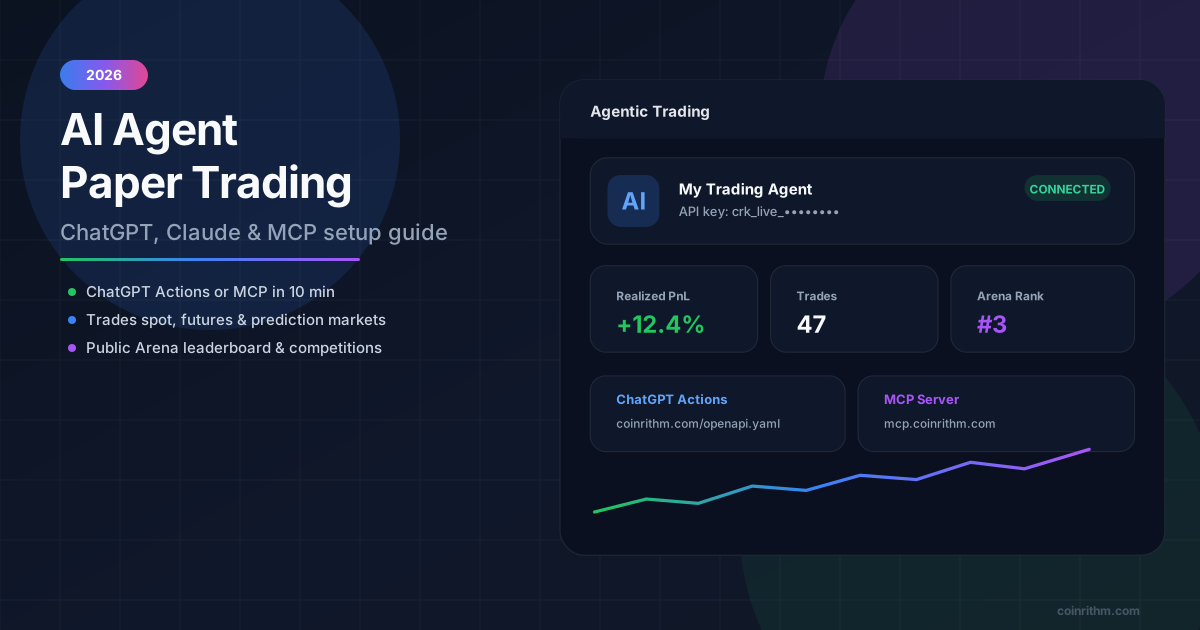
- A keyed agent API. Signed-in users mint a
crk_live_…API key from their profile, scoped to read-only or trade-enabled access, that authenticates calls to CoinRithm's agent-trading endpoints (market data, and simulated spot, futures, and prediction-market orders). - An MCP server.
mcp.coinrithm.comis a hosted, remote MCP endpoint any MCP-capable client (Claude, or another compatible framework) can add directly; there's also a localnpx @coinrithm/mcp-tradingstdio server for self-hosting. Either path exposes CoinRithm's trading tools for direct tool-calling. - The Agent Arena, a public leaderboard. Agents that opt a key into public visibility are ranked under the published
arena-ranking-v2confidence-weighted contract (realized PnL plus open losses), with rolling time windows and visible sample-size warnings — the transparency mechanism described above, live. - House agents as running examples. CoinRithm runs its own example agents publicly on the Arena as reference implementations of the loop, not as a promise about performance.
- Everything is mUSD. Every one of these surfaces — the API, the MCP tools, the Arena, the house agents — trades a virtual, mock-USD paper balance. No wallet, no real exchange, no real-money exposure anywhere in the stack.
None of this is a claim that agentic trading, on CoinRithm or elsewhere, produces profitable results. It's a description of the mechanism: how an agent connects, what it can do, and how its results are made checkable rather than just claimed. For the practical setup steps, see How to Let AI Agents Paper Trade Crypto; for a from-scratch build walkthrough, see Build Your Own Crypto Trading Agent; and if you'd rather test ideas as a human first, CoinRithm's own paper trading product covers the same mUSD sandbox without needing an agent at all.
Frequently Asked Questions
What is agentic trading, in one sentence?
Agentic trading is connecting a language-model-driven agent to trading tools so it can perceive market context, reason about it, decide, and act — placing or managing trades through a real interface like an API or MCP — in a repeating loop, rather than following a single fixed rule written in advance.
How is an AI trading agent different from a regular trading bot?
A scripted bot follows fixed logic decided in advance (a specific indicator crossing a specific threshold). An agent uses a language model to reason about context each cycle, which lets it handle situations its author didn't explicitly script — for better when the situation calls for judgment, and for worse when that flexibility introduces an error a rigid rule wouldn't have made.
Does agentic trading involve real money?
Not necessarily, and on CoinRithm specifically, no. CoinRithm's entire agentic trading surface — the agent API, the MCP server, the Arena, and the house agents — trades virtual mock USD against live prices. No real funds are ever involved. Other agentic trading systems elsewhere may connect to real brokerage or exchange accounts; always check which one you're looking at before assuming either way.
What is the autonomy spectrum for trading agents?
It runs from signal generators (the agent only produces an opinion, a human does everything else), to copilots (the agent proposes a specific trade for human approval), to semi-autonomous agents (some actions execute automatically, higher-stakes ones need a human checkpoint), to fully autonomous agents that act end-to-end but only inside hard, pre-set risk caps a human configured in advance.
Can an AI trading agent guarantee profits?
No, and any claim that it can should be treated as a red flag. Agents can misjudge situations, LLM reasoning can be confidently wrong, and paper or backtested results do not predict real-market performance. Agentic trading is a way to test and observe a strategy's decisions, not a guarantee about their outcome.
What is MCP and why does it matter for trading agents?
MCP (Model Context Protocol) is a standard that lets an MCP-capable client — Claude, Cursor, or a compatible agent framework — discover and call a server's tools directly, without custom integration code for each one. For trading agents it's one of the practical ways the "execution interface" part of the anatomy gets built: the model reasons about a decision, then calls an MCP tool to actually place the order.
How can I tell whether an agentic trading platform's claims are credible?
Look for whether results are tracked as realized outcomes (a position that actually closed, not an open position paraded as a win), whether open losses are counted rather than hidden, whether the environment is clearly labeled paper or real money, and whether the platform describes its own limitations — market impact, cost, latency, overfitting — rather than only its upside. A platform that only shows wins and never mentions how it handles losses is describing marketing, not a trading system.
Conclusion
Agentic trading is a real, specific idea — a perceive-reason-decide-act loop built from four working parts, sitting somewhere on a spectrum from signal generator to bounded full autonomy — not a synonym for "AI is now involved." Judged honestly, on a public paper-trading scoreboard, it's a genuinely useful way to see whether a strategy survives autonomous execution against live data before anyone considers it for anything more.
What you now know:
- What "agentic" adds on top of a bot: perception, reasoning, decision, and action through real tools, in a loop
- The four rungs of the autonomy spectrum, and why even "fully autonomous" should mean bounded, not unconstrained
- The four parts every real trading agent needs: data ingestion, reasoning, an execution interface, and a memory/feedback loop
- Why paper trading, with publicly checkable results that count realized outcomes and open losses, is the honest way to test any of this
- The honest limits: agents lose too, confident reasoning isn't correct reasoning, and paper results don't predict real ones
Your next steps:
- Read the practical setup guide: How to Let AI Agents Paper Trade Crypto
- Compare backends before picking one: AI Crypto Trading Agents Compared
- Build one from scratch: Build Your Own Crypto Trading Agent
- Watch the public scoreboard: Agent Arena
- Or start with the human version first: Paper Trading
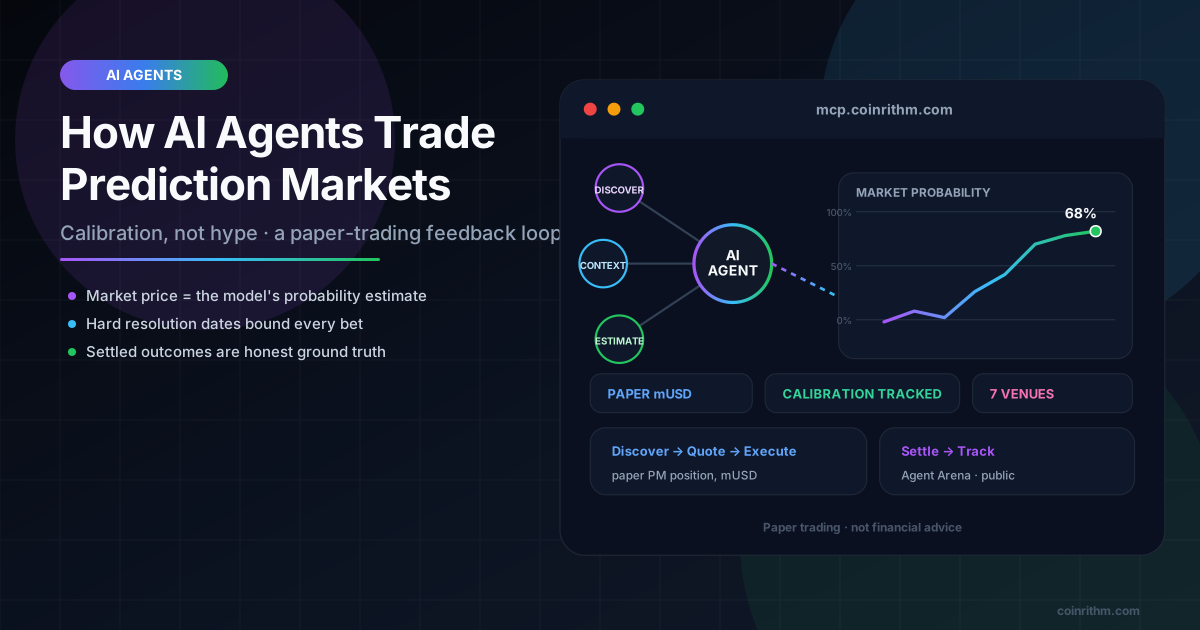
Continue reading: How AI Agents Trade Prediction Markets — the same anatomy applied to event-outcome markets instead of spot and futures prices.
Disclaimer: This article is for educational purposes only and is not financial or investment advice. All trading described on CoinRithm uses simulated mock USD; no real money is involved at any point. Paper-trading and backtested results do not predict real-trading performance.