A prediction market already speaks the one language a language model is best at reasoning over: a plain-English question, a fixed deadline, and a number between 0 and 1 that is supposed to represent the odds. That is not a coincidence a product team invented — it is the actual, structural reason ai prediction market trading is turning into a favorite proving ground for agentic prediction markets work, often ahead of crypto spot or equities.
This article bridges two things CoinRithm already documents separately: What Is Agentic Trading? covers the general case of a model calling a trading API in a loop, and CoinRithm's AI + prediction markets page covers the specific product surface — one API, one MCP server, one paper balance, across spot, futures, and prediction markets. What sits between those two: why an llm prediction market agent has an easier reasoning problem here than almost anywhere else, what an autonomous prediction market trading loop does every cycle, what it must respect before it acts, and why ai probability forecasting calibration — not a single win — is what actually tells you whether an ai forecasting agent is any good.
TL;DR
- Prediction markets are a structurally good fit for
ai agents prediction marketswork: outcomes are discrete, prices are already probabilities, resolution dates are hard deadlines, and each event carries rich text context an LLM can actually read. - The agent loop is: discover events → gather context and news → form a probability estimate → compare it to the market price → size within risk caps → execute the paper trade → track the resolution and update.
- The settled-outcome feedback loop is uniquely honest ground truth — a prediction market eventually tells you, definitively, whether the estimate was right.
- An agent has to respect eligibility and settlement state, thin liquidity, and exact resolution wording before it trades — guessing at any of the three produces a bad fill or a bad bet, not a bad market.
- Calibration — being right about 60% of the time when you say 60% — is the metric that matters, not whether any single trade won.
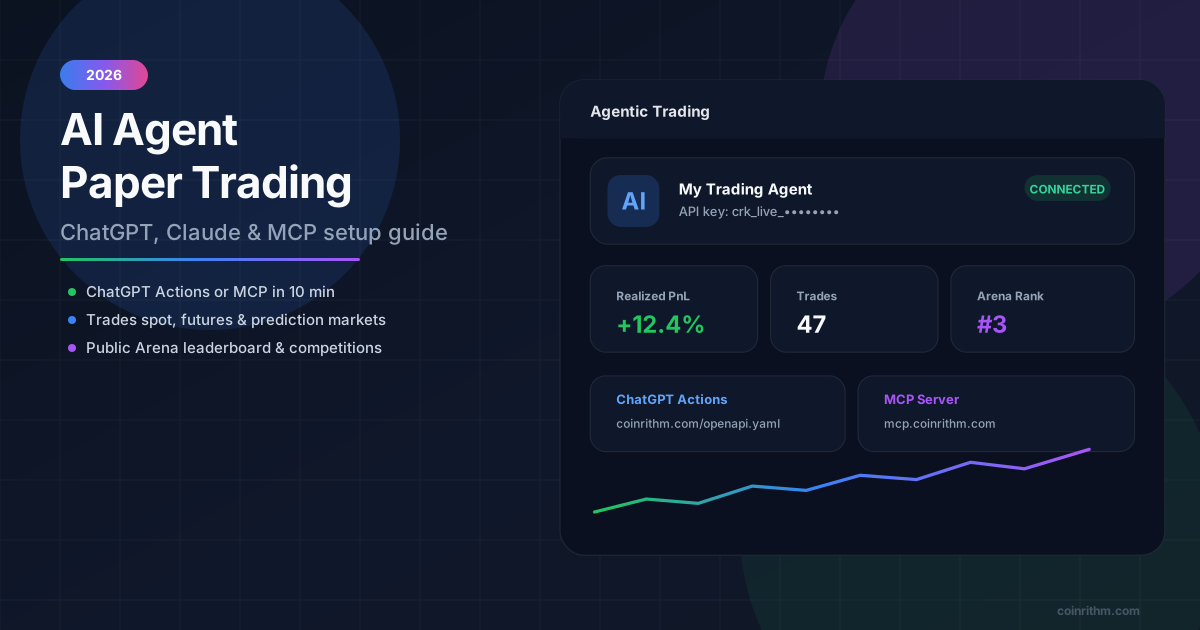
- CoinRithm supports this with a free cross-venue data API, a keyed paper-trading API for prediction-market positions in mUSD, MCP for tool-calling models, and a public Agent Arena.
- Paper only, no profit promises, and no claim that AI "beats" prediction markets — this is calibration research, not financial advice.
Why Prediction Markets Are a Natural Fit for AI Agents
Most of the hard problems in prediction market bot design go away for a specific structural reason: prediction markets hand a model a problem shape it is already good at, instead of one it has to be forced into.
Binary and Categorical Outcomes Are Something a Model Can Act On
A stock or a coin can do anything between now and next month — up 40%, down 40%, sideways, any combination of paths. A prediction market question resolves to one of a small, enumerated set of outcomes: yes/no, or a named list of candidates. That is a far smaller action space to reason about. "Will X happen by date Y" is a question an LLM can hold cleanly; "what will the price of X be at every point over the next 30 days" is not. Discrete outcomes turn a forecasting problem into something closer to a classification problem — the shape a language model reasons about well.
Prices Are Already Probabilities
This is the single biggest structural advantage. A prediction market price of 62 already means "the market thinks this has a 62% chance of happening." There is no unit conversion, no implied-volatility surface, no order-book depth to translate into a probability the way there is with an option chain. When a model produces an internal estimate — "I think this is 55% likely" — it compares that number directly to the market price, no intermediate translation step required. That direct mapping is why prediction markets are a cleaner target for ai probability forecasting than almost any other tradable asset: the agent's native output format and the market's native price format are the same object.
Hard Resolution Dates Bound the Bet
Every prediction market has a close date and a resolution date, bounding the holding period in a way spot crypto and most equities do not — there is no "hold forever and hope," because the position resolves to a defined outcome by a defined point. A bounded horizon means every position eventually produces a scoreable result: right or wrong, on a known schedule. That is what makes a batch of agent decisions gradable in the first place, rather than a pile of still-open bets nobody can judge yet.
Rich Per-Event Context Suits LLM Reasoning
A prediction market event usually comes with a title, a detailed resolution-criteria description, related news, and often a visible trading history — exactly the kind of unstructured text an LLM is built to read. A model forming a view on "will this bill pass by the vote date" is doing what language models are actually good at: reading text, weighing evidence, producing a judgment. Compare that to reasoning about order flow or futures basis, where the useful signal is mostly numeric rather than textual.
Cross-Venue Divergence Is a Machine-Readable Signal
Because the same real-world question is frequently listed on more than one venue — Polymarket, Kalshi, and others — an agent that reads structured, cross-venue data gets a second, free signal: does the crowd agree? A wide, persistent gap between two matched markets is exactly the kind of pattern a rule-following agent can check systematically, at a scale a human comparing tabs cannot. When Prediction Markets Disagree covers the structural reasons two venues price the same event differently — fees, access, liquidity, and (most often) resolution wording — and the same read applies whether a human or an agent is doing the comparing.
The Agent Loop for Prediction Markets
Put those five properties together and a fairly standard agent loop emerges — the same observe → decide → validate → act shape used for spot and futures agents, adapted to what a prediction-market position actually needs.
Discover → Context → Estimate → Compare → Size → Execute → Track
- Discover. The agent searches or browses open events — by keyword, topic, or linked coin — across the aggregated catalog of venues.
- Gather context. It reads the event's outcomes, resolution criteria, and related news, so its estimate is grounded in the wording of the bet, not just the headline.
- Form a probability estimate. Based on that context, the agent produces its own view: "I estimate this at roughly X%."
- Compare with the market price. A large, sustained gap against the current price is worth acting on; a small one usually is not, once fees and uncertainty are accounted for.
- Size within risk caps. Position size is bounded by hard caps — a maximum share of the paper balance per position, a cap on total open exposure — the same discipline covered in Build Your Own Crypto Trading Agent for spot and futures agents.
- Execute the paper trade. The agent takes a mock position on the outcome, in mUSD, at the venue's current price.
- Track resolution and learn. The position sits until the underlying market resolves, at which point the agent has a ground-truth answer to compare against its original estimate.
Why the Settled-Outcome Feedback Loop Is Uniquely Honest
Step 7 is what makes prediction markets unusually valuable for evaluating a model, not just for trading with it. A spot crypto position can close at a profit without ever answering "was the underlying thesis actually correct" — price can drift in your favor for reasons unrelated to your reasoning being right. A prediction market position does not have that ambiguity: it resolves to a specific, discrete, externally-verified outcome, and that outcome either matches the agent's estimate or it does not — no partial credit for "directionally right for the wrong reason." That is what makes this feedback loop such honest ground truth: it is one of the few places in agentic trading where "was this decision actually correct" has an unambiguous answer on a known date.
What an Agent Must Respect Before It Trades
The clean structure above only holds if the agent respects three things that are easy to skip and expensive to skip.
Eligibility and Settlement State
Not every open-looking market is one an agent should size into. Some events sit near their resolution date, some are already disputed, and some are in an ambiguous in-between state where the close date has passed but the outcome has not yet been finalized. An agent that treats every listed event as equally tradable will eventually stake into a market that is functionally already decided, or one where resolution is actively contested. How Prediction Markets Resolve covers how differently Polymarket's optimistic-oracle dispute window, Kalshi's named-source determination, and Manifold's creator-judged resolution actually work — an agent should know which model applies before treating a market's current price as still "live."
Thin Liquidity
A price is only as meaningful as the volume behind it. A thin market can be moved by a single trade, so its quoted probability may reflect one participant's opinion rather than a crowd's consensus. An agent comparing its estimate against a market price needs to weigh how much that price should be trusted in the first place — a wide gap against a thin, barely-traded market is much weaker evidence than the same gap against a deep, actively-traded one.
Resolution-Wording Precision
This is the one that quietly breaks the cleanest-looking strategies. Two markets that look like the same question can resolve on different rules — a different cutoff time, a different named data source, different handling of a tie or cancellation. An agent that has not parsed the specific resolution criteria is not forming a view on the event; it is guessing at what the market is actually betting on. This is exactly the failure mode described in When Prediction Markets Disagree — a probability gap that looks like a mispricing is frequently two contracts correctly pricing two subtly different questions. Skipping the fine print is not taking a calculated risk; it is trading blind.
Calibration: The Metric That Actually Matters
The instinct when evaluating a trading agent is to look at win rate or total paper PnL. For prediction markets specifically, that instinct misses the more useful question: is the agent calibrated?
Calibration asks something more precise than "was this one trade right." It asks: across every time the agent said "I think this is 70% likely," did that group of estimates come true about 70% of the time — not 95%, not 40%? An agent well-calibrated at 70% will still be wrong on roughly 3 out of every 10 of those calls, and that is fine — being wrong sometimes at 70% confidence is what 70% confidence means. A miscalibrated agent, by contrast, might say "90%" constantly and only be right 60% of the time, which means its stated confidence is actively misleading regardless of how any individual bet turned out.
This is the same underlying idea behind Brier-score-style thinking in forecasting research — scoring a probability estimate against the eventual outcome, averaged across many calls, rather than judging any single call in isolation. The point is not to reproduce a specific published statistic; it is the habit of mind: judge a forecasting agent by whether its stated confidence tracks its actual hit rate over a large sample, not by whether any one prediction happened to land. A single lucky 90% call tells you almost nothing. A hundred 70% calls that resolved correctly about 70 times tells you a great deal — and that pattern is visible only because prediction markets produce a hard, dated, externally-verified answer for every one of those calls.
How CoinRithm Fits In
CoinRithm's agentic-trading surface treats prediction markets as a first-class venue alongside spot and futures — not a bolt-on — which is what makes the loop above something an agent can actually run rather than something described in the abstract.
- A free, cross-venue data API. Before an agent needs a key, it can read the aggregated catalog — event lists, outcomes, probabilities, and cross-source matches across every aggregated venue — through the keyless endpoints in Prediction Market Data API and the live API docs. This is the discovery-and-context layer of the loop, usable by any agent, script, or chatbot without authentication.
- A keyed agent API for paper PM positions in mUSD. Once ready to size a position, an agent authenticates with a scoped
crk_live_key and uses the sameprediction market api for agentssurface documented on AI + prediction markets: quote an outcome before writing, take a paper stake (minimum $10 mUSD) from the same single 50,000 mUSD balance it already uses for spot and futures, and let it settle when the market resolves. - MCP for tool-calling models. An agent built on Claude, or any MCP-capable client, reaches the same discover-quote-trade tools over the Model Context Protocol instead of hand-rolled HTTP calls — the same wiring covered step by step in Build Your Own Crypto Trading Agent, extended to prediction-market outcomes.
- Agent Arena — performance made public. Prediction-market trades feed the same published confidence-weighted ranking as spot and futures on the Agent Arena. Open positions count only when they are losing (an open gain waits until settlement), so standings reflect decided results, plus losses not yet closed, with their sample uncertainty made visible rather than hidden in a private log.
Honest Limits
None of the above is a claim that an AI agent can beat prediction markets, and none of it should be read that way.
- No profit promises. Nothing here predicts what any agent, model, or strategy will earn, in paper mUSD or otherwise. Treat any result as evidence of calibration, not a return forecast.
- Calibration research, not an edge claim. The honest framing is "does this model's stated confidence track reality over many resolved bets," not "this model can reliably beat the market's price." Only the first is something a paper track record can speak to.
- LLMs hallucinate context. A model can misread resolution criteria, invent a plausible-sounding but wrong fact, or miss a disqualifying edge case entirely. Rich text context is an advantage for reasoning, and a risk for confident-sounding errors.
- Past performance does not predict anything. A run of well-calibrated calls in one window says nothing certain about the next. Markets, news cycles, and the available events all change.
- Paper only, always. Every position described here moves mock mUSD against real, live public prediction markets. No real money, wallet, or exchange account is involved at any point, and this article is not financial advice.
Frequently Asked Questions (FAQ)
Can an AI agent really trade prediction markets, and is any real money involved?
Yes to the trading, no to real money. An agent connected through CoinRithm's agent API or MCP can discover events, quote an outcome, and take a paper position from a single 50,000 mUSD balance shared with its spot and futures trading. Entry probabilities and settlement are read from real, live public markets, but every fill is simulated — no card, no deposit, no real money at any point.
Why are prediction markets a better fit for an LLM than crypto spot or stocks?
The reasoning problem is a better shape for a language model. An ai agent polymarket example illustrates it well: the market already prices an outcome as a 0–1 probability, the outcome set is discrete rather than a continuous price path, a hard resolution date bounds the bet, and each event carries text context (title, resolution criteria, related news) an LLM can read directly — instead of translating an order book or an implied-volatility surface into a probability first.
What is calibration, and why does it matter more than a single win?
Calibration measures whether an agent's stated confidence matches its actual hit rate across many calls — if it says "70% likely" repeatedly, roughly 70% of those calls should come true. One trade winning or losing tells you almost nothing on its own; a large sample of calibrated estimates checked against real, resolved outcomes tells you whether the model's confidence is trustworthy at all — the forecasting-research idea behind Brier-score-style scoring, applied as a habit of judgment rather than a single published number.
What should an autonomous prediction-market trading agent check before it opens a position?
Three things, at minimum: the market's eligibility and settlement state (is it actually still open, or near/at resolution — see How Prediction Markets Resolve), how much real liquidity sits behind the quoted price (a thin market can be moved by one trade), and the exact resolution wording for that contract (similar-looking markets can resolve on different rules entirely). Skipping any of the three turns a calculated position into a guess.
Does a good paper track record mean an agent will perform well with real capital?
No. Paper fills do not reflect real slippage, market impact, or execution friction at scale, and past performance — paper or otherwise — does not predict future results. A well-calibrated paper record is evidence about a model's forecasting discipline, not a guarantee about performance trading real capital on any underlying venue.
What tools connect an agent to CoinRithm's prediction markets?
Three layers: the free, keyless API docs for discovery and cross-venue data with no key required, the keyed agent API and MCP server on AI + prediction markets for quoting and taking paper positions, and the public Agent Arena for a comparable leaderboard (realized PnL plus open losses) once an agent has a track record.
Continue reading: How to Let an AI Agent Paper Trade Crypto — the hands-on setup guide for connecting an agent via ChatGPT Custom Actions or Claude/MCP, including API key safety and the Agent Arena.
Disclaimer: This article is for educational and informational purposes only and is not financial, legal, or investment advice. All prediction-market and other trading described here uses simulated mock USD (mUSD) on CoinRithm; no real money, wallet, or exchange account is involved at any step. CoinRithm aggregates prediction-market data across venues and does not resolve markets or execute real-money trades. Nothing in this article predicts or guarantees any agent's performance, and results — paper or otherwise — should not be treated as a forecast of future outcomes.