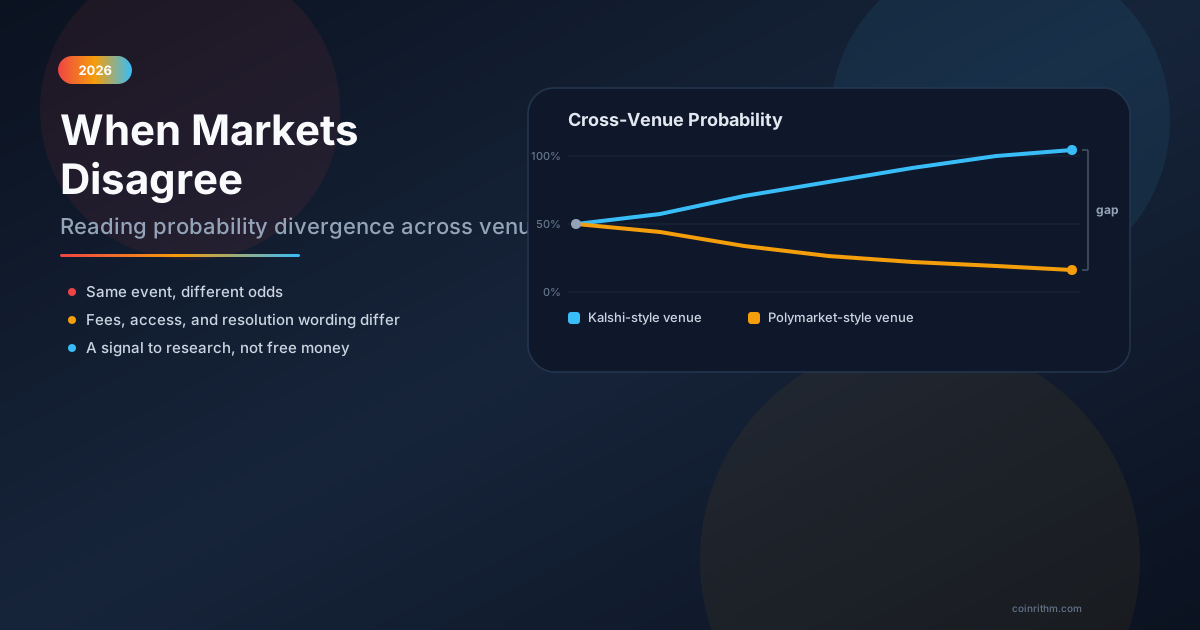
Here is the fantasy: the same question is priced at 62% on one venue and 71% on another, so you buy the cheap side, sell the expensive side, and pocket a guaranteed nine points no matter what happens. Free money, sitting in plain sight, because prediction markets are fragmented and inefficient. It is one of the first ideas everyone has when they see cross-venue price differences — and it is almost always wrong for reasons that only show up when you try to actually do it.
Cross-venue gaps are real and worth understanding; we surface them constantly through probability divergence and the compare view. But "there is a gap" and "there is prediction market arbitrage" are very different claims. This guide walks through why most apparent arbitrage evaporates on contact — and what the gaps are actually good for.
TL;DR
- A price gap between venues is not automatically arbitrage. Four things usually eat it: fees, settlement risk, resolution mismatch, and liquidity.
- Resolution mismatch is the killer: two markets that look like the same question can settle on different criteria, so your "hedge" is not hedged at all.
- Fees and spreads on both legs routinely exceed a single-digit gap, turning "profit" into a loss.
- Capital is locked until resolution — sometimes months — and each venue carries its own settlement and counterparty risk.
- Gaps are better read as information — a signal of disagreement or mispricing — than as free money. That is how CoinRithm treats them.
- CoinRithm is a data and paper-trading platform, not a broker: use it to study divergence, not to chase riskless profit that rarely exists.
What arbitrage would require
True arbitrage is a riskless, guaranteed profit from a price discrepancy. For a cross-venue prediction-market gap to be genuine arbitrage, every one of these has to hold at once:
- The two markets resolve on exactly the same criteria, at the same time, to the same source of truth.
- The gap is larger than the total cost of both legs — fees, spreads, and slippage combined.
- Both venues have enough depth to fill your size at the quoted prices.
- Both venues will actually pay out correctly when the market resolves.
- You can afford to lock up the capital on both legs until then.
Miss any one and it is not arbitrage — it is a directional bet with extra steps and hidden risk. In practice, at least one fails almost every time. Let us take them in order of how often they quietly kill the trade.
Resolution mismatch: the gap that is not a gap
This is the one that catches everyone, because it is invisible in the price. Two markets can carry near-identical titles — "Will Candidate X win?" — and resolve on genuinely different rules. One settles on the official certified result; the other on a call by a named source by a specific date. One counts a runoff; the other resolves at the first round. One voids on cancellation; the other pays out anyway.
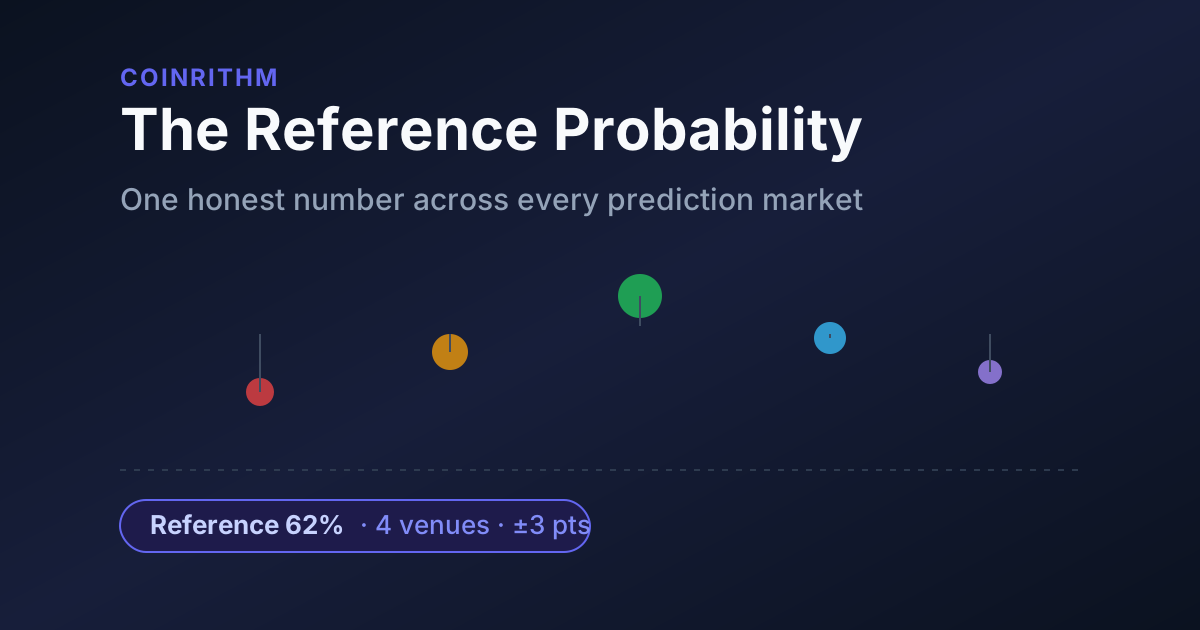
When the resolution criteria differ, the two contracts are not the same instrument, so buying one and selling the other is not a hedge. You can be "right" on both legs and still lose, because they can resolve to different answers about what is nominally the same event. The apparent nine-point edge was compensation for a risk you did not see: the risk that the two markets disagree about the question itself. This is exactly why CoinRithm matches markets across venues conservatively — a wrong match would imply an arbitrage that does not exist — and why our reference probability only aggregates carefully matched, real-money markets. A sloppy aggregator manufactures phantom arbitrage by treating different questions as the same one.
Fees and spreads: the gap you pay away
Even when two markets genuinely match, the round trip is not free. Each leg has a spread — you buy at the ask and sell at the bid, not at the mid you were quoting in your head — and many venues charge trading fees on top. Kalshi, for instance, applies a taker fee; other venues bake costs into the spread or charge on settlement. You are also crossing the spread twice, once per venue.
Add it up and a single-digit gap frequently disappears. A nine-point difference against, say, a couple of points of spread and fees per leg can net out to roughly nothing — and that is before slippage. The gaps large enough to survive costs tend to exist precisely because something else is wrong: a resolution mismatch, a thin market, or a venue people distrust. The market is not leaving free money on the table; it is pricing a risk you have not accounted for. Our fees comparison lays out what each venue actually charges.
Liquidity: the price that moves when you touch it
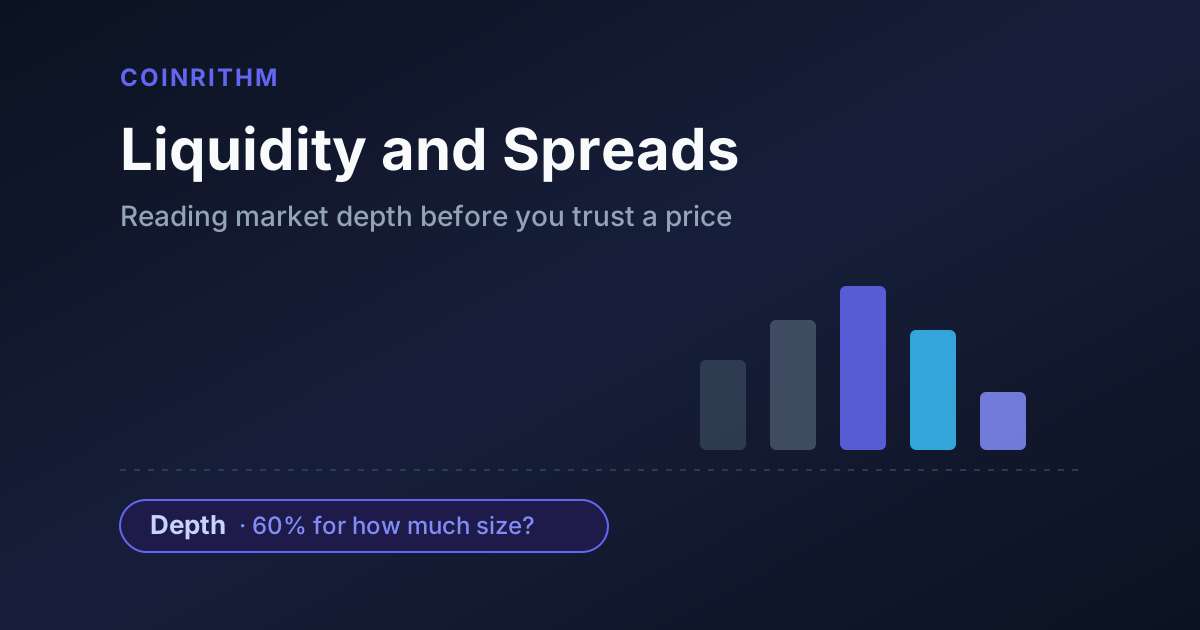
The quoted gap assumes you can trade both legs at the prices you see. Often you cannot. The cheap side may be cheap because it is thin — a few dollars deep — so your buying pushes it up as you go, and the expensive side may be equally shallow, so your selling pushes it down. By the time you have built the position, the gap has closed against you through slippage, the microstructure trap covered in liquidity and spreads.
This is why a large gap on a thin market is the least likely to be real arbitrage: thinness is both the reason the price is off and the reason you cannot capture it. Deep, liquid markets, where you could trade size, rarely show large gaps for long — because anyone who could arbitrage them already has.
Settlement risk and locked capital
Finally, the two costs everyone forgets. First, your money is locked on both venues until the market resolves, which can be weeks or months. That capital is doing nothing, and "guaranteed nine points in six months" is a very different proposition once you account for the time and the opportunities forgone.
Second, each venue carries its own settlement risk — the possibility that it resolves late, resolves disputably, or in the extreme fails to pay. A cross-venue position doubles your exposure to that risk, because you are now counting on two venues to settle correctly, and a resolution dispute on either leg can turn a "riskless" trade into a loss. Real arbitrage assumes flawless settlement; prediction markets do not guarantee it, which is the whole reason we treat settlement trust as a first-class property rather than an afterthought.
What the gaps are actually for
If cross-venue gaps are so rarely free money, why do we surface them at all? Because they are information, and that is far more durable than a fleeting trade.
A persistent gap tells you two venues, with different user bases and incentives, genuinely disagree — which is a prompt to ask why, and often a sign that one side is mispriced or that the questions differ in a way worth understanding. A gap that appears and closes quickly tells you the market is efficient and doing its job. Read this way, divergence is a lens on where the real uncertainty and the real mispricings live, not a get-rich scheme. That is how CoinRithm presents it: the compare matrix shows the gap and the cross-venue reference side by side, so you see both the disagreement and the honest consensus, and can judge for yourself whether a gap is opportunity or illusion.
And to be explicit about what we are: CoinRithm is a data and paper-trading platform, not a broker or exchange. We are the place to study prediction market pricing — including where and why venues diverge — with no real capital at risk. Use the gaps to sharpen your read, not to chase an arbitrage that usually is not there.
FAQ
Is prediction market arbitrage actually possible?
Occasionally, but it is far rarer than the price gaps suggest. A genuine cross-venue arbitrage needs identical resolution criteria, a gap bigger than the combined fees and spreads, enough depth to fill both legs, and reliable settlement on both venues. Most apparent gaps fail at least one of those tests, which is why they persist without being captured.
Why can't I just buy the cheap venue and sell the expensive one?
Because the two markets may not be the same instrument. If their resolution criteria differ — different sources, dates, or handling of edge cases — your "hedge" is not hedged, and you can lose on both legs. Even when they match, fees, spreads, slippage, and locked capital usually consume a single-digit gap.
What is resolution mismatch?
It is when two markets that look like the same question actually settle on different rules — a different official source, a different date, different handling of runoffs or cancellations. It is the most common reason cross-venue arbitrage fails, because it makes two contracts that appear identical resolve to potentially different answers.
Do fees really wipe out the gap?
Frequently, yes. You cross the spread on both venues and may pay explicit trading fees on top, so a couple of points of cost per leg against a single-digit gap can net to roughly zero — before any slippage from thin liquidity. See our fees comparison for what each venue charges.
If gaps aren't free money, why does CoinRithm show them?
Because a price gap is information. A persistent gap flags genuine disagreement or a possible mispricing worth investigating; a gap that closes fast shows the market working efficiently. We present divergence alongside the cross-venue reference probability so you can read the signal, not chase a trade that rarely pays.
Can I practise this without real money?
Yes — that is what CoinRithm is for. It is a data and paper-trading platform, so you can study divergence, resolution differences, and how gaps behave with no capital at risk, before ever deciding whether a real position makes sense on a venue elsewhere.