Two prediction markets both say 60%. One has a hundred thousand dollars resting within a penny of that price and trades constantly; the other has forty dollars and last saw a trade on Tuesday. They print the identical number, and that number means something completely different in each. The difference is microstructure — liquidity, spread, and depth — and it is the layer beneath the price that tells you whether the price is worth anything at all.
Most guides stop at "the price is the probability". True, but incomplete: a price is only a probability if there is a real market underneath it, and reading that market is a skill. If you are still building intuition for how prices become probabilities, start with how prediction market probabilities work; here we go one level down, into the plumbing that decides whether a prediction market liquidity number deserves your trust.
TL;DR
- Liquidity is how much money stands behind a price. Thin liquidity means one small order can move the "probability" several points — a quote pretending to be a consensus.
- Spread is the gap between the best buy and sell price. A tight spread signals a contested, tradable market; a wide one signals uncertainty or neglect.
- Depth is how much you can trade before you move the price. Shallow depth means slippage — you do not get filled at the number you see.
- Two designs dominate: order books (CLOB), used by Kalshi and Polymarket, and automated market makers (AMM), used by venues like Limitless. They fail and inform differently.
- CoinRithm turns microstructure into readable quality tiers — liquidity, volume, and spread — so you can judge a price at a glance, and never blend a thin market into consensus.
Liquidity: the money behind the number
Liquidity is the total capital resting in a market ready to be traded against. It is the single most important thing to check before trusting a price, because it determines how hard the number is.
In a deep market, the price is a genuine consensus: to move it, someone has to overpower a lot of standing capital, so the number reflects the aggregated conviction of many participants. In a thin market, the price is whatever the last, or the loudest, small order made it. Forty dollars of liquidity cannot represent a crowd's belief about anything; it represents one person's whim, dressed up as a probability. This is why thin markets are the classic trap, and why our data-quality engine flags them explicitly rather than letting them masquerade as reliable.
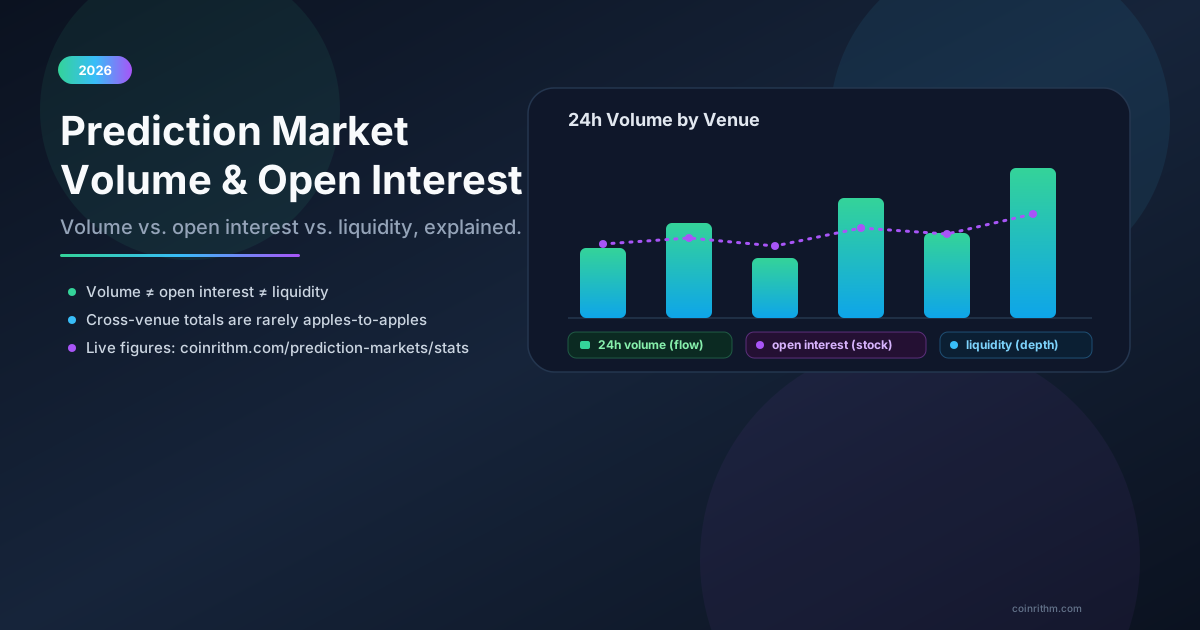
A related but distinct signal is volume — how much has actually traded recently, versus how much is merely resting. A market can have decent liquidity but no recent volume, which tells you the price is a stale belief: real once, but the world has moved and the market has not. Liquidity says "how much money is here"; volume says "is anyone actually acting on it". You want both.
Spread: the market's confidence in its own price
The spread is the gap between the highest price someone will pay (the best bid) and the lowest price someone will accept (the best ask). It is the market telling you how sure it is about its own number.
A tight spread — bid and ask nearly touching — means participants broadly agree on the price and are willing to trade at it. The number is contested, active, and tradable; you can act on it at close to the quoted level. A wide spread means the two sides disagree about what the market is worth, or that nobody is bothering to tighten it. Either way, the "price" (usually the midpoint) is soft: there may be no one actually willing to trade there. A market showing 60% with a 10-point spread is not really at 60%; it is somewhere between 55% and 65% with nobody committing.
Spread is also your early warning for the failure modes that distort accuracy. Markets that are thin, neglected, or ambiguous tend to have wide spreads, because there is no competitive pressure squeezing the two sides together.
Depth and slippage: what the headline price hides
Liquidity and spread describe the top of the book. Depth describes the rest of it — how much size is available as you walk away from the best price. Depth is what determines slippage: the difference between the price you see and the average price you actually get when your order is large enough to eat through several levels.
A market can have a tight spread at the top and almost nothing behind it. Your first dollar trades at 60%; your five-hundredth might trade at 68% because you have exhausted the shallow book. The quoted price was real for a trivial size and fictional for a meaningful one. This is why "the price is 60%" is an incomplete statement — the honest version is "the price is 60% for this much size." Serious readers of a market always ask how deep the number goes, not just what it is.
Two ways markets are built: order books vs AMMs
How a venue is constructed changes how you read its microstructure. Two designs dominate prediction markets.
Central limit order books (CLOB)
A CLOB is the classic exchange model: buyers and sellers post limit orders, and the venue matches them. Kalshi and Polymarket both run order-book models. Here, liquidity and depth are literal — you can see the resting orders — and the spread is a direct, real-time read on agreement. The strength is transparency: the book is the truth about who will trade what, at what price, for how much size. The weakness is that when interest dries up, the book empties, spreads gape, and the market visibly goes thin. A CLOB does not hide its own neglect, which is a feature.
Automated market makers (AMM)
An AMM replaces the order book with a formula and a pool of capital: a smart contract quotes a price derived from the pool's balances, and every trade moves along that curve. Venues like Limitless use this design. The strength is that there is always a quote — you never face an empty book — which is why AMMs are popular for long-tail markets. The weakness is that the always-available price can be shallow: the curve will happily quote you a number while a modest trade moves it a lot, so slippage is the thing to watch rather than a visible spread. With an AMM, "is there a price?" is never the question; "how much does my trade move it?" always is.
Knowing which model a venue uses tells you how to be sceptical. On a CLOB, watch the spread and the visible depth. On an AMM, watch the pool size and expected slippage. Each venue's model, fee structure, and settlement details are laid out on the sources page.
How CoinRithm makes microstructure readable
You should not have to reconstruct an order book to know whether a price is trustworthy. So CoinRithm distils microstructure into plain tiers on every market: a liquidity tier, a volume tier, and a spread tier, rolled into the quality scorecard described in our data-quality guide. A high-liquidity, high-volume, tight-spread market earns trust; a thin, inactive, wide-spread one gets flagged — visibly, never hidden.
Microstructure also guards the numbers built on top of markets. Liquidity, or open interest when every venue reports it, is what weights each venue in the cross-venue reference probability (with caps, so one deep book cannot dominate and one thin book cannot distort). It is why a raw cross-venue gap is not free money — the subject of our arbitrage guide — because the thin side often cannot absorb your trade without moving. And it is the context the whale tape needs: a large trade into a deep book is a signal, while the same size into a thin one is just someone moving an illiquid price. You can inspect all of it — liquidity, volume, spread, best bid and ask — per market through the free data API.
FAQ
What is liquidity in a prediction market?
Liquidity is the amount of money resting in a market ready to be traded against. It determines how hard the price is: deep liquidity means the number is a genuine consensus that takes real capital to move, while thin liquidity means a single small order can swing the "probability" several points.
What does the bid-ask spread tell me?
The spread — the gap between the best buy price and best sell price — tells you how confident the market is in its own number. A tight spread means participants agree and will trade near that level; a wide spread means they disagree or are not paying attention, so the midpoint price is soft and may not be tradable at all.
What is the difference between an order book and an AMM prediction market?
An order book (CLOB), used by Kalshi and Polymarket, matches posted buy and sell orders, so liquidity, depth, and spread are directly visible. An AMM, used by venues like Limitless, quotes a price from a formula and a capital pool, so there is always a price but shallow pools cause slippage. On a CLOB watch the spread and depth; on an AMM watch the pool size and how much your trade moves the price.
Why does a thin market's price mislead me?
Because it looks identical to a deep market's price while meaning far less. With almost no money behind it, the number reflects one small order rather than a crowd's belief, and it can lurch on the next trade. That is why we flag thin markets in the quality scorecard instead of treating their prices as reliable.
What is slippage and how do I avoid it?
Slippage is the difference between the price you see and the average price you actually get when your order is big enough to trade through multiple levels of the book. You avoid it by checking depth, not just the top-of-book price, and by sizing trades to the liquidity available — a lesson that matters even in paper trading.
Where can I see liquidity and spread data on CoinRithm?
On every market via its quality tiers, on the sources page per venue, and through the free public API, which exposes liquidity, 24-hour volume, spread, and best bid/ask for each market.