Should you analyze a crypto project's fundamentals or study its price charts?
This is one of the most debated questions in trading. In Market Wizards, Jack Schwager interviewed dozens of traders who turned thousands into millions. Some swore by fundamental analysis and dismissed charts as "tea leaf reading." Others relied purely on technical analysis and couldn't care less about a project's whitepaper. Many combined both.
The lesson? There's no single right answer. The most important thing is finding an approach that works for you.
In this guide, you'll learn exactly how fundamental and technical analysis differ, when to use each, and how legendary traders approach this question. Whether you're an investor focused on long-term value or a trader looking to time entries, this guide will help you develop your own analysis framework.
TL;DR
- Fundamental analysis evaluates a project's real value (team, technology, tokenomics, adoption).
- Technical analysis studies price behavior and chart patterns to time entries and exits.
- Neither is universally "better" - Market Wizards traders succeeded with both approaches.
- Some traders develop intuition from experience (like Jesse Livermore in bucket shops).
- The best approach is the one you can execute consistently and that matches your personality.
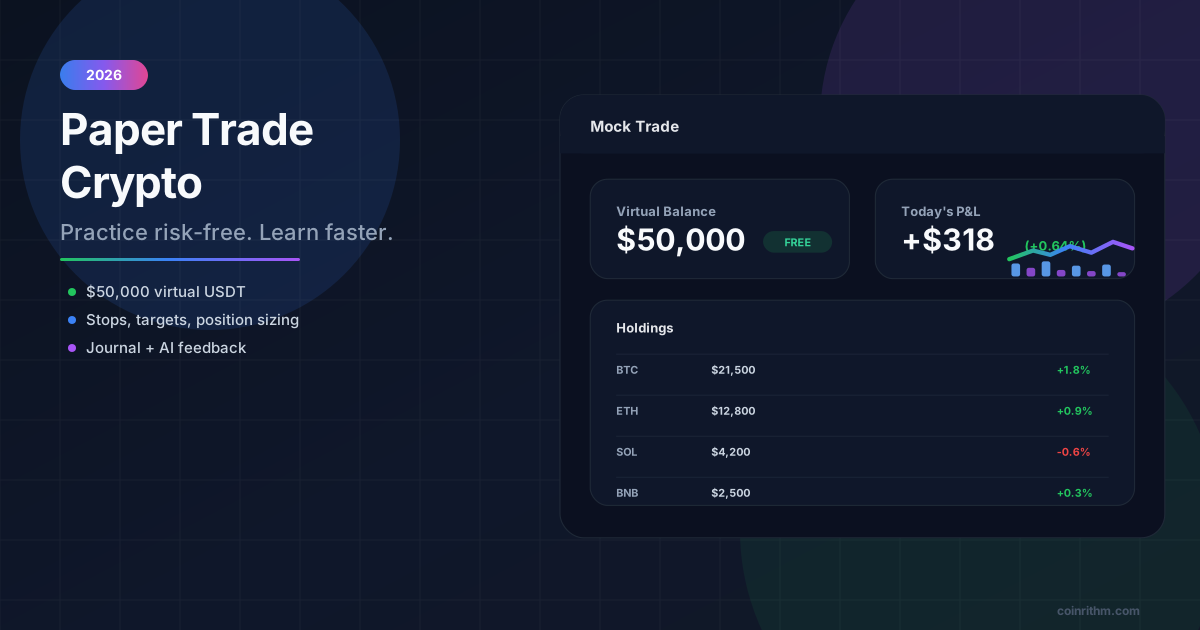
- Practice both methods risk-free with CoinRithm Paper Trading before risking real money.
What Is Fundamental Analysis in Crypto
Fundamental analysis (FA) evaluates the intrinsic value of a cryptocurrency by examining everything except price charts.
Instead of asking "How is the price moving?", fundamental analysis asks:
- What does this project actually do?
- Does it solve a real problem people will pay for?
- Can it survive and grow long-term?
- Is the current price justified by the project's potential?
The goal is to determine whether a crypto asset is undervalued or overvalued relative to its true worth.
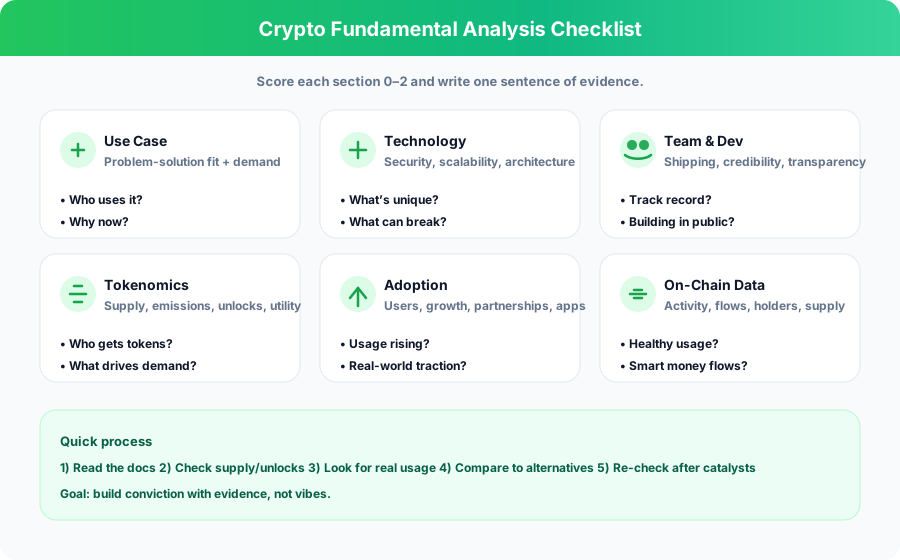
Key Factors in Crypto Fundamental Analysis
When analyzing a crypto project fundamentally, investors examine:
Use Case & Problem-Solution Fit
- What problem does the token solve?
- Is there genuine demand for this solution?
- How large is the addressable market?
Technology & Architecture
- Blockchain design and consensus mechanism
- Scalability solutions
- Security track record
- Technical innovation vs. competitors
Team & Development Activity
- Team backgrounds and credibility
- GitHub commit frequency
- Roadmap progress
- Transparency and communication
Tokenomics
- Total supply and circulating supply
- Inflation/deflation mechanisms
- Vesting schedules for team/investors
- Token utility within the ecosystem
Adoption & Network Effects
- Active users and growth rate
- Partnerships and integrations
- Developer ecosystem
- Real-world usage metrics
On-Chain Data
- Active addresses
- Transaction volume
- Holder distribution
- Exchange inflows/outflows
On-Chain Analysis: Fundamentals Meet Data
On-chain analysis bridges fundamental and technical analysis. It uses blockchain data to understand:
- Accumulation patterns - Are large holders buying or selling?
- Network health - Is usage growing or declining?
- Supply dynamics - How much supply is liquid vs. locked?
Tools like Glassnode, Nansen, and blockchain explorers provide this data.
Use CoinRithm to track fundamentals: Browse CoinRithm for market data, supply metrics, and price information on thousands of tokens.
What Is Technical Analysis in Crypto
Technical analysis (TA) studies price movements and chart patterns to predict future price direction.
Instead of asking "What is this project worth?", technical analysis asks:
- How is price moving right now?
- Where do buyers and sellers react?
- What patterns have repeated historically?
- When should I enter or exit?
Technical analysis operates on a core belief: All known information is already reflected in the price. Therefore, studying price action tells you everything you need to know.
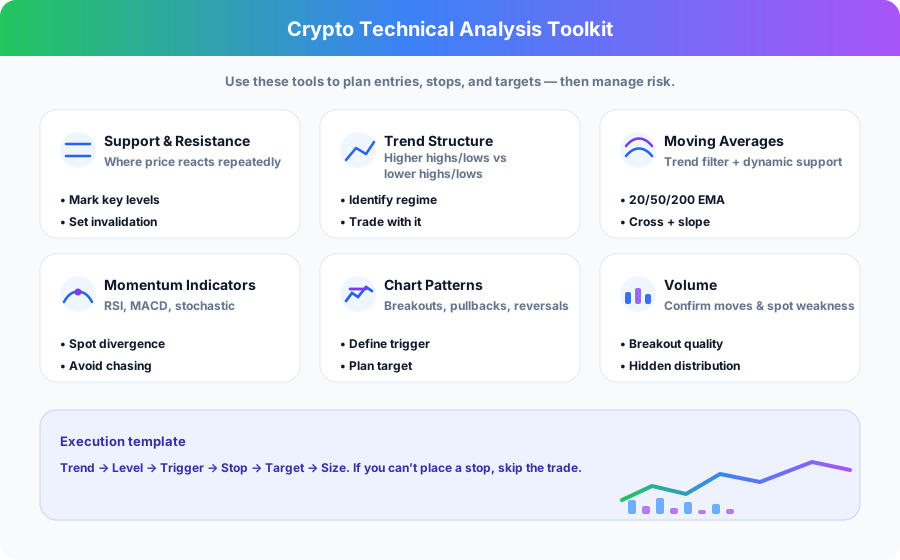
Common Technical Analysis Tools
Support and Resistance
- Support: Price levels where buying pressure historically emerges
- Resistance: Price levels where selling pressure historically emerges
Trend Analysis
- Trend lines connecting highs or lows
- Higher highs/higher lows (uptrend)
- Lower highs/lower lows (downtrend)
Moving Averages
- Simple Moving Average (SMA)
- Exponential Moving Average (EMA)
- Common periods: 20, 50, 100, 200
Momentum Indicators
- RSI (Relative Strength Index) - Overbought/oversold conditions
- MACD (Moving Average Convergence Divergence) - Trend strength and direction
- Stochastic Oscillator - Momentum shifts
Chart Patterns
- Continuation: Flags, pennants, triangles
- Reversal: Head and shoulders, double tops/bottoms
- Breakout patterns
Volume Analysis
- Volume confirms price moves
- High volume breakouts are more reliable
- Divergences between price and volume signal weakness
Core Assumptions of Technical Analysis
Technical analysis rests on three assumptions:
- Price discounts everything - All information (fundamental, psychological, political) is reflected in price
- Price moves in trends - Once established, trends tend to continue
- History repeats - Human psychology creates recognizable patterns
Practice technical analysis risk-free: Use CoinRithm Paper Trading to test chart patterns and indicators with virtual funds before risking real money.
Fundamental vs Technical Analysis: Key Differences
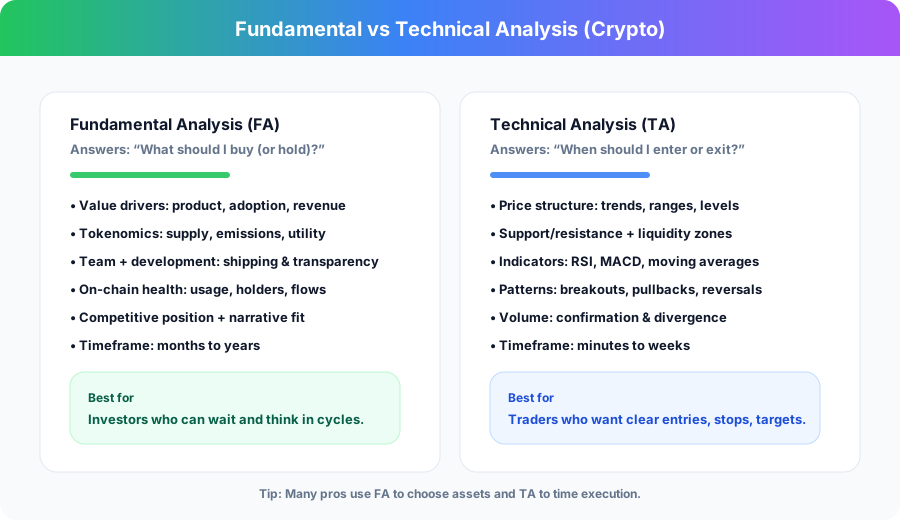
| Aspect | Fundamental Analysis | Technical Analysis |
|---|---|---|
| Primary Focus | Project value and potential | Price movement and patterns |
| Time Horizon | Long-term (months to years) | Short to medium-term (minutes to weeks) |
| Data Used | Whitepapers, metrics, on-chain data | Charts, indicators, volume |
| Main Question | "Is this asset worth holding?" | "When should I buy or sell?" |
| Typical Users | Investors, value seekers | Traders, market timers |
| Entry Timing | Less precise | Highly precise |
| Required Skills | Research, industry knowledge | Pattern recognition, discipline |
| Emotional Challenge | Patience during drawdowns | Avoiding overtrading |
Key insight: These approaches answer different questions. Fundamental analysis helps you decide what to buy. Technical analysis helps you decide when to buy it.
Lessons from Market Wizards: What the Pros Actually Do
In Market Wizards (1989) and The New Market Wizards (1992), Jack Schwager interviewed some of the most successful traders in history - people who turned small stakes into fortunes. Their approaches to fundamental vs. technical analysis varied dramatically.
The Fundamental-Only Traders
Jim Rogers (co-founder of Quantum Fund with George Soros) dismissed technical analysis entirely:
I haven't met a rich technician.
Rogers focused exclusively on understanding macroeconomic trends, supply/demand imbalances, and fundamental value. He made his fortune by deeply researching markets others ignored.
Michael Steinhardt similarly relied on fundamental research and contrarian thinking rather than chart patterns.
For these traders, technical analysis was noise. What mattered was understanding the underlying reality - the fundamentals that would eventually drive prices.
The Technical-Only Traders
Ed Seykota, one of the original system traders, took the opposite view:
Fundamentals that you read about are typically useless as the market has already discounted the price.
Seykota built computerized trading systems based purely on price trends and momentum. He turned $5,000 into $15 million over 12 years using technical rules.
Richard Dennis (the "Prince of the Pit") trained the famous Turtle Traders to follow purely technical, trend-following rules. His students collectively made over $175 million.
For these traders, fundamentals were irrelevant. Price was the only truth.
The Hybrid Approach
Paul Tudor Jones used both:
I believe the very best money is made at the market turns. Everyone says you get killed trying to pick tops and bottoms and you make all your money by playing the trend in the middle. Well for twelve years I have been missing the meat in the middle but I have made a lot of money at tops and bottoms.
Jones used fundamental macro analysis to identify potential turning points, then technical analysis to time entries precisely.
Bruce Kovner similarly combined macro fundamental views with technical execution:
I almost always trade on a market view; I don't trade simply on technical information... Technical analysis tracks the past; it does not predict the future.
Yet Kovner still used charts to refine entries and manage risk.
The Key Insight
The Market Wizards teach us something crucial: There is no single correct approach.
Some of the most successful traders in history:
- Used only fundamentals and made fortunes
- Used only technicals and made fortunes
- Combined both and made fortunes
What they all shared:
- Deep expertise in their chosen approach
- Rigorous risk management
- Psychological discipline
- Consistency - they stuck with what worked for them
The lesson isn't which approach is "right." It's that you must find what works for your personality, time horizon, and skills - then master it completely.
The Role of Intuition: Lessons from Reminiscences of a Stock Operator
Reminiscences of a Stock Operator (1923) tells the story of Jesse Livermore, one of the greatest traders in history. Livermore started as a teenager in "bucket shops" - storefront gambling operations where people bet on stock price movements without actually owning shares.
In these bucket shops, Livermore spent years watching price movements all day, every day. He developed something he called "reading the tape" - an intuitive feel for how prices moved.
The tape tells you what to do, if you can read it.
This wasn't technical analysis in the modern sense - no RSI, no MACD, no chart patterns. It was pure intuition developed through thousands of hours of observation.
Livermore described it as a physical sensation:
He would feel it "in his gut" when a stock was about to move. After years of watching price action, his subconscious mind recognized patterns his conscious mind couldn't articulate.
What This Means for You
Intuition isn't magic - it's pattern recognition built through experience.
When you've watched enough price action:
- Certain setups "feel" right
- You sense when momentum is shifting
- You recognize danger before you can explain why
This doesn't mean you should trade on "feelings" as a beginner. Livermore went broke multiple times before mastering his craft.
But it does mean:
- Screen time matters - Hours watching markets builds pattern recognition
- Experience compounds - Early failures teach lessons books can't
- Trust develops slowly - Intuition only becomes reliable after extensive practice
- Paper trading helps - Practice builds experience without the cost of real mistakes
Build your trading intuition safely: Use CoinRithm Paper Trading to accumulate screen time and develop pattern recognition without risking capital. Track your decisions with AI feedback to accelerate learning.
How Traders Use Each Approach in Practice
For Trading (Short-Term)
Most short-term crypto traders:
- Primary tool: Technical analysis for timing
- Secondary tool: Basic fundamentals to filter quality
Example workflow:
- Use fundamentals to create a watchlist of quality projects
- Use technicals to identify entry setups
- Execute when technical and fundamental views align
Practical example:
A trader believes Bitcoin has strong fundamentals (institutional adoption, supply scarcity, network effects). But instead of buying immediately, they wait for:
- Price to pull back to the 50-day moving average
- RSI to reach oversold territory
- A bullish reversal candlestick pattern
Then they enter with a defined stop-loss and target.
For Investing (Long-Term)
Long-term crypto investors:
- Primary tool: Fundamental analysis for asset selection
- Secondary tool: Technical analysis for better entries
Example workflow:
- Research projects deeply using fundamental analysis
- Identify undervalued assets with strong potential
- Use technical support levels to time accumulation
- Hold through volatility based on fundamental conviction
Practical example:
An investor researches Ethereum and concludes:
- Strong developer ecosystem
- Real-world usage (DeFi, NFTs, L2s)
- Deflationary tokenomics post-merge
- Long-term growth potential
Instead of buying all at once, they use technical analysis to accumulate during market pullbacks - buying at support levels rather than at resistance.
Risk Management: Where Both Approaches Matter
Regardless of your analysis style, risk management determines survival.
How fundamentals help risk management:
- Avoid projects with weak foundations (rug pull risk)
- Understand downside scenarios
- Size positions based on conviction level
- Recognize when thesis is broken
How technicals help risk management:
- Define precise stop-loss levels
- Calculate position size based on risk
- Identify risk-to-reward ratios
- Time exits before major support breaks
The danger of ignoring either:
- Strong fundamentals don't prevent 80% drawdowns
- Perfect chart setups don't save dying projects
- Combining both reduces overall risk
Risk management rules to follow:
- Never risk more than 1-2% of capital per trade
- Always know your exit before you enter
- Position size based on stop distance, not conviction
- Diversify across assets and strategies
Learn more about risk management in our Complete Guide to Paper Trading Crypto.
How to Practice Both Approaches Risk-Free
Before committing real money, test both fundamental and technical analysis:
Practice Fundamental Analysis:
- Research 5 projects deeply using criteria above
- Write investment theses for each
- Track them in your CoinRithm Watchlist
- Review after 3 months - were your assessments correct?
Practice Technical Analysis:
- Start Paper Trading on CoinRithm with virtual funds
- Use TradingView charts to identify setups
- Execute trades based on technical signals
- Review with AI-powered feedback
- Track win rate and risk-reward over 50+ trades
Practice the Hybrid Approach:
- Use fundamentals to select your trading watchlist
- Use technicals to time entries and exits
- Track which approach contributes more to your success
- Adjust your balance based on results
Why paper trading matters:
Just like Livermore spent years in bucket shops before trading real money, you need screen time to develop intuition. Mock trading lets you:
- Make mistakes without financial pain
- Build pattern recognition
- Test different analysis styles
- Discover what fits your personality
Which Approach Should You Use
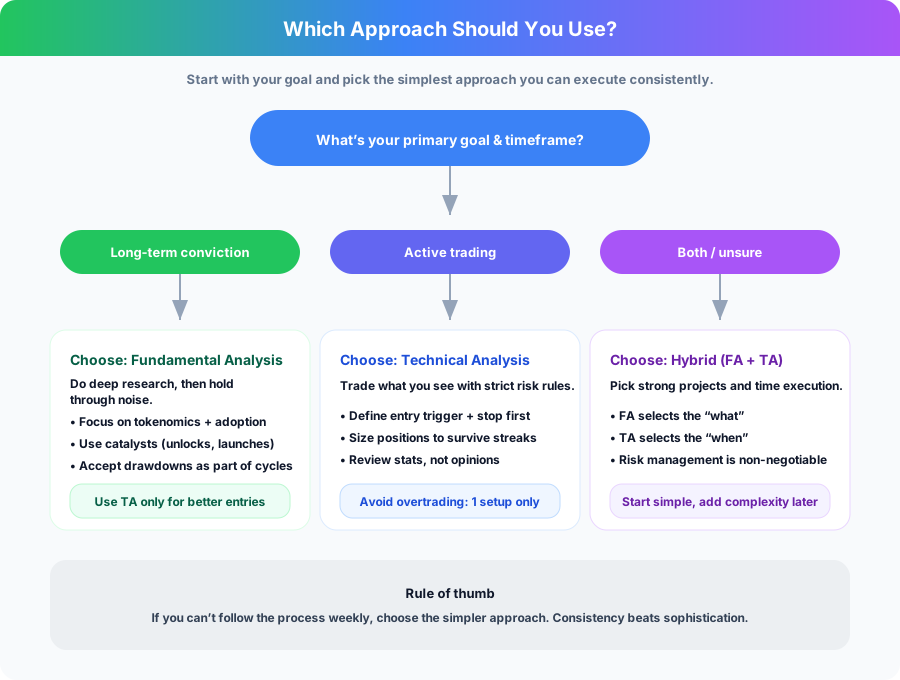
There is no universally "better" approach. It depends on:
| Factor | Favors Fundamentals | Favors Technicals |
|---|---|---|
| Time available | Can research deeply | Limited research time |
| Time horizon | Months to years | Days to weeks |
| Personality | Patient, analytical | Action-oriented, decisive |
| Goal | Wealth building | Active income |
| Market view | Inefficient, undervalued gems exist | Price reflects all information |
Simple guidelines:
- Long-term investors → Fundamental analysis primary
- Short-term traders → Technical analysis primary
- Swing traders → Combine both
- Beginners → Learn both, discover your preference through practice
The honest truth:
Most successful traders eventually develop their own hybrid approach. They take elements from both methods and combine them with personal experience and intuition.
The key is to start somewhere, practice consistently, and adapt based on results.
Frequently Asked Questions
Is fundamental or technical analysis better for crypto
Neither is universally better. Fundamental analysis suits long-term investors evaluating project value. Technical analysis suits traders timing entries and exits. Many successful traders use both. The best approach is the one you can execute consistently and that matches your time horizon.
Can you make money with just technical analysis
Yes. Traders like Ed Seykota and the Turtle Traders made fortunes using purely technical, trend-following systems. Technical analysis works when applied with discipline, proper risk management, and consistent execution. However, ignoring fundamentals entirely increases risk of trading worthless projects.
Can you make money with just fundamental analysis
Yes. Investors like Jim Rogers and Warren Buffett built wealth through pure fundamental analysis. In crypto, early investors in projects like Ethereum and Solana profited by recognizing fundamental value before the market. The challenge is timing - fundamental value can take years to be reflected in price.
How do professional traders analyze crypto
Professional crypto traders typically combine approaches. They use fundamental analysis to identify quality assets and understand market narratives. They use technical analysis to time entries, set stop-losses, and manage positions. Many also incorporate on-chain analysis and sentiment data.
Should beginners start with fundamental or technical analysis
Start with both at a basic level. Learn to evaluate projects fundamentally (team, technology, tokenomics) to avoid scams and weak projects. Learn basic technical analysis (support/resistance, trends) to improve entry timing. Practice both with paper trading before risking real money.
What is the best technical indicator for crypto
No single indicator is "best." Popular indicators include RSI (momentum), MACD (trend), and moving averages (trend direction). Most successful traders use multiple indicators for confirmation rather than relying on any single one. Focus on understanding what each indicator measures rather than searching for a magic solution.
How long does it take to learn technical analysis
Basic technical analysis (support/resistance, trends, key indicators) can be learned in weeks. Developing consistent profitability takes months to years of practice. Like any skill, competence comes from deliberate practice and reviewing your results over hundreds of trades.
What is on-chain analysis
On-chain analysis examines blockchain data to understand market dynamics. This includes active addresses, transaction volume, exchange flows, whale movements, and holder distribution. It bridges fundamental analysis (network health) and technical analysis (supply/demand) using transparent blockchain data.
Do professional traders use intuition
Many do, but it's developed through experience rather than guesswork. Jesse Livermore famously developed "tape reading" intuition through years of observation. Professional traders often describe sensing market shifts before they can articulate why. This intuition comes from pattern recognition built over thousands of hours of screen time.
How do I know which analysis style suits me
Experiment with both through paper trading. Track your results over 50+ trades. Notice which approach feels more natural and produces better results for you. Consider your personality: patient researchers often prefer fundamentals; action-oriented people often prefer technicals. Your results will show what works.
Conclusion: Find What Works for You
Fundamental analysis and technical analysis are not enemies - they're tools.
The Market Wizards proved that traders can succeed with either approach, or both:
- Jim Rogers dismissed charts and made fortunes on fundamentals
- Ed Seykota ignored fundamentals and made fortunes on technicals
- Paul Tudor Jones combined both and made fortunes
Jesse Livermore showed us that intuition built through experience can become a powerful edge - but only after thousands of hours of practice.
What the legends all shared:
- Deep expertise in their chosen approach
- Rigorous risk management
- Psychological discipline
- Consistency over time
Your action plan:
- Learn both approaches at a basic level
- Practice with paper trading - Use CoinRithm Paper Trading to test strategies risk-free
- Track your results - Which approach produces better outcomes for you?
- Develop your edge - Master the approach that fits your personality
- Start small - When ready for real trading, begin with amounts you can afford to lose
- Keep learning - Markets evolve, and so should your approach
Remember:
The goal isn't to find the "right" analysis method. It's to find your method - the approach you can execute consistently, that matches your personality, and that you'll stick with through winning and losing streaks.
The best analysis is the one you'll actually use.
Ready to practice both approaches?
Start Paper Trading on CoinRithm - Test fundamental and technical strategies with virtual funds across spot and futures markets. Get AI-powered feedback on your trades.
Track Your Watchlist - Monitor projects you've analyzed fundamentally and track price movements over time.
Browse CoinRithm - Research market data, supply metrics, and price information for thousands of tokens.
Follow Crypto News - Stay updated on events and narratives that move markets — a key input for both fundamental and technical analysis.
Last Updated: June 11, 2026
Disclaimer: This guide is for educational purposes only and is not financial or investment advice. Cryptocurrency trading involves substantial risk. Always do your own research and only invest money you can afford to lose. Past performance does not guarantee future results.