Elliott Wave Theory is one of the most misunderstood tools in technical analysis. Some traders treat it like a crystal ball. Others dismiss it as “too subjective.”
The truth is more useful: Elliott Wave gives you a framework for identifying trend direction, measuring where you are in a cycle, and defining clear invalidation levels. When you use it like a decision tool (not a prophecy), it can help you trade crypto more consistently.
If you’ve ever thought, “crypto looks chaotic — it pumps, dumps, and reverses without warning,” Elliott Wave offers a simple starting premise: markets often move in repeating wave patterns driven by crowd psychology.
In this guide, you’ll learn:
- What Elliott Wave Theory is (in plain English)
- How to spot impulse vs corrective structure
- The 3 rules you must follow (and the guidelines you should)
- How Fibonacci levels fit into wave targets
- A practical, step-by-step method to count waves on crypto charts
- How to translate a wave count into a trade plan (entry, stop, targets)
You can pair Elliott Wave with any execution style, but it works best when combined with solid risk management and a clean charting workflow. If you want a broader primer first, read our guide to fundamental vs technical analysis for crypto.
If you want a beginner-friendly external walkthrough of the wave model, see the Elliott Wave primer at BabyPips. For more formal terminology (degrees, impulse/corrective variations), Elliott Wave International is a well-known reference: elliottwave.com.
TL;DR
- Impulse waves (trend): usually move in a 5-wave structure (1-2-3-4-5).
- Corrective waves (pullback): usually move in a 3-wave structure (A-B-C).
- Three core impulse rules: Wave 2 can’t retrace beyond Wave 1 start; Wave 3 can’t be the shortest; Wave 4 can’t overlap Wave 1 (in most standard impulses).
- Fibonacci is a measuring tool, not magic: common retracements are 38.2%–61.8%; common extensions include 1.618×.
- Your wave count should produce clear invalidation. If you can’t define “I’m wrong here,” you’re not trading a setup.
What Is Elliott Wave Theory
Elliott Wave Theory (EWT) is a technical analysis framework that describes how market prices tend to move in repeating cycles driven by crowd psychology.
Instead of viewing price action as random, Elliott Wave suggests markets often alternate between:
- Trending phases (strong directional movement)
- Corrective phases (pullbacks, consolidations, “cool-down” periods)
In crypto, this can be especially visible because sentiment often swings harder and faster than in traditional markets.
The Core Idea: Crowd Psychology in Waves
The simplest way to understand Elliott Wave is to think in terms of participation:
- Early trend: a few participants move price (Wave 1)
- Pullback: doubt and profit-taking (Wave 2)
- Expansion: the crowd joins and momentum accelerates (Wave 3)
- Pause: market digests gains, rotates, consolidates (Wave 4)
- Final push: late buyers chase, media attention spikes (Wave 5)
Then the market corrects (A-B-C) as enthusiasm fades and price seeks balance before the next major move.
This isn’t about predicting the future perfectly. It’s about answering practical questions like:
- Are we in a trend or a correction?
- Is the move likely early, middle, or late stage?
- Where is the most logical invalidation level?
Elliott Wave Structure: Impulse vs Corrective
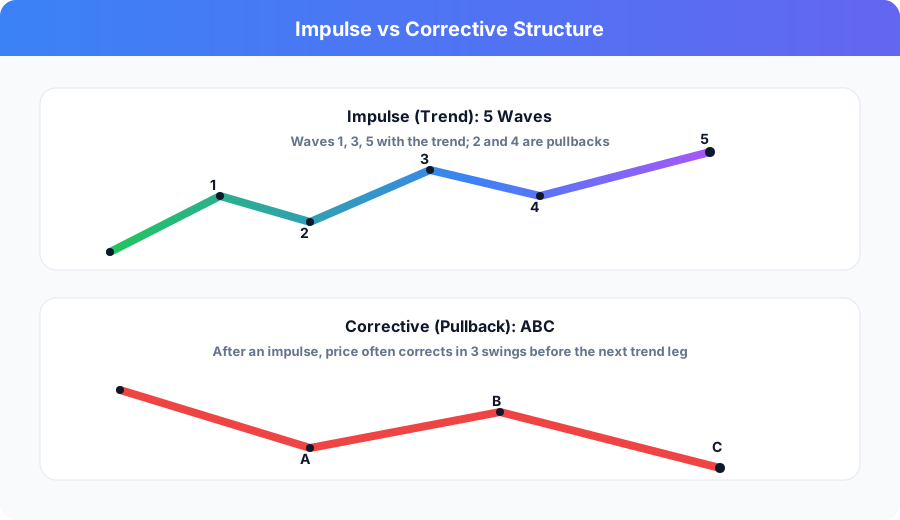
In its “classic” form, Elliott Wave structure looks like this:
- Impulse (trend): 5 waves (1-2-3-4-5)
- Correction (counter-trend): 3 waves (A-B-C)
Impulse waves (1-2-3-4-5)
An impulse is the main trend move. In a bullish impulse:
- Waves 1, 3, and 5 push higher (with the trend)
- Waves 2 and 4 pull back (against the trend)
In a bearish impulse, it’s the same pattern inverted.
One practical takeaway: Wave 3 is often the strongest and longest, especially in high-momentum crypto trends.
Corrective waves (A-B-C)
A correction is the counter-trend move that follows an impulse. The most common simple correction is A-B-C:
- A: first selloff/pullback
- B: bounce that often “tricks” traders into thinking the trend is back
- C: final leg that completes the correction
Corrections can be simple or complex (zigzags, flats, triangles). You don’t need to memorize every pattern to trade effectively; you need to recognize whether the structure is trending cleanly or chopping sideways.
Why Elliott Wave Often Fits Crypto Markets
Crypto is heavily sentiment-driven, and sentiment tends to move in cycles:
- Hype and narratives spreading fast
- Panic selling during drawdowns
- FOMO buying near breakouts
- Herd behavior around round numbers and headlines
Because Elliott Wave is a psychology-first framework, traders often find its impulse/correction lens especially useful in markets like crypto that frequently shift between euphoria and fear.
The 3 Elliott Wave Rules (Non-Negotiable)
If you remember nothing else, remember these. A valid impulse wave count must respect the rules below (standard impulse, not the exceptions and advanced variations).
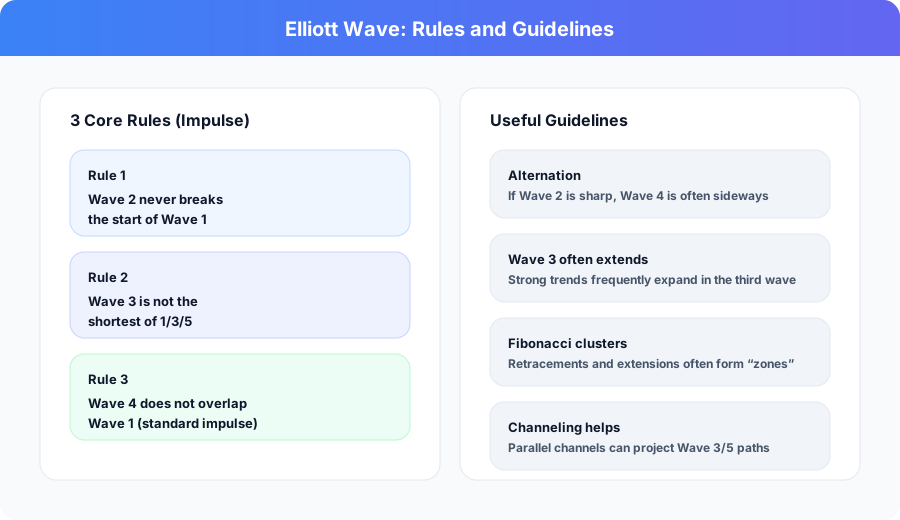
Rule 1: Wave 2 can’t retrace beyond the start of Wave 1
In an uptrend, Wave 2 must not drop below where Wave 1 began. If it does, your wave count is wrong (or you’re on a different timeframe/degree).
Rule 2: Wave 3 can’t be the shortest of Waves 1, 3, and 5
Wave 3 is often the strongest, but the strict rule is simpler: it can’t be the shortest among the three impulse waves.
Rule 3: Wave 4 can’t overlap Wave 1 in a standard impulse
In bullish impulses, Wave 4 typically doesn’t dip into Wave 1 price territory. If it overlaps heavily, you may be looking at:
- A different correction type
- A diagonal (advanced)
- A range/chop where wave labeling is forced
Key Elliott Wave Guidelines (Practical, Not Perfect)
Guidelines are not “musts,” but they’re incredibly useful because they help you choose between competing counts.
Guideline: Alternation between Wave 2 and Wave 4
If Wave 2 is sharp (fast, deep), Wave 4 often becomes sideways (slow, shallow), and vice versa. This helps you set expectations for the next pullback.
Guideline: Wave 3 often extends
In many strong trends, Wave 3 travels further than Wave 1 and Wave 5. When you see aggressive momentum, consider that you may be in Wave 3 (or something that resembles it).
Guideline: Wave relationships tend to cluster around Fibonacci levels
Fibonacci levels don’t create price movement, but they often show where traders cluster orders. Elliott Wave uses Fibonacci to:
- Measure retracements of Wave 2 and Wave 4
- Project extensions for Wave 3 and Wave 5
- Identify likely zones for Wave C
How Fibonacci Fits Into Elliott Wave
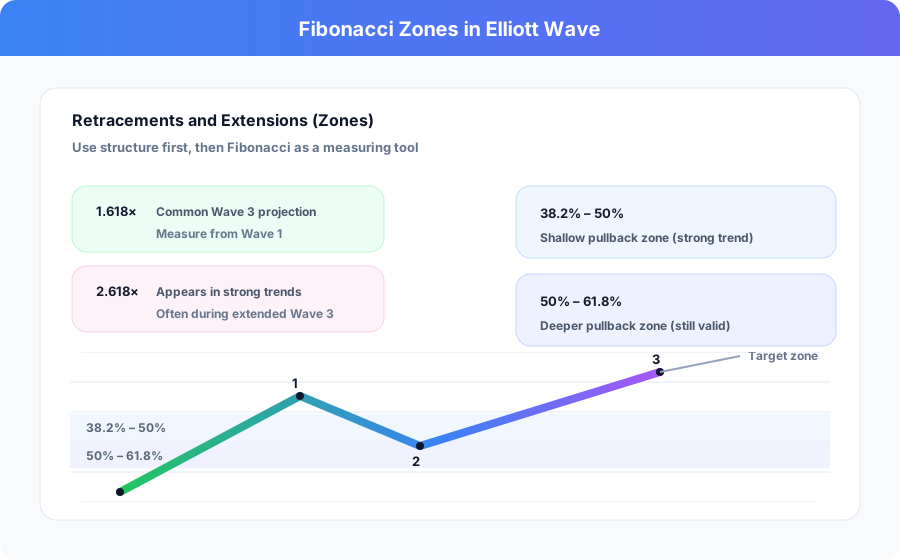
Fibonacci is easiest when you treat it as zones, not single prices.
If you’re new to Fibonacci tools, this overview is a solid starting point: Fibonacci retracement (Investopedia). (Use it as a measuring aid, not a prediction engine.)
Common retracement zones (Waves 2 and 4)
Typical retracement zones you’ll see repeatedly:
- 38.2% (shallow pullback in strong trends)
- 50% (common mean-reversion level)
- 61.8% (deeper pullback that still keeps the trend intact)
Wave 2 often retraces more than Wave 4, but it’s not a law. Use the structure and the invalidation level first, then Fibonacci as confirmation.
Common extension zones (Waves 3 and 5)
Common extension areas used in Elliott Wave projections:
- 1.618× of Wave 1 (often used for Wave 3 targets)
- 2.618× of Wave 1 (in very strong trends)
For Wave 5, traders often look at relationships such as:
- Wave 5 ~ Wave 1 (equality)
- Wave 5 reaching a Fibonacci extension from Waves 1–3
Again: zones and probabilities, not guarantees.
How to Count Elliott Waves on Crypto Charts (Step-by-Step)
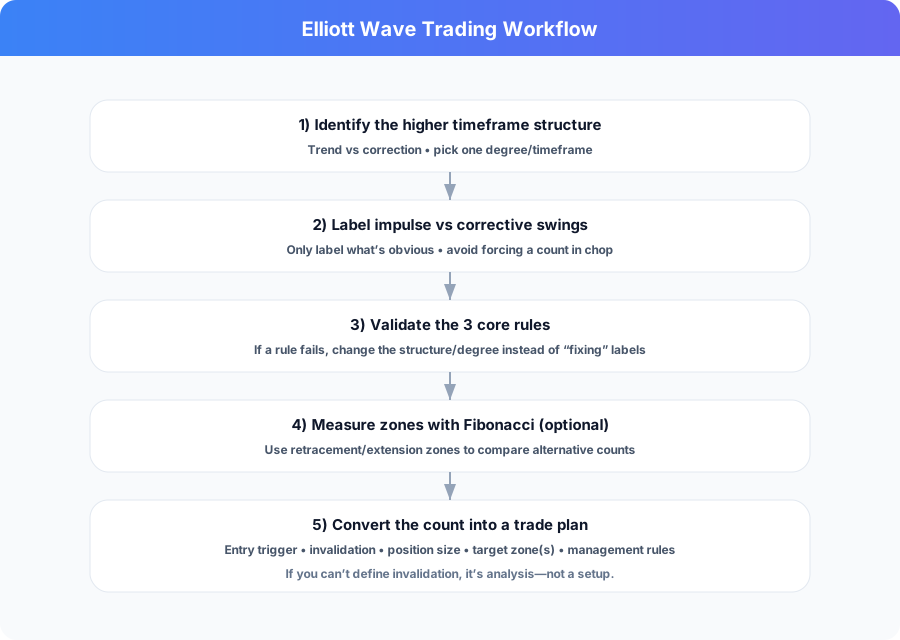
Wave counting becomes “subjective” when traders skip process. Here’s a clean method you can repeat on any liquid crypto chart (BTC, ETH, majors).
Step 1: Pick a timeframe and stick to one degree at a time
Start with a higher timeframe (like 1D or 4H) to find the major structure. Then zoom in (1H / 15m) only if you’re labeling a smaller sub-wave inside a larger wave.
If you change timeframes mid-count, you’ll constantly “fix” your labels to fit the last candle.
Step 2: Identify whether price is trending or correcting
Ask:
- Are we making higher highs/higher lows (uptrend) or lower highs/lower lows (downtrend)?
- Is price chopping with overlapping candles and failed breakouts (correction/range)?
If it’s overlapping and messy, don’t force a 1–2–3–4–5.
Step 3: Find the most obvious impulse leg
Look for the cleanest directional move with momentum expansion. Label it as a candidate Wave 1 or Wave 3, then work outward:
- If you think it’s Wave 3, Wave 2 should be visible before it, and Wave 4 should come after it.
Step 4: Validate the 3 rules
Before you do anything else, test the impulse rules:
- Wave 2 doesn’t break Wave 1 start
- Wave 3 isn’t the shortest
- Wave 4 doesn’t overlap Wave 1 (standard impulse)
If any fails, your count needs a different structure or degree.
Step 5: Use Fibonacci as a measuring check
Measure:
- Wave 2 retracement (does it land in a common zone?)
- Wave 3 extension (does it look like an extended wave?)
- Wave 4 retracement and alternation vs Wave 2
This doesn’t “prove” your count, but it can help choose the more realistic one.
Step 6: Define your invalidation level (the most important step)
Your count should tell you exactly where you’re wrong.
Examples:
- If you’re buying a Wave 2 pullback, invalidation is often below Wave 1 start
- If you’re trading a Wave 4 consolidation, invalidation is often into Wave 1 territory (standard impulse)
If you can’t define invalidation, it’s not a trade setup yet.
How to Trade Crypto Using Elliott Wave (Setups + Risk)
Elliott Wave trading is not “buy wave 1, sell wave 5.” It’s about aligning structure, timing, and risk.
Setup 1: Trend continuation after Wave 2 (classic)
Goal: Enter early in a potential Wave 3.
What to look for:
- A clear Wave 1 up
- A Wave 2 pullback that respects Wave 1 start
- Momentum/structure shift suggesting the pullback is ending
Risk idea:
- Invalidation often sits below Wave 1 start (or below the Wave 2 low, depending on your rules)
Targets idea:
- Use extensions from Wave 1 to project likely Wave 3 areas, then manage actively.
Setup 2: Breakout after Wave 4 (compression → expansion)
Goal: Catch the move into Wave 5 (or an extended continuation).
What to look for:
- Strong Wave 3
- Sideways Wave 4 consolidation with overlapping candles
- Breakout with volume/volatility expansion
Risk idea:
- Invalidation often sits back inside the Wave 4 range (or into Wave 1 territory if your count requires it).
Setup 3: Correction completion (A-B-C) into the next trend leg
Goal: Enter near the end of a correction when the larger trend is likely to resume.
What to look for:
- A completed 5-wave impulse
- A clean A-B-C correction (or a clear corrective structure)
- Wave C reaching a common zone (structure first, Fibonacci second)
Risk idea:
- Invalidation often sits below the correction low (bullish case) or above the correction high (bearish case).
Risk management: the part most wave traders ignore
Two traders can have the same wave count and get opposite results because of risk.
At minimum, define:
- Entry trigger: what must happen before you enter (break of structure, reclaim level, etc.)
- Invalidation: where your wave count fails
- Position size: based on stop distance, not conviction
- Profit plan: partials, trailing stops, or a pre-defined target zone
If you want a risk-free way to practice turning setups into plans, start with crypto paper trading. Here’s our complete guide: How to paper trade crypto.
Common Elliott Wave Mistakes (And How to Avoid Them)
Mistake 1: Forcing a wave count in choppy markets
If price overlaps constantly and swings are symmetric, you’re likely in a correction/range. Trade the range (or wait). Don’t invent a perfect 1–2–3–4–5.
Mistake 2: Changing the count to avoid being wrong
Wave counting is only useful if it creates falsifiable ideas. If you relabel every invalidation, you’re not analyzing; you’re rationalizing.
Mistake 3: Ignoring degree (timeframe context)
A move that looks like Wave 5 on 15m can be Wave 1 on 4H. Always know which degree you’re labeling and what higher timeframe structure you’re inside.
Mistake 4: Using Fibonacci as a “must hit” target
Fibonacci levels are zones where reactions are common, not guaranteed. Let structure and liquidity decide execution.
Mistake 5: Trading without a clear invalidation
If your count can’t tell you where you’re wrong, you don’t have a setup. You have a story.
Limitations of Elliott Wave Theory
Elliott Wave can be powerful, but it’s not a perfect system.
- Wave counting can be subjective: more than one valid interpretation can exist, especially during complex corrections.
- Different degrees overlap: what looks like “Wave 5” on a low timeframe may be “Wave 1” on a higher timeframe.
- It’s not a standalone signal: many traders combine wave structure with support/resistance, volume, and momentum/volatility context.
The solution is to keep your approach simple: trade only the counts that produce clear invalidation, and avoid forcing labels in choppy conditions.
Elliott Wave Cheat Sheet (Rules, Structure, Fibonacci)
Use this quick reference to keep your counts grounded.
| Topic | Quick rule of thumb |
|---|---|
| Impulse structure | 5 waves: 1-2-3-4-5 (trend) |
| Corrective structure | 3 waves: A-B-C (counter-trend) |
| Core rules | Wave 2 doesn’t break Wave 1 start; Wave 3 isn’t shortest; Wave 4 doesn’t overlap Wave 1 (standard impulse) |
| Common Wave 2 zone | Often 50%–61.8% retracement (varies by trend strength) |
| Common Wave 3 target | Often ~1.618× Wave 1 (varies; treat as a zone) |
| Best practice | Always define invalidation before entry |
Tools That Make Wave Counting Easier
You don’t need 12 indicators. A clean workflow usually wins:
- Market structure tools: swing high/low marking, trendlines, channels
- Fibonacci retracement/extension: to measure and project zones
- Volume/volatility: to spot expansion vs compression
- Multi-timeframe view: to keep degree consistent
Some traders also use momentum indicators (like RSI) as secondary confirmation (divergences near Wave 5 are a common example), but your wave count should stand on its own first.
How to Practice Elliott Wave Risk-Free
The fastest way to improve wave counting is repetition:
- Pick one liquid asset (BTC or ETH)
- Choose one primary timeframe (4H or 1D)
- Mark impulse vs corrective structure
- Write down your invalidation level
- Track what happened next
If you want to practice execution without risking money, CoinRithm’s paper trading simulator covers spot and crypto futures (up to 20x leverage) — letting you test wave-count setups with no financial risk. Treat your wave count as a hypothesis, run it in the simulator, and iterate based on what the market does.
You can also use CoinRithm’s market tools to keep context across assets and timeframes:
- Browse coins: Cryptocurrencies
- Research a specific coin (example): Bitcoin (BTC)
- Follow market-moving events: Crypto News
Frequently Asked Questions
Is Elliott Wave Theory accurate for crypto?
It can be useful in crypto because sentiment-driven moves often create clear impulses and corrections. But it’s not “accurate” in the sense of always predicting the next move. Treat it as a framework for trend + risk, and be strict about invalidation.
What timeframe is best for Elliott Wave?
Higher timeframes (4H, 1D, 1W) usually produce cleaner structure and reduce noise. Lower timeframes can work, but wave counts change more often and require tighter risk management.
What are the 3 rules of Elliott Wave?
For a standard impulse: (1) Wave 2 can’t retrace beyond the start of Wave 1, (2) Wave 3 can’t be the shortest of Waves 1, 3, and 5, and (3) Wave 4 can’t overlap Wave 1.
Do I need Fibonacci for Elliott Wave?
No, but it helps. Fibonacci is mainly a measuring tool to estimate common retracement/extension zones and to compare alternative wave counts.
Why do different traders have different wave counts?
Because markets have nested structures across timeframes (degrees), and because corrections can be complex. The best way to reduce subjectivity is to follow a consistent process and only trade counts that create clear invalidation.
Can beginners trade with Elliott Wave?
Yes, if you keep it simple: focus on identifying impulse vs correction, learn the 3 rules, and practice on higher timeframes with small (or paper) position sizes.
Where did Elliott Wave Theory come from?
It was developed by Ralph Nelson Elliott in the 1930s as a way to describe repeating market cycles. Most modern “Elliott Wave” material builds on that foundation and expands it with additional patterns and terminology.
Conclusion
Elliott Wave Theory isn’t a guaranteed forecast tool. It’s a market structure framework that helps you:
- Identify whether the market is trending or correcting
- Estimate where you are in the cycle
- Define a clear invalidation level for risk management
If you apply Elliott Wave with discipline (and avoid forcing labels), it can add structure to your crypto trading decisions.
Disclaimer: This article is for educational purposes only and does not constitute financial advice. Crypto trading involves risk, and you may lose money.