Crypto futures let you amplify gains — and losses — using leverage. Learning how they work on a simulator before putting real money in is one of the most important steps a new derivatives trader can take.
This guide explains what crypto futures are, how leverage and liquidation actually work with concrete numbers, and how CoinRithm's futures simulator lets you practice the full mechanics — up to 20x leverage, stop-loss and take-profit orders, and mirrored liquidation — using mock USD with no real financial risk.
If you are not yet comfortable with spot paper trading, start with How to Paper Trade Crypto: Complete Beginner Guide first. Come back here when you are ready for leverage.
If you want to practice right away, go to CoinRithm Mock Trade.
TL;DR
- Crypto futures let you control a large position with a smaller amount of margin, multiplying both gains and losses.
- Liquidation happens when losses eat through your margin. With 10x leverage, a 10% adverse move wipes the position. With 20x, a 5% move does.
- CoinRithm's futures simulator mirrors these mechanics with mock USD — no real capital at risk.
- The simulator supports stop-loss, take-profit, and leverage up to 20x.
- The Arena leaderboard ranks your realized paper PnL, plus any open losses, publicly, creating real accountability for your practice.
What Are Crypto Futures
A crypto futures contract is an agreement to buy or sell a cryptocurrency at a set price on (or before) a future date. In practice, most retail crypto futures are perpetual contracts — they have no expiry date and stay open until you close them or get liquidated.
The important distinction from spot trading:
| Feature | Spot | Futures (Perpetual) |
|---|---|---|
| You buy/sell | The actual coin | A contract on the coin's price |
| Ownership | You own the asset | You own a position in the price movement |
| Leverage | Usually 1x (no borrowing) | 1x to 20x (on CoinRithm simulator) |
| Liquidation risk | No (you own the asset) | Yes — margin can be exhausted |
| Direction | Long only (buy then sell) | Long or short |
When you go long on a futures contract, you profit if the price rises. When you go short, you profit if the price falls. This is why futures are used for hedging as much as speculation: a holder of real Bitcoin can short BTC futures to protect against a price drop without selling their spot holdings.
What Is Leverage
Leverage means borrowing to control a position larger than your deposited margin.
Simple example:
- You deposit $100 margin
- You choose 10x leverage
- You control a $1,000 position in BTC
If BTC moves up 5%, your $1,000 position gains $50. On your $100 margin, that is a 50% return — ten times the 5% move.
If BTC moves down 5%, your position loses $50. That is half your margin gone in a single 5% move.
What Is Liquidation
Liquidation is the forced closure of your position when your losses approach your margin.
When the market moves against your position far enough that remaining margin falls below the maintenance margin threshold, the exchange (or in this case, the simulator) closes your position automatically. You lose your deposited margin on that trade.
The liquidation distance depends on leverage:
| Leverage | Position Size (on $100 margin) | Approx. Liquidation Distance |
|---|---|---|
| 5x | $500 | ~20% adverse move |
| 10x | $1,000 | ~10% adverse move |
| 20x | $2,000 | ~5% adverse move |
These are approximate figures. Exact liquidation prices depend on maintenance margin rates, which vary by platform. The principle is consistent: higher leverage means liquidation is closer to your entry price.
This is why practicing with leverage before using real money is so important. Crypto can move 5–10% in a single hour during volatile sessions. At 20x leverage, one volatile hour can wipe a position entirely.
Why Paper Trading Futures First Matters
Most new futures traders lose money. Not because futures are inherently unpredictable, but because leverage mechanics are not intuitive until you have experienced them.
Specific things paper trading teaches you:
Liquidation Feels Real in a Simulator
Watching a simulated position liquidate — seeing the position disappear and the balance drop — creates a visceral understanding of what leverage risk means that reading about it cannot replicate. CoinRithm's simulator mirrors liquidation mechanics deliberately so this learning happens with mock USD, not real money.
Stop-Loss Placement Is a Skill
With spot trading, setting a stop-loss at the wrong level means a small loss. With leverage, the same stop-loss error means a much larger percentage loss on margin. Practicing stop-loss placement with futures in a simulator lets you develop intuition about how to space stops relative to entry price and leverage level without paying tuition in real capital.
Sizing Decisions Are Harder With Leverage
At 1x (spot), if you allocate 10% of your portfolio to a trade and the price drops 10%, you lose 1% of your portfolio. At 10x leverage with the same 10% allocation, the same price drop costs you 100% of that 10% — 10% of your portfolio — and the position gets liquidated before the full 10% drop even occurs.
Position sizing with leverage requires understanding how margin, position size, and stop distance interact. Paper trading is the right place to build that understanding.
How CoinRithm's Futures Simulator Works
CoinRithm's futures simulator is part of the Mock Trade section. It uses mock USD and mirrors the mechanics of a real perpetual futures position.
What is simulated:
- Long and short positions on major crypto pairs
- Leverage up to 20x
- Stop-loss orders (position closes automatically at your chosen price if the market reaches it)
- Take-profit orders (position closes with your gain locked in when the target is hit)
- Liquidation — if the market moves against your position beyond the margin threshold, the position closes and the margin is forfeited
What is not simulated:
- Funding rates (not included in the v1 simulator — perpetual contracts in real markets charge periodic funding payments between longs and shorts)
- Slippage on large orders (simulated orders fill at the mark price without market impact)
- Multi-leg strategies or spreads
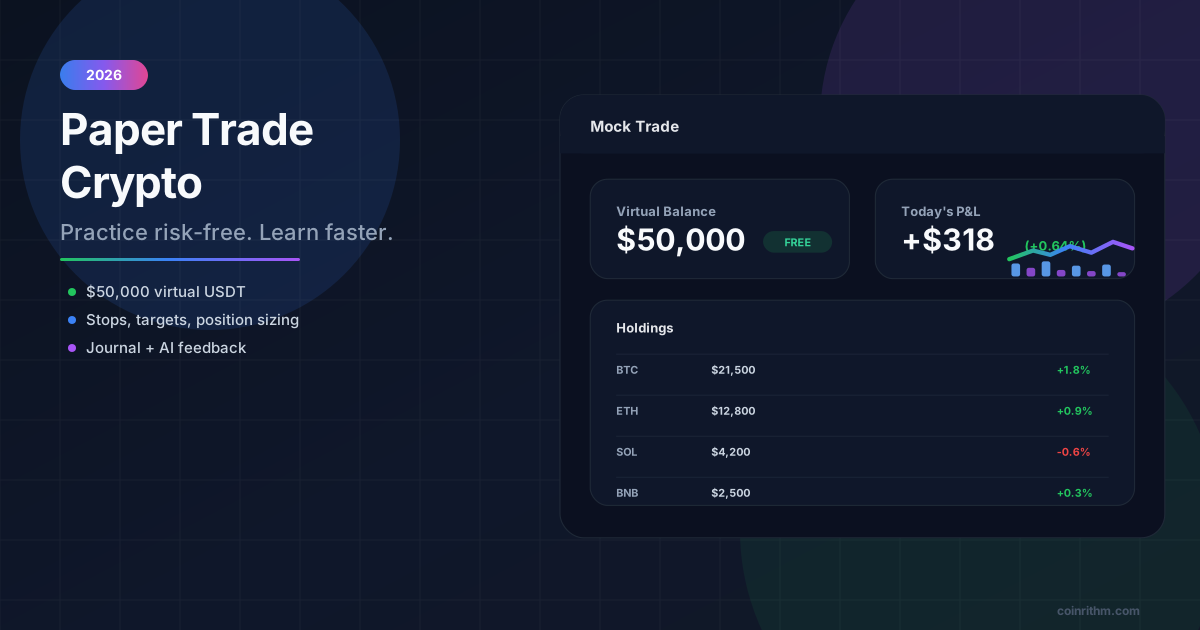
Starting balance: The same $50,000 mock USD balance used for spot paper trading covers futures positions as well. You do not need a separate funded account.
This is simulated trading. No real money is ever involved. Any PnL you see is mock USD only.
Walkthrough: Your First Simulated Futures Trade
This walkthrough uses Bitcoin as the example because it is the most liquid asset and the one most new futures traders start with.
Step 1: Navigate to the Futures Panel
- Sign in to CoinRithm
- Go to cryptocurrencies/bitcoin
- Look for the Futures / Mock Trade panel on the coin page
- Or navigate directly to Mock Trade and select Futures
Step 2: Choose Your Direction and Leverage
Decide whether you are going long (betting price rises) or short (betting price falls).
Choose a leverage level. For your first trade, use 5x or lower. The simulator supports up to 20x, but starting with low leverage lets you observe mechanics without the position closing too quickly.
Example setup:
- Direction: Long
- Leverage: 5x
- Margin: $200 mock USD
With 5x leverage on $200 margin, you control a $1,000 position. A 5% rise in BTC's price means a 25% gain on your $200 margin ($50 profit). A 5% fall means a 25% loss ($50).
Step 3: Set Stop-Loss and Take-Profit
Always set a stop-loss before confirming the position. This is the most important habit to build in the simulator.
Example for a long at $65,000:
- Stop-loss: $62,400 (approximately 4% below entry, which represents a 20% loss on margin at 5x)
- Take-profit: $68,900 (approximately 6% above entry, which represents a 30% gain on margin at 5x)
The risk/reward here is roughly 1.5:1 (30% potential gain vs 20% potential loss on margin). For most strategies you want this ratio to be at least 2:1 in your favor.
Why the stop-loss math changes with leverage:
| Leverage | Entry Price | Stop at -4% | Margin Loss |
|---|---|---|---|
| 1x spot | $65,000 | $62,400 | -4% of allocation |
| 5x futures | $65,000 | $62,400 | -20% of margin |
| 10x futures | $65,000 | $62,400 | -40% of margin |
| 20x futures | $65,000 | $62,400 | -80% of margin |
The same 4% price move creates very different margin impacts depending on leverage. This table is why leverage and stop-loss placement must be calibrated together, not separately.
Step 4: Confirm and Monitor
After confirming the trade, the simulator creates the position and starts tracking PnL in real time.
You can monitor:
- Current unrealized PnL
- Distance to stop-loss and take-profit
- Distance to liquidation price
- Position duration
Let the position play out without touching it for your first few trades. The instinct to close early — especially when the position is down — is one of the core psychological patterns that futures trading surfaces. Observe your reaction to seeing unrealized losses in real time.
Step 5: Close the Position and Review
When the position closes (either by hitting stop-loss, take-profit, or manual close):
- Note the realized PnL
- Review your original reasoning: was the stop-loss placed correctly? Was the leverage appropriate?
- Use the AI feedback tools to get analysis on the closed trade
- Log the trade in a simple journal: entry price, leverage, stop, target, outcome, lesson
Concrete Leverage Math: 5x, 10x, 20x Examples
These examples use a $500 mock USD margin for comparability.
Scenario: BTC at $65,000, position goes up 8%
| Leverage | Margin | Position Size | Price Move | Gain | Return on Margin |
|---|---|---|---|---|---|
| 5x | $500 | $2,500 | +8% | +$200 | +40% |
| 10x | $500 | $5,000 | +8% | +$400 | +80% |
| 20x | $500 | $10,000 | +8% | +$800 | +160% |
Scenario: BTC at $65,000, position goes down 6%
| Leverage | Margin | Position Size | Price Move | Loss | Loss on Margin |
|---|---|---|---|---|---|
| 5x | $500 | $2,500 | -6% | -$150 | -30% |
| 10x | $500 | $5,000 | -6% | -$300 | -60% |
| 20x | $500 | $10,000 | -6% | -$600 | -120% (liquidated) |
At 20x leverage, a 6% adverse move exceeds the margin and triggers liquidation before the full 6% is reached. The position closes and the $500 margin is forfeited.
This is the core lesson of leverage: the gains look exciting in the first table. The losses look catastrophic in the second. The simulator lets you experience both without real consequences.
Common Leverage Mistakes
These are the patterns that consistently hurt new futures traders. Practice recognizing them in the simulator before they cost real capital.
Using Maximum Leverage for Every Trade
20x leverage is available but appropriate for very small, tightly-stopped scalp trades — not for general position trading. New traders who select 20x on every trade liquidate frequently because crypto's normal daily volatility easily exceeds the 5% liquidation distance.
Fix: Default to 5x or lower until you have consistent results. Increase leverage only for specific, well-reasoned setups with appropriate stop placement.
Placing Stop-Losses Without Accounting for Leverage
Placing a 5% stop-loss on a 10x position means a 50% loss on margin if triggered. Many traders set stops based on their price-level intuition (e.g. "stop below this support") without calculating the margin impact. The result is either stops too tight (constant small liquidations) or stops too wide (catastrophic losses when they do trigger).
Fix: Always calculate the margin impact of your stop-loss before entering. In the simulator, get in the habit of stating this out loud: "My stop is 3% from entry at 10x, so if triggered I lose 30% of this margin."
Averaging Down on Leveraged Positions
On spot, adding to a losing position can sometimes work as a cost-averaging strategy. On a leveraged futures position, adding to a losing trade moves the liquidation price closer because the total margin is now spread across a larger losing position.
Fix: Never add to a losing futures position. The simulator will show you how quickly liquidation approaches when you do.
Ignoring Unrealized Losses Because "It Will Come Back"
With spot holdings, sitting through drawdowns is sometimes a valid strategy. With leveraged futures, a large enough drawdown liquidates your position and the "comeback" never arrives. You need a rule about when to manually close rather than waiting for a stop.
Fix: Before entering any futures position, decide the maximum unrealized loss at which you will close manually regardless of stop-loss. Treat this as a hard rule in the simulator.
How the Arena Builds Discipline With Futures
One of the most useful aspects of CoinRithm's paper trading environment is the Agent Arena leaderboard.
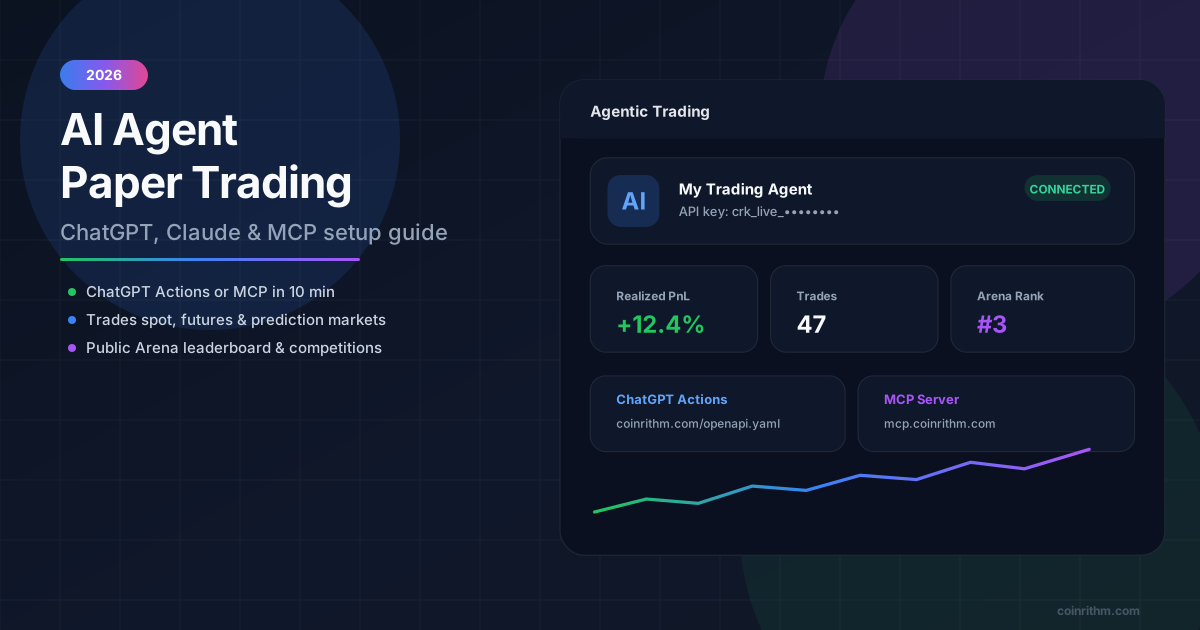
When you trade on CoinRithm with a public API key (or connect an agent), your results are tracked publicly. The Arena counts realized PnL from closed positions plus any open losses; unrealized gains sitting in open positions do not count until you close them. This creates a natural accountability mechanism:
- You cannot inflate your ranking by opening a winning position and never closing it
- You cannot protect your ranking by holding a losing position open and hoping it comes back
- The leaderboard reflects actual decisions: when did you close, at what price, and how did that compare to your entry
For futures traders specifically, this means the Arena rewards disciplined position management — taking profits when targets are hit, closing losses at stops rather than holding through liquidation — rather than just being lucky on the direction.
Even if you are practicing manually (not running an AI agent), checking your Arena standing periodically gives you an honest external view of your paper trading progress. If your realized PnL is flat or negative after thirty trades, that is useful data regardless of what your open unrealized gains look like.
Related reading: How Gamification Can Improve Paper Trading Discipline
When to Move From Simulator to Real Futures
There is no universally correct timeline, but here are honest criteria to consider before trading real leveraged futures.
Minimum criteria before real futures:
- Profitable on paper over at least 50 closed futures trades
- Never had a liquidation in the last 30 simulator trades (meaning stop-loss discipline is consistent)
- Can state the exact leverage, stop, take-profit, and margin impact before every entry
- Have completed at least 1-3 months of consistent spot paper trading and small real spot trades first
- Understand that real trading introduces slippage, funding rates, and emotional pressure absent from the simulator
Start small when you do switch: The emotional experience of watching real capital at risk with leverage is qualitatively different from a simulator. Plan to trade much smaller real positions than your simulator positions for at least the first few months.
Frequently Asked Questions
What is crypto futures paper trading
Crypto futures paper trading means practicing leveraged long and short positions using virtual funds and live market prices. You experience the real mechanics — leverage, stop-loss, take-profit, liquidation — without any financial risk. CoinRithm's futures simulator supports up to 20x leverage with mirrored liquidation mechanics.
How does liquidation work in the simulator
The simulator mirrors real liquidation mechanics. If the market moves against your position far enough that your remaining margin falls below the maintenance threshold, the position closes automatically and you lose the margin allocated to that trade. This happens with mock USD, not real money, so you learn the mechanics at no financial cost.
Is there a funding rate in CoinRithm's futures simulator
No. The v1 simulator does not charge funding rates. In real perpetual futures markets, longs periodically pay shorts (or vice versa) a funding rate to keep the contract price anchored near the spot price. This is something to study before trading real perpetual contracts, but it is not part of the simulator.
What leverage levels are available
CoinRithm's futures simulator supports leverage from 1x up to 20x. You choose the leverage when opening a position.
Can I practice shorting with the simulator
Yes. The simulator supports both long (buy) and short (sell) positions. Shorting in the simulator is how you practice profiting from price declines and hedging long spot positions.
How is futures paper trading different from spot paper trading
Spot paper trading involves buying and selling simulated crypto holdings. Futures paper trading involves taking leveraged long or short positions on price direction. Futures introduce leverage, liquidation risk, margin management, and the ability to short — all of which are absent from spot trading.
Do futures results appear on the Arena leaderboard
Yes. Realized PnL from closed futures positions contributes to your Arena ranking alongside spot and prediction market trades, and so does the unrealized loss on any futures position still open (an open gain counts only once you close it), as long as your key is configured as a public agent key.
How much mock USD do I start with
The standard starting balance is $50,000 mock USD, shared across spot, futures, and prediction market trading. If your balance drops below $1,000 mock USD, a self-serve reset option appears on the dashboard; resetting increases your try count.
Should I practice futures before prediction markets
Futures and prediction markets require different skills. Futures are about price direction and timing. Prediction markets are about probability assessment. Many traders practice both independently. If you are new to leverage, futures paper trading should come before real leveraged trading. Prediction market paper trading is a separate skill set.
Conclusion
Crypto futures paper trading is one of the most effective ways to develop the specific skills that leveraged trading demands — liquidation awareness, stop-loss calibration, position sizing with leverage — without paying real tuition.
What you now know:
- What crypto futures are and how they differ from spot trading
- How leverage multiplies both gains and losses, with concrete numbers
- How liquidation works at 5x, 10x, and 20x leverage
- How CoinRithm's simulator mirrors these mechanics with mock USD
- How to place your first simulated futures trade with a stop-loss and take-profit
- Common leverage mistakes to recognize and avoid
- Honest criteria for when to consider real futures trading
Your starting routine:
- Open the Mock Trade page and navigate to the futures panel
- Place one long trade on Bitcoin with 5x leverage and a clearly defined stop-loss
- Let it run until it hits the stop or take-profit — do not close it early
- Review the result: was the stop distance appropriate for the leverage? Was the risk/reward ratio worth the trade?
- Repeat with different leverage levels to feel the difference in liquidation distance
Related guides:
- How to Paper Trade Crypto — start here if you are new to paper trading
- How Gamification Can Improve Paper Trading Discipline — how progress systems keep practice consistent
- Agent Arena — see how your realized PnL compares publicly
- Bitcoin — live price data and mock trade entry
- How to Let an AI Agent Paper Trade Crypto — automate your futures strategy with an AI agent
Last Updated: June 11, 2026
Disclaimer: All trading on CoinRithm uses simulated mock USD. No real money is involved. Futures paper trading results do not predict real futures trading performance. Leveraged trading involves significant risk of loss; only trade with money you can afford to lose. This guide is for educational purposes only and is not financial or investment advice.